Image Resources Our extensive research library contains thousands of summaries of journal articles, reports and news stories that can be searched by keyword and category RESOURCES CATEGORYBooksBriefing paperEvent recordingFeatured articlesFeatured reportGameJournal articlesNews and resourcesReportsThink pieceVideoWorking paperWorkshop summary YEAR201220132014201520162017201820192020202120222023202420252026 Resource IFPRI report: Food policy in 2012: Walk the Talk The International Food Policy Research Institute (IFPRI) has published its 2012 Food policy report. Its main arguments are as follows: In 2012, world food security remained vulnerable. Progress in the fight against hunger and malnutrition has been piecemeal, at best, and levels remain unacceptably high, with 870 million people hungry and 2 billion suffering from micronutrient deficiencies. Read Image Resource Environmental Impacts of Cultured Meat Production FCRN network member Hannah Tuomisto has co-authored a life cycle analysis of (hypothetical) in-vitro meat production here: Tuomisto H L, Teixeira de Mattos M J (2011) Environmental Impacts of Cultured Meat Production. Environ. Sci. Technol. dx.doi.org/10.1021/es200130u Read Image Resource Bill Gates on meat and artificial meat Bill Gates seems to have entered into the meat question. In his view it is simply not possible to feed 9 billion people on a high meat diet and the way forward is therefore the development of artificial meat and eggs. Read Image Resource Paper on the EU’s water footprint and the role of diet This paper finds that the water footprint of agricultural products (a definition that presumably includes non-food products) accounts for 91% of the EU’s production-related water footprint and 89% of its consumption related footpint. It argues that much more water can be saved by modifying diets and reducing food waste than through the traditional water-saving routes highlighted in mainstream awareness raising campaigns. The paper echoes others that find animal products to be particularly water intensive. Read Image Resource Paper: attitudes to reducing meat consumption This paper addresses the relationship between meat eating and climate change focusing on motivational explanations of environmentally-relevant consumer behavior. Based on a sample of 1083 Dutch consumers, it examines their responses to the idea that they can make a big difference to nature and climate protection by choosing one or more meals without meat every week. Read Image Resource Paper: People’s willingness to act on climate change Consumers influence climate change through their consumption patterns and their support or dismissal of climate mitigation policy measures. Both climate-friendly actions and policy support comprise a broad range of options, which vary in manifold ways and, therefore, might be influenced by different factors. Read Resource Norwegian pension fund pulls out of 23 palm oil companies The Norwegian pension fund GPFG, the largest in the world and worth US$710 billion, has pulled out of 23 palm oil companies in Indonesia and Malaysia which it judged to unsustainable. GPFG’s investments in the palm oil industry are now reduced by more than 40 per cent. Read Resource Free carbon footprinting tool For those interested in or working on life cycle analysis type approaches you may be interested in a free carbon footprinting tool Ccalc. The tool can be used for the following: Read Image Resource Allan Savory Holistic Management TED talk Allan Savory of the Savory Institute has given a TED talk that outlines his ‘Holistic Management’ approach. In brief, holistic management is based on the idea that large herds of livestock, far from causing desertification, can reverse it, by stimulating plant growth and water retention while also enhancing soil carbon sequestration (so reducing GHG emissions). Read VIEW MORE
Resource IFPRI report: Food policy in 2012: Walk the Talk The International Food Policy Research Institute (IFPRI) has published its 2012 Food policy report. Its main arguments are as follows: In 2012, world food security remained vulnerable. Progress in the fight against hunger and malnutrition has been piecemeal, at best, and levels remain unacceptably high, with 870 million people hungry and 2 billion suffering from micronutrient deficiencies. Read
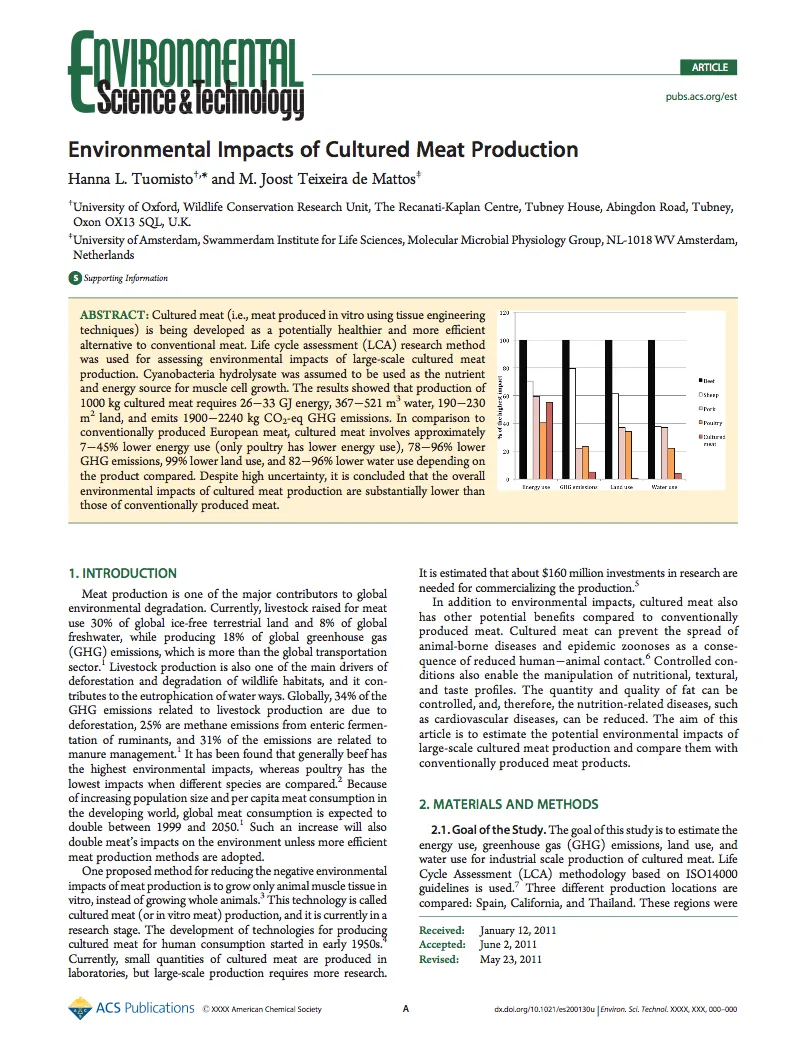
Image Resource Environmental Impacts of Cultured Meat Production FCRN network member Hannah Tuomisto has co-authored a life cycle analysis of (hypothetical) in-vitro meat production here: Tuomisto H L, Teixeira de Mattos M J (2011) Environmental Impacts of Cultured Meat Production. Environ. Sci. Technol. dx.doi.org/10.1021/es200130u Read
Image Resource Bill Gates on meat and artificial meat Bill Gates seems to have entered into the meat question. In his view it is simply not possible to feed 9 billion people on a high meat diet and the way forward is therefore the development of artificial meat and eggs. Read
Image Resource Paper on the EU’s water footprint and the role of diet This paper finds that the water footprint of agricultural products (a definition that presumably includes non-food products) accounts for 91% of the EU’s production-related water footprint and 89% of its consumption related footpint. It argues that much more water can be saved by modifying diets and reducing food waste than through the traditional water-saving routes highlighted in mainstream awareness raising campaigns. The paper echoes others that find animal products to be particularly water intensive. Read
Image Resource Paper: attitudes to reducing meat consumption This paper addresses the relationship between meat eating and climate change focusing on motivational explanations of environmentally-relevant consumer behavior. Based on a sample of 1083 Dutch consumers, it examines their responses to the idea that they can make a big difference to nature and climate protection by choosing one or more meals without meat every week. Read
Image Resource Paper: People’s willingness to act on climate change Consumers influence climate change through their consumption patterns and their support or dismissal of climate mitigation policy measures. Both climate-friendly actions and policy support comprise a broad range of options, which vary in manifold ways and, therefore, might be influenced by different factors. Read
Resource Norwegian pension fund pulls out of 23 palm oil companies The Norwegian pension fund GPFG, the largest in the world and worth US$710 billion, has pulled out of 23 palm oil companies in Indonesia and Malaysia which it judged to unsustainable. GPFG’s investments in the palm oil industry are now reduced by more than 40 per cent. Read
Resource Free carbon footprinting tool For those interested in or working on life cycle analysis type approaches you may be interested in a free carbon footprinting tool Ccalc. The tool can be used for the following: Read
Image Resource Allan Savory Holistic Management TED talk Allan Savory of the Savory Institute has given a TED talk that outlines his ‘Holistic Management’ approach. In brief, holistic management is based on the idea that large herds of livestock, far from causing desertification, can reverse it, by stimulating plant growth and water retention while also enhancing soil carbon sequestration (so reducing GHG emissions). Read