Close
Login Register
Search
  • About
    • What We Do
    • Who We Are
    • FAQs
  • Our Writing
    • Explainers
    • Essays
    • Letterbox
    • More
  • Podcasts
  • Our Events
  • Projects
    • Power In The Food Systems
    • Local-Global Scale Project
    • MEAT: The Four Futures Podcast
    • Fuel To Fork
    • Nature
    • Reckoning with Regeneration
    • SHIFT
    • Rethinking the Global Soy Dilemma
  • Resources
  • Opportunities
    • Jobs
    • Funding
    • Courses
    • Collaborations
    • Events
  • Newsletter
  • TABLE (EN)
Search
Back

Food and health

Image
Plating up Progress
Reports
More supermarkets setting healthy food sales targets
Plating Up Progress, a project run by the UK charity The Food Foundation, has published its 2021 report, which analyses how various UK food sectors are performing on health, environmental and social inclusion issues. 
Read
Image
Image: Copernicus Sentinel-2, ESA, Flevopolder by Sentinel-2, Wikimedia Commons, Creative Commons Attribution-ShareAlike 3.0 IGO (https://creativecommons.org/licenses/by-sa/3.0/igo/deed.en). Contains modified Copernicus Sentinel data 2018.
Essay
Support Your Locals: on international solidarity in a resilient and sustainable urban food system
Anke Brons is a PhD candidate at Aeres University of Applied Sciences Almere and the Environmental Policy Group, Wageningen University & Research. Her research focuses on questions of inclusiveness in relation to healthy and sustainable food practices. Dr Sigrid Wertheim-Heck is associate professor global food system transformation in the Environmental Policy Group at WUR, and is professor Food and Healthy Living at Aeres University of Applied Sciences, both in The Netherlands. Her interest in urban food systems informs her agenda on the relationship between urbanisation, food provisioning and food consumption. She is part of TABLE’s board of directors. This blog post is based on a Dutch essay, originally published in the Flevo Campus essay bundle ‘Veerkracht als opdracht’ (Resilience as a mission).
Read
Image
Agriculture, Nutrition and Health (ANH) Academy
News and resources
Database: Teaching resources on agriculture, nutrition & health
The Agriculture, Nutrition and Health (ANH) Academy curates a database of teaching resources on interdisciplinary agriculture, nutrition and health topics, including journals, online courses, lecture slides, games, infographics and other recommended reading.
Read
Image
Image: ponce_photography, cereal spoon milk, Pixabay, Pixabay Licence
Journal articles
Models of obesity: energy balance vs carbohydrate-insulin
This article outlines two different models for understanding the obesity pandemic: the first and most commonly accepted being the energy balance model, which argues that obesity is driven by high energy consumption, and the second, favoured by the authors, being the carbohydrate-insulin model, which suggests that obesity is instead driven by consumption of rapidly digestible carbohydrates.
Read
Image
Several red-gold apples on a branch. Photo by Lichtsammler via Pixabay.
Reports
A One Health approach to food
This report by the Barilla Center for Food & Nutrition presents a “Double Pyramid” of food systems, which aims to illustrate eating styles that are both healthy and environmentally sustainable. The model (view it here) uses a “health” pyramid and a “climate pyramid”. In both, foods are placed vertically according to whether it is advised to eat them more frequently (towards the bottom of the pyramids) or less frequently (towards the top of the pyramids).
Read
Image
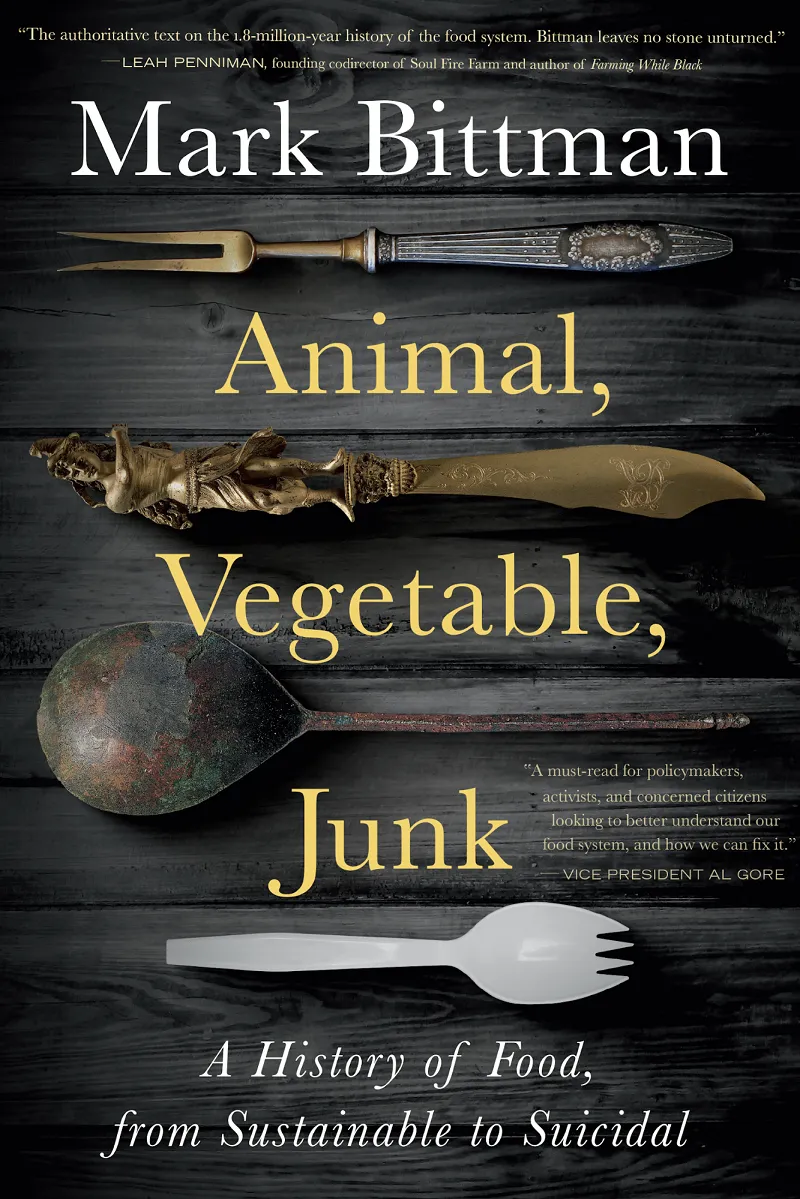
Animal, Vegetable, Junk - book cover
Books
Animal, Vegetable, Junk: A History of Food
This book uses food as a lens to explore the history of human development. It explores the links between food and exploration, colonialism, slavery and capitalism, as well as the environmental implications of current industrialised food systems.
Read
Image
Image: holstein, Movement feet run, Pixabay, Pixabay Licence
Journal articles
Fish-eaters, vegetarians and vegans have higher fracture risk
This paper, by the Wellcome Trust-funded Oxford Livestock, Environment & People (LEAP) programme, finds that non-meat eaters, particularly vegans, have a higher total risk of bone fractures and some specific fracture types, such as hip fractures. After controlling for various confounding factors, the study finds that, relative to meat-eaters, vegans have a 2.31x higher risk of fractures; vegetarians have a 1.25x higher risk; and fish eaters have a 1.26x higher risk.
Read
Image
Foodsource
Explainer
What is the connection between infectious diseases in humans and livestock?
Diseases that pass between animals and humans are responsible for many of the diseases affecting people worldwide, especially in developing countries. Animals (wild and domestic) also play an important role in the emergence and spread of entirely novel human diseases, with the potential for large impacts on human health, such as bird flu. Another aspect of this to which livestock contribute, is the rise and spread of resistance to antibiotic drugs. One outcome of sustainable food systems is that they should be health promoting. It is, therefore, useful to understand the interconnection between infectious diseases in human and animals, and how these risks may be amplified or reduced by changes in farming systems.
Read
Image
Foodsource
Explainer
How are food systems, diets, and health connected?
Today, billions are malnourished: not eating a diet containing energy and nutrients in healthy amounts. Both lack of food and excess of consumption cause huge levels of disease worldwide. To a significant extent, the food systems in which people participate determine what people can and do eat (i.e. their diets); and as a consequence, their health. Food systems are, therefore, central to solving many of the world’s biggest health challenges. But the way in which they affect health in different regions and among different groups of people is complex, and varies greatly. An understanding of these interconnections and their effects is needed, in order for food systems to be changed in ways that promote human wellbeing.
Read
  • VIEW MORE

Sign up for Fodder, our newsletter covering sustainable food news.

Sign up
  • Glossary
  • About
  • Our Writing
  • Podcasts
  • Resources

Social

YouTube Facebook Instagram

© Copyright 2025

A collaboration between: