Close
Login Register
Search
  • About
    • What We Do
    • Who We Are
    • FAQs
  • Our Writing
    • Explainers
    • Essays
    • Letterbox
    • Reports & More
  • Podcasts
  • Our Events
  • Projects
    • Power In The Food Systems
    • Local-Global Scale Project
    • MEAT: The Four Futures Podcast
    • Fuel To Fork
    • Nature
    • Reckoning with Regeneration
    • SHIFT
    • Games at TABLE
    • Rethinking the Global Soy Dilemma
  • Resources
  • Opportunities
    • Jobs
    • Funding
    • Courses
    • Collaborations
    • Events
  • Newsletter
  • TABLE (EN)
Search
Back

TABLE

Image
Resource
French supermarkets forced to donate unsold food under new law
A large proportion of supermarket food is thrown away every day regardless of quality, to avoid legal liability if a customer complains. In France, the government has now taken a firm step to incentivise food donation by removing the liability from the supermarkets. By barring stores from spoiling and throwing away food the government aims to tackle waste alongside food poverty. The measure follows a decision from February 2015 to remove the best-before dates on fresh foods and it is part of a wider drive to halve the amount of food waste in France by 2025. The bill will also ban supermarkets from deliberately spoiling unsold food so it cannot be eaten and the law will also introduce an education programme about food waste in schools and businesses.
Read
Image
Resource
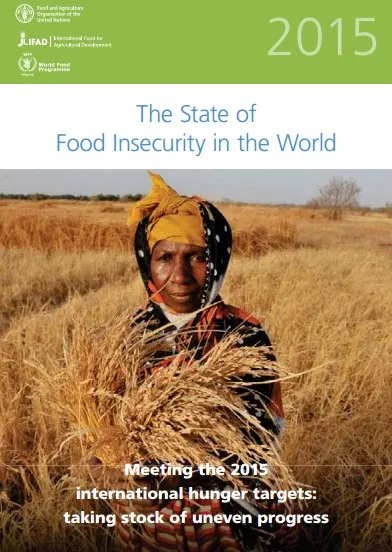
The state of food insecurity in the world 2015 - Meeting the 2015 international hunger targets: taking stock of uneven progress
In this publication FAO highlights the latest statistics on global food insecurity. The latest available estimates indicate that about 795 million people in the world – just over one in nine – were undernourished in 2014–16. In relative terms, the share of undernourished people in the population, or the prevalence of undernourishment (PoU), has decreased from 18.6 percent in 1990–92 to 10.9 percent in 2014–16, reflecting fewer undernourished people in a growing global population.
Read
Image
Resource
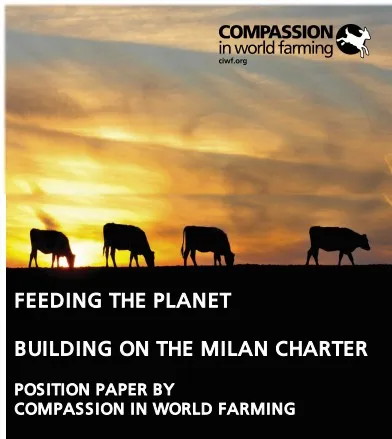
‘Feeding the Planet: Building on the Milan Charter’ - Position statement by CIWF
Compassion In World Farming (CIWF) has produced a new report, Feeding the Planet: Building on the Milan Charter, released to coincide with the Expo Milan 2015 which is organised around the theme: Feeding The Planet, Energy for Life. The Milan Charter – produced by Italy - highlights the need to produce healthy, safe and sufficient food for everyone, while respecting the planet and its equilibrium. 
Read
Image
Resource
Donor mapping - Global sustainable food and agriculture: a landscape assessment
This is a new report commissioned by the Global Alliance for the Future of Food in collaboration with the Meridian Institute for use by Global Alliance members.  The Global Alliance is a coalition of foundations that have come together to help shift food and agriculture systems towards greater sustainability, security, and equity.  In this report they aim to provide a high level assessment and overview of the philanthropic donor landscape in relation to sustainable food and agriculture systems. The report represents a synthesis of several parallel and complementary efforts:
Read
Image
Resource
First report from IPES-Food: Who shapes food systems, and who has a say in how they are reformed?
This report was produced by the International Panel of Experts on Sustainable Food Systems, IPES-Food -a new transdisciplinary initiative to support, inform and advise the policy debate on how to reform food systems across the world.
Read
Image
Resource
The principles of healthy and sustainable eating patterns
This report is produced as follow-on work to the Green Food Project, which focused on sustainable consumption and production. The Green Food Project report in July 2012 concluded that follow-on work was required to enable a broader and more sophisticated debate around the roles that diet and consumption play in the sustainability of the whole food system.
Read
Image
Resource
Can seafood with a high carbon footprint be sustainable?
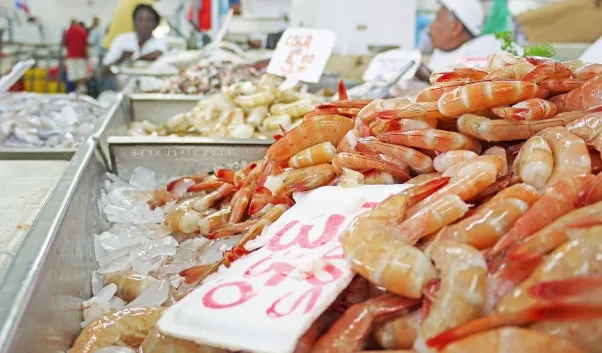
This new paper in Marine Policy suggests that eco-label improvements can be made by integrating the carbon footprints of products in sustainability assessments (eco-labels, sustainability certification, or consumer seafood sustainability guides).
Read
Image
Resource
Policies and actions to shift eating patterns: What works?
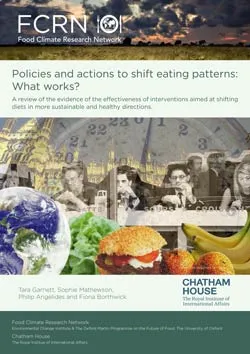
This literature review, undertaken by the Food Climate Research Network and Chatham House, and in association with EAT who also kindly supported the work, considers what the evidence has to say about effective ways of shifting people’s consumption patterns in more sustainable and healthy directions.
Read
Image
Resource
The impact of eating habits on climate –research project analysing trends and ways to change course in India
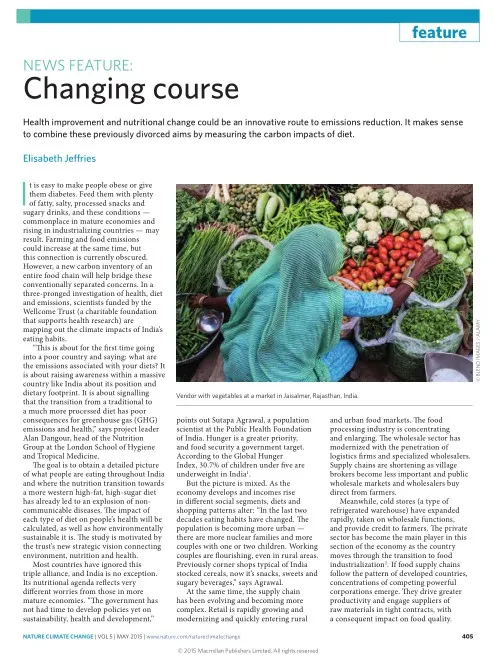
This article from Nature Climate Change discusses a research project that investigates the impacts of both traditional and transitioning Indian diets on the climate. Funded by Wellcome Trust, the goal is to obtain a detailed picture of what people are eating throughout India and calculate both the climate and health impacts of different types of diets. 
Read
  • VIEW MORE

Sign up for Fodder, our monthly newsletter unpacking the future of food.

Tick below to opt-in to email communications.

You can change your mind at any time by clicking the unsubscribe link in the footer of any email you receive from us, or by contacting us at info@tabledebates.org.

We use Mailchimp as our marketing platform. By clicking below to subscribe, you acknowledge that your information will be transferred to Mailchimp for processing. Learn more about Mailchimp's privacy practices.
  • Glossary
  • About
  • Our Writing
  • Podcasts
  • Resources

Social

YouTube Facebook Instagram

© Copyright 2025

A collaboration between: