Image Resources Our extensive research library contains thousands of summaries of journal articles, reports and news stories that can be searched by keyword and category RESOURCES CATEGORYBooksBriefing paperEvent recordingFeatured articlesFeatured reportGameJournal articlesNews and resourcesReportsThink pieceVideoWorking paperWorkshop summary YEAR201220132014201520162017201820192020202120222023202420252026 Image Resource Realising Farmers' Rights to Crop Genetic Resources The book summary says the following: Farmers' Rights are essential for maintaining crop genetic diversity, which is the basis of all food and agricultural production in the world. The International Treaty on Plant Genetic Resources for Food and Agriculture recognizes Farmers' Rights and provides for relevant measures. However, implementation is slow, and in many countries there is resistance. This book shows the necessity of realizing Farmers' Rights for poverty alleviation and food security, the practical possibilities of doing so, and the potential gains for development and society at large. Read Image Resource The State of Food and Agriculture 2013: Food systems for better nutrition The FAO’s latest food and agriculture series report is on the theme of better nutrition. Focusing on malnutrition in all its forms – underweight, micronutrient deficiencies and overweight/obesity – the report argues that approaches to improving nutrition need to move beyond a traditional focus on agricultural alone as a source of food and incomes. Instead, it is necessary to consider the larger contribution that the entire food system (from inputs and production, through processing, storage, transport and retailing, to consumption) can play in influencing malnutrition outcomes. Read Image Resource WHO report: Marketing of foods high in fat, salt and sugar to children The WHO Regional Office for Europe has produced a report calling for tighter controls on the marketing to children of foods high in saturated and trans fats, free sugars and salt, in order to fight childhood obesity. It says that while adults know when they are being targeted by advertising, children cannot distinguish, for example, between advertisements and cartoons. This makes them particularly receptive and vulnerable to messages that lead to unhealthy choices. Read Image Resource Meat consumption and climate change: The role of non-governmental organisations This study by researchers at the Johns Hopkins Bloomberg School of Public Health examines the approaches taken by NGOs in the U.S., Canada, and Sweden to encourage consumers to reduce their meat consumption in light of climate change. Read Image Resource Ecosystem function enhanced by combining four functional types of plant species in intensively managed grassland mixtures: a 3-year continental-scale field experiment. A paper published in the Journal of Applied Ecology finds that grassland plots planted with a mixture of several agricultural plant species produced a greater yield than plots planted with a single species. The EU-funded study explored whether different combinations and proportions of agricultural plants can lead to higher yields with lower input of fertilisers and more efficient use of land. Intensively managed agricultural grasslands, cultivated to provide food for livestock, have the potential to support, or damage, a range of ecosystem services, depending on how they are managed. Read Resource FCRN-Oxford Martin Programme Future of Food report: Expert Comments on ‘Sustainable Intensification in Agriculture’ Following the release last year of the report on ‘Sustainable Intensification in Agriculture’ by the FCRN and the Oxford Martin Programme on the Future of Food, around 30 experts in this field, from academic, governmental, NGO and industrial organisations, were asked to give their comments on the report. Read Image Resource Expert comments on Sustainable Intensification in Agriculture Following the release last year of the report on ‘Sustainable Intensification in Agriculture’ by the FCRN and the Oxford Martin Programme on the Future of Food, around 30 experts in this field, from academic, governmental, NGO and industrial organisations, were asked to give their comments on the report. Read Image Resource PRESS RELEASE: Sustainable intensification in agriculture: premises and policies UNIVERSITY OF OXFORD PRESS RELEASE A policy known as sustainable intensification could help meet the challenges of increasing demands for food from a growing global population, argues a team of scientists in an article in the journal Science. Read Resource Videos on Waste: climate and environmental costs Two videos on food waste and recycling. Read VIEW MORE
Image Resource Realising Farmers' Rights to Crop Genetic Resources The book summary says the following: Farmers' Rights are essential for maintaining crop genetic diversity, which is the basis of all food and agricultural production in the world. The International Treaty on Plant Genetic Resources for Food and Agriculture recognizes Farmers' Rights and provides for relevant measures. However, implementation is slow, and in many countries there is resistance. This book shows the necessity of realizing Farmers' Rights for poverty alleviation and food security, the practical possibilities of doing so, and the potential gains for development and society at large. Read
Image Resource The State of Food and Agriculture 2013: Food systems for better nutrition The FAO’s latest food and agriculture series report is on the theme of better nutrition. Focusing on malnutrition in all its forms – underweight, micronutrient deficiencies and overweight/obesity – the report argues that approaches to improving nutrition need to move beyond a traditional focus on agricultural alone as a source of food and incomes. Instead, it is necessary to consider the larger contribution that the entire food system (from inputs and production, through processing, storage, transport and retailing, to consumption) can play in influencing malnutrition outcomes. Read
Image Resource WHO report: Marketing of foods high in fat, salt and sugar to children The WHO Regional Office for Europe has produced a report calling for tighter controls on the marketing to children of foods high in saturated and trans fats, free sugars and salt, in order to fight childhood obesity. It says that while adults know when they are being targeted by advertising, children cannot distinguish, for example, between advertisements and cartoons. This makes them particularly receptive and vulnerable to messages that lead to unhealthy choices. Read
Image Resource Meat consumption and climate change: The role of non-governmental organisations This study by researchers at the Johns Hopkins Bloomberg School of Public Health examines the approaches taken by NGOs in the U.S., Canada, and Sweden to encourage consumers to reduce their meat consumption in light of climate change. Read
Image Resource Ecosystem function enhanced by combining four functional types of plant species in intensively managed grassland mixtures: a 3-year continental-scale field experiment. A paper published in the Journal of Applied Ecology finds that grassland plots planted with a mixture of several agricultural plant species produced a greater yield than plots planted with a single species. The EU-funded study explored whether different combinations and proportions of agricultural plants can lead to higher yields with lower input of fertilisers and more efficient use of land. Intensively managed agricultural grasslands, cultivated to provide food for livestock, have the potential to support, or damage, a range of ecosystem services, depending on how they are managed. Read
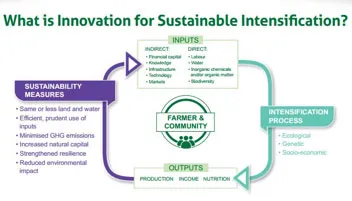
Resource FCRN-Oxford Martin Programme Future of Food report: Expert Comments on ‘Sustainable Intensification in Agriculture’ Following the release last year of the report on ‘Sustainable Intensification in Agriculture’ by the FCRN and the Oxford Martin Programme on the Future of Food, around 30 experts in this field, from academic, governmental, NGO and industrial organisations, were asked to give their comments on the report. Read
Image Resource Expert comments on Sustainable Intensification in Agriculture Following the release last year of the report on ‘Sustainable Intensification in Agriculture’ by the FCRN and the Oxford Martin Programme on the Future of Food, around 30 experts in this field, from academic, governmental, NGO and industrial organisations, were asked to give their comments on the report. Read
Image Resource PRESS RELEASE: Sustainable intensification in agriculture: premises and policies UNIVERSITY OF OXFORD PRESS RELEASE A policy known as sustainable intensification could help meet the challenges of increasing demands for food from a growing global population, argues a team of scientists in an article in the journal Science. Read
Resource Videos on Waste: climate and environmental costs Two videos on food waste and recycling. Read