Image Resources Our extensive research library contains thousands of summaries of journal articles, reports and news stories that can be searched by keyword and category RESOURCES CATEGORY Books Briefing paper Event recording Featured articles Featured report Game Journal articles News and resources Reports Think piece Video Working paper Workshop summary Year 2026 2025 2024 2023 2022 2021 2020 2019 2018 2017 2016 2015 2014 2013 2012 2011 2010 2009 2008 2007 2002 2001 Image Resource Leverage points for improving global food security and the environment This study looks at the double challenge of increasing food security while addressing environmental problems caused by agriculture. It identifies a set of key actions in three broad areas that hold the greatest potential for achieving these efficiency and sustainability goals. Read Image Resource Paper compares organic food to conventionally-produced food This study, undertaken by UK researchers from the University of Newcastle uses the extensive data set of 343 peer-reviewed publications in a meta-analysis to investigate ‘differences in composition between organic and non-organic crops/crop-based foods’. It suggests that there are ‘statistically significant’ differences between the production methods particularly with regard to a range of antioxidants. Read Resource The Guardian: 10 things you need to know about sustainable agriculture The Guardian recently hosted a live chat where a panel of experts joined readers online to discuss the future of sustainable agriculture in the face of changing weather driven by climate change and increasing competition for food. This article discusses 10 points that were discussed by participats. Read the full article here. Read Image Resource Best Use of UK Agricultural Land Collaborating with Asda, Sainsbury’s, Nestlé, AB Agri, Yara, BASF, BOCM Pauls, Volac and the NFU and CLA, the University of Cambridge’s Institute for Sustainable Leadership has produced a report entitled The Best Use of UK Agricultural Land which considers how to best manage the 35% difference they projected between the supply and demand of available land. Read Image Resource A tank of cold: cleantech leapfrog to a more food secure world This report from the Institution for Mechanical Engineers discusses the role that cold chain technologies can play in improving food security in developing countries. It argues that we need to address the question of how we can achieve sustainable food security and not just increased production. Read Image Resource The Sustainable Intensification of European Agriculture: A Review Sponsored by the RISE Foundation This report builds on the dialogue built during a workshop held by RISE in 2014 regarding the measurement of farming environmental performance so as to further refine the definitions of sustainable intensification and the subsequent implications that such definitions pose on policy making to progress it. In doing so, the report explores three different case studies: The first case study focuses on soil performance and resilience. It shows how achieving sustainable intensification is highly dependent on having sound measurement of the underlying conditions. Read Image Resource New indicators from World Resources Institute on sustainable agriculture This working paper, discussing indicators for sustainable agriculture, is published as Part 6 of a major report by WRI – Creating a Sustainable Food Future. Read Image Resource Special Issue on Cooperatives and Alternative Food Systems Initiatives A special issue of the Journal of Agriculture, Food Systems, and Community Development (JAFSCD) on Cooperatives and Alternative Food Systems Initiatives is now out. Read Image Resource New Paper: Putting Back Meaning into “Sustainable Intensification” This paper critiques the concept of sustainable intensification as follows: “Though often lauded by scientists and policy makers alike as a panacea to the mass environmental degradation that accompanies typical food production processes, the authors find that ‘sustainable intensification’ is actually highly unsustainable as it fails to consider the long run social, economic and ecological consequences of intensified production. Thus the authors aim to redefine the scope of the discourse, moving beyond simple calls for increased production capacities to instead enmesh food security within a more holistic approach to development which requires better governance, more empowerment, and greater access and fairer distribution of food within more resilient food systems. Ultimately, sustainable intensification is rendered worthless if those facing dire food insecurity remain unable to access the yields of increasing production.“ Read VIEW MORE
Image Resource Leverage points for improving global food security and the environment This study looks at the double challenge of increasing food security while addressing environmental problems caused by agriculture. It identifies a set of key actions in three broad areas that hold the greatest potential for achieving these efficiency and sustainability goals. Read
Image Resource Paper compares organic food to conventionally-produced food This study, undertaken by UK researchers from the University of Newcastle uses the extensive data set of 343 peer-reviewed publications in a meta-analysis to investigate ‘differences in composition between organic and non-organic crops/crop-based foods’. It suggests that there are ‘statistically significant’ differences between the production methods particularly with regard to a range of antioxidants. Read
Resource The Guardian: 10 things you need to know about sustainable agriculture The Guardian recently hosted a live chat where a panel of experts joined readers online to discuss the future of sustainable agriculture in the face of changing weather driven by climate change and increasing competition for food. This article discusses 10 points that were discussed by participats. Read the full article here. Read
Image Resource Best Use of UK Agricultural Land Collaborating with Asda, Sainsbury’s, Nestlé, AB Agri, Yara, BASF, BOCM Pauls, Volac and the NFU and CLA, the University of Cambridge’s Institute for Sustainable Leadership has produced a report entitled The Best Use of UK Agricultural Land which considers how to best manage the 35% difference they projected between the supply and demand of available land. Read
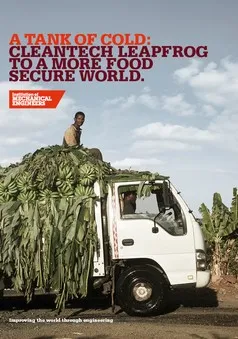
Image Resource A tank of cold: cleantech leapfrog to a more food secure world This report from the Institution for Mechanical Engineers discusses the role that cold chain technologies can play in improving food security in developing countries. It argues that we need to address the question of how we can achieve sustainable food security and not just increased production. Read
Image Resource The Sustainable Intensification of European Agriculture: A Review Sponsored by the RISE Foundation This report builds on the dialogue built during a workshop held by RISE in 2014 regarding the measurement of farming environmental performance so as to further refine the definitions of sustainable intensification and the subsequent implications that such definitions pose on policy making to progress it. In doing so, the report explores three different case studies: The first case study focuses on soil performance and resilience. It shows how achieving sustainable intensification is highly dependent on having sound measurement of the underlying conditions. Read
Image Resource New indicators from World Resources Institute on sustainable agriculture This working paper, discussing indicators for sustainable agriculture, is published as Part 6 of a major report by WRI – Creating a Sustainable Food Future. Read
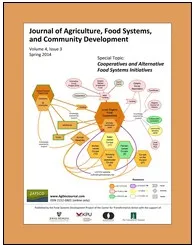
Image Resource Special Issue on Cooperatives and Alternative Food Systems Initiatives A special issue of the Journal of Agriculture, Food Systems, and Community Development (JAFSCD) on Cooperatives and Alternative Food Systems Initiatives is now out. Read
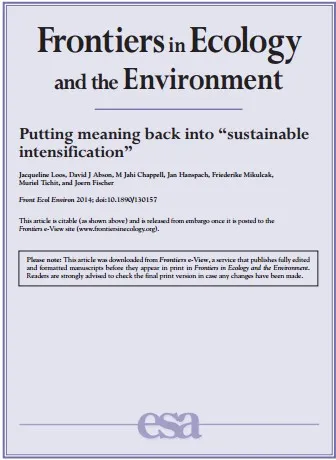
Image Resource New Paper: Putting Back Meaning into “Sustainable Intensification” This paper critiques the concept of sustainable intensification as follows: “Though often lauded by scientists and policy makers alike as a panacea to the mass environmental degradation that accompanies typical food production processes, the authors find that ‘sustainable intensification’ is actually highly unsustainable as it fails to consider the long run social, economic and ecological consequences of intensified production. Thus the authors aim to redefine the scope of the discourse, moving beyond simple calls for increased production capacities to instead enmesh food security within a more holistic approach to development which requires better governance, more empowerment, and greater access and fairer distribution of food within more resilient food systems. Ultimately, sustainable intensification is rendered worthless if those facing dire food insecurity remain unable to access the yields of increasing production.“ Read