Think piece
Resilience? For what? And for who?
Droughts in Europe have caused at least €14 billion in damage to agriculture this year. Wars in the Middle East and Black Sea have sent fertiliser, energy and grain prices surging. El Niño is looming, threatening to pummel agriculture further.
No wonder resilience - the capacity and decision to bounce back, adapt or transform in response to a shock - is the term du jour in conversations around food. This week, the UK government has even issued warnings to stockpile tins of tuna and bottled water to be more ‘resilient’ to shocks.
As we’ll explore in this edition of TABLE’s contested terms series, resilience is a semantic minefield. Depending on the framing, resilience can be used to justify all sorts of interventions in food systems, from actions to secure the status quo to radical systems change.
For some farmers, resilience is about being able to stay in business. For others, it’s about changing their model by reducing fertiliser and inputs. For supermarkets, resilience is keeping the shelves full and supply chains running. For some organisations promoting agroecology, building resilience is, variously, an opportunity for farmers to reduce reliance on farm inputs based on fossil fuels; fertiliser, diesel and pesticides, to shorten the distance between farm produce and the end consumer, and, more far reachingly, to change the incentives structures which determine what foods are produced, how they are transformed and consumed, and who benefits.
In this latest in our series, we’re asking our experts, Monika Zurek, titular associate professor and leader of the Food Systems Transformation Group at the University of Oxford, Tim Lang, professor emeritus of Food Policy at City St George's, and Nick Hughes, editor of Footprint: Resilience according to whom? And to achieve what?
Because when these crucial concept-defining questions are left unarticulated, people often end up talking at cross purposes simply because they mean very different things by the word they’re both using.
And this gap in understanding means it’s possible to have conversations that mean one thing to someone, and something completely different to another – which makes for unproductive exchanges. Our guests will also explain how building resilience in one sector can often undermine it in others, impacting those more vulnerable.
More positively, new terms – despite their bagginess – can catalyse fresh thinking and the possibility of change. What change that is, remains to be negotiated. Look out for TABLE’s explainer on Resilience in the new year, which will unpack these different perspectives in-depth.
The origins of resilience
The Latin root of resilience is salio–“to leap” with resilio meaning the action of rebound or springing back and even to recoil, to retreat, to shrink, to contract. The term has been adopted by many disciplines, including engineering, ecology, psychology and socioecological systems.
Monika Zurek from Oxford categorises resilience building in food systems into three different framings; robustness, recovery and reorientation.
In engineering, she says, resilience is thought of as making the system ‘robust’ so no shock can enter, and the speed in which the system can return to the original state following a shock.
“It’s building a higher wall in coastlines so rising water can’t enter, building irrigation on farms to deal with drought or drainage for floods,” explains Zurek. Or as the UK’s National Farmers Union set out in its Fertiliser Resilience Action Plan, it’s paying farmers if fertiliser prices increase over a certain level to keep them in business.
In ecology however, resilience refers to the capacity of different elements of the system to reorganise in order to recover from a shock while maintaining the same relationships. Zurek references communities’ response to Covid-19, which involved the distribution of food through outlets other than supermarkets, as an example of an ecological framing of resilience in food systems.
Finally, the third – reorientation – is what Zurek terms “transformational resilience”. This framing in food systems views the current situation as an undesirable state to bounce back to, and sees the shocks as presenting an opportunity to change the system.
“Why do we want to make a system that's utterly broken, resilient?” asks Zurek. “Why don't we use this disruption as an opportunity to change it to build back better?”
Paul Behrens, British Academy Global professor at the Oxford Martin School, recently spoke on the Food Foundation’s podcast, Quick Bites, outlining his view of reorientation: via dietary change.
“When the food system is under more and more pressure - both natural and geopolitical - we need to buy ourselves more headroom,” says Behrens. “The way we do that is to improve the way in which we move calories and protein through the system. The biggest option we have is eating more plants because it’s far more direct.”
But a new system comes with new risks. Farmers can grow different crops but if markets and consumption don’t shift in step, they risk lower margins and profitability.
Meanwhile, Anna Taylor, executive director of the Food Foundation, understands food resilience in relation to households and citizens, and their ability to cope with shocks.
“If people are in poor health, their ability to cope with a crisis is significantly eroded – you can see how it escalates in all the wrong directions,” she says in the Food Foundation podcast, Quick Bites.
With so many origins, elements and interpretations, it’s little wonder that their nuances, and differences of emphasis or focus, can be significant.
The rise of resilience
Nick Hughes, editor of Footprint, a business intelligence platform on the foodservice and hospitality sector, remembers first hearing about resilience when Lang was on his tour talking about the National Preparedness Commission and his Civil Food Resilience report in 2025. It was the right time for the term.
“There had been a gap in the market for a new industry buzzword because the use of the term sustainability had kind of become so distorted and elastic that it rendered it almost meaningless,” recalls Hughes.
He explains that uptake of the term is down to its ability to better capture the immediate challenges faced by businesses concerning climate, geopolitics and digital disruption than the word ‘sustainability’.
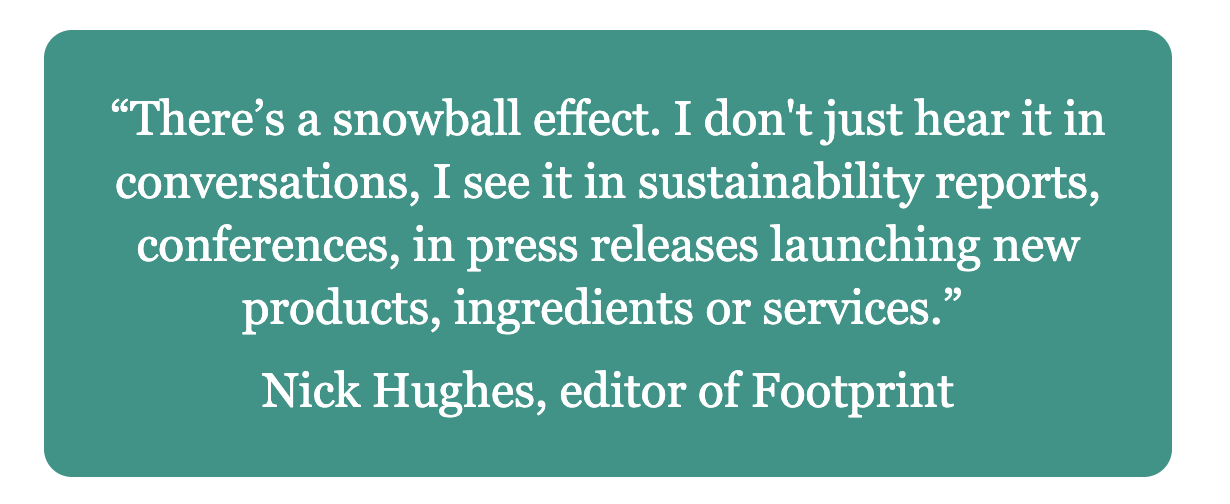
“There’s a snowball effect,” says Hughes. “I don't just hear it in conversations, I see it in sustainability reports, conferences, in press releases launching new products, ingredients or services.”
He separates companies’ use of resilience into two broad buckets. The first is short-term tactical interventions to guarantee supply of key ingredients at an acceptable price and acceptable quality – these sit within Zurek’s ‘robustness’ and ‘recovery’ categories.
Actions here include changing recipes, substituting ingredients or switching sourcing regions. One trend he’s seeing in the foodservice industry is suppliers switching from beef to venison due to high prices and abundant supply, and shifting to making fries out of sweet potatoes rather than potatoes due to shortages from extreme weather.
The second bucket is around longer term strategies, particularly in the farming sector, around helping growers to be better insulated from financial pressures and supporting them in ‘regenerative’ agriculture schemes (a contested term we’ll be looking at in the next edition).
“There's a realisation there that actually if companies are serious about resilience that is a longer term play, it needs sustained support and investment over a period of time,” says Hughes.
But he believes that even these longer term strategies are “tinkering in the margins” and not addressing systemic change by connecting production with consumption.
New words have new subtleties. Does the focus on resilience legitimize only taking an interest in sustainability through the lens of risk and business performance while losing the duty of collective responsibility?
In a guest article on Footprint, editor of Fodder, Jack Thompson interrogates the latest food buzzword, resilience, and what it means in practice.
Resilience for who?
As it stands, resilience is very siloed, rather than thought about within a systems framing. This is an important omission, says Zurek, because actions in the name of building resilience for one part of the system can undermine it in others, particularly for those less powerful.
In a 2020 paper, she looked at how the South African fruit industry, a major exporter to the UK and beyond, was trying to build resilience in its supply chain and the cascading consequences of its actions. One clear strategy to insulate risk for supermarkets was to diversify suppliers. But this came at a cost for farmers: shorter contracts, less capital to invest in their orchards and no long term planning horizons.
“It meant one part of the system building resilience for themselves so that consumers would have apples on the shelves but kicking other actors like farmers,” says Zurek. “It's the more powerful who get to define it.”
That’s why, when it comes to understanding the framing of resilience, we need to ask a series of questions, particularly these:
Resilience of what? The soil, the farm business, citizens, the supply chain or the system more widely?
Resilience to what? What specific shock and risks should we prepare for? Extreme weather, geopolitical turbulence, food safety outbreaks?
Resilience from whose perspective? Is it the farmer’s, the consumer’s, an endangered species', or a CEO of a large company?
Resilience for how long? Strategies to build resilience in the short term may deplete resilience in the long term.
Negotiating resilience
In Lang’s report, Just in Case: 7 steps to narrow the UK civil food resilience gap, he defines exactly what he means by resilience.
“I coined the phrase civil food resilience to be very specific, in other words to nail resilience down with regard to food for the people,” explains Lang. “I mean the capacity of a system to bounce back but feed the people in and after a shock.”
The question of resilience boils down to what we want our food system to achieve. Lang is very clear about what he thinks: “What's the point of the food system? The conclusion that was drawn out of my process was the point of a food system must be to feed people. All the people, not just some of the people.”
Zurek, meanwhile, argues that we need negotiating spaces that bring all actors together to plot a path forward when it comes to building resilient food systems, rather than resilience through the lens of particular sectors.
“One of the big fallacies of the whole food transformation and resilience debate is that we believe that each actor wants the same thing out of the system and there is no real space to discuss that right or to assess these different impacts on each other,” says Zurek.
“We need to define our guiding star because if you don't sort this out, what we've seen is that you also have these different framings colliding with each other and basically the least powerful get kicked out of the system.”
The window of opportunity
While the ambiguity of resilience has dangers, Hughes from Footprint says that the term has opened up a conversation that wasn’t happening with sustainability.
“Resilience lands much better in the boardroom,” says Hughes. “Sustainability has always been pigeonholed as a box to be ticked that sits with a discrete team and isn't necessarily central to business strategy. I think what resilience does somewhat is break out of that silo and make it more relevant to conversations around business performance and strategy.”
For Zurek, it’s bringing new people into the conversation around food systems transformation.
“You suddenly have people from the Ministry of Defence sitting in our workshops and that changes the nature of the people that are starting to get into that governance space.”
As Tara Garnett, TABLE’s director, noted in our report Lean, Green, Mean, What is efficiency?, new terms eventually become dumping grounds for people’s values and aspirations. This is inevitable – it is what happens with language. Resilience might lose its meaning in the way that sustainability has, or it may become very politically and ideologically charged, as with words like efficiency, sustainable intensification or agroecology. It will likely eventually need to be replaced with new buzz words.
But for a short time that they are new, they can spark fresh thinking; opening windows of opportunities for interventions. The question is who will take advantage of this? And what will that mean for food systems change?

Comments (0)