Image Resources Our extensive research library contains thousands of summaries of journal articles, reports and news stories that can be searched by keyword and category RESOURCES CATEGORYBooksBriefing paperEvent recordingFeatured articlesFeatured reportGameJournal articlesNews and resourcesReportsThink pieceVideoWorking paperWorkshop summary YEAR201220132014201520162017201820192020202120222023202420252026 Image Resource Foods for Special Dietary Needs: Non-Dairy Plant Based Milk Substitutes and Fermented Dairy Type Products This paper provides a useful overview of the nutritional, and (very briefly) some of the environmental differences between cow’s milk and substitute milks made from plants such as soy, rice, quinoa and oats. Having described the process of transforming plants into milks it then goes on to conclude that there are important nutritional differences, with cow’s milk generally richer in protein and essential micronutrients. It notes, however, that the GHG footprint non-dairy substitutes tends to be lower. It concludes: Read Image Resource Rescuing food from the organics waste stream to feed the food insecure in Australia This paper, co-authored by FCRN member Christian Reynolds, investigates the economic and environmental efficiency of charities and NGOs that divert and redistribute wasted but edible food. Through a case study of food rescue organizations in Australia, the authors show that food rescue operations generate approximately six kilograms of food waste per tonne of food rescued, at a cost of US$222 per tonne of food rescued. This is lower than purchasing edible, non-food waste food at market-cost. Secondly, for every US dollar spent on food rescue, edible food to the value of US$5.71 (1863 calories) was rescued. Read Image Resource De-mystifying family farming: Features, diversity and trends across the globe This very interesting paper, co-authored by FCRN member Ken Giller, pays serious attention to the question of what a family farm actually is and the assumptions that people make about them. Taking as its starting point for exploration the FAO’s assertion that family farms are important as a means of eradicating poverty, providing food and achieving sustainable development, it explores the characteristics and patterns of family farming in countries as diverse as the United States, Netherlands, China, Brazil, Ethiopia and India. Read Image Resource Megacity metabolism: What cities are the worst energy hogs? This paper provides the first estimate of energy and material flows in the world’s 27 megacities (cities with over 10 million inhabitants). These megacities are home to 6.7 per cent of the world's population, but consume 9.3 per cent of global electricity and produce 12.6 per cent of global waste. The authors establish statistical relations for energy use, transport, water use, waste and so forth and factors such as average temperature, urban form, level and type of economic activity, and population growth. This allows the researchers to evaluate which cities have high versus low levels of consumption and which ones make efficient use of resources. Read Resource Waste not, want not: Reducing livestock's greenhouse gas emissions in the UK Livestock, domestic animals raised for meat, dairy and eggs, is responsible for 14.5 percent of anthropogenic greenhouse gas (GHG) emissions. Because of the scale of its contribution, mitigation of emissions from the livestock sector must be addressed in order to avoid an average global temperature rise of more than 2°C compared to pre-industrial times. Read Image Resource FCRN China Briefing papers In 2014, the FCRN released a major report entitled Appetite for change: social, economic and environmental transformations in China’s food system. This provided a detailed and integrative analysis of the dramatic changes in China’s food system over the last 35 years, explored emerging environmental, health, economic and cultural trends and challenges, and identified policy and research implications. Read Image Resource New initiative explores African opportunities for sustainable food systems Twenty three African and European research partners are involved in this new long term research and innovation partnership on the sustainable intensification of the agro-food system in Africa - PROIntensAfrica. The project is funded by the EU and its focus is on sustainably improving food and nutrition security and the livelihoods of African farmers. Read Image Resource World Bank blog-post: Greenhouse gas accounting: A step forward for climate-smart agriculture In this blog-post Ademola Braimoh, Senior Natural Resources Management Specialist, at the World Bank, argues that quantifying greenhouse gas emissions from agricultural production is a necessary step for climate-smart agriculture (CSA). He writes that greenhouse gas accounting can provide the numbers and data that are important for solid decision making. Read Image Resource Healthy Food for a Healthy World: Leveraging Agriculture & Food to Improve Nutrition This report is published by the Chicago Council for Global Affairs, an independent, nonpartisan organization committed to educating the public—and influencing the public discourse - on global issues of the day. In the report’s introduction they write: “In the effort to produce enough calories to sustain the global population, we have neglected the importance of nutrition. Food systems today simply are not structured to provide the most nutritious food possible to the greatest number of people. We need a new approach to address not just the quantity of food to be produced, but also its quality.” Read VIEW MORE
Image Resource Foods for Special Dietary Needs: Non-Dairy Plant Based Milk Substitutes and Fermented Dairy Type Products This paper provides a useful overview of the nutritional, and (very briefly) some of the environmental differences between cow’s milk and substitute milks made from plants such as soy, rice, quinoa and oats. Having described the process of transforming plants into milks it then goes on to conclude that there are important nutritional differences, with cow’s milk generally richer in protein and essential micronutrients. It notes, however, that the GHG footprint non-dairy substitutes tends to be lower. It concludes: Read
Image Resource Rescuing food from the organics waste stream to feed the food insecure in Australia This paper, co-authored by FCRN member Christian Reynolds, investigates the economic and environmental efficiency of charities and NGOs that divert and redistribute wasted but edible food. Through a case study of food rescue organizations in Australia, the authors show that food rescue operations generate approximately six kilograms of food waste per tonne of food rescued, at a cost of US$222 per tonne of food rescued. This is lower than purchasing edible, non-food waste food at market-cost. Secondly, for every US dollar spent on food rescue, edible food to the value of US$5.71 (1863 calories) was rescued. Read
Image Resource De-mystifying family farming: Features, diversity and trends across the globe This very interesting paper, co-authored by FCRN member Ken Giller, pays serious attention to the question of what a family farm actually is and the assumptions that people make about them. Taking as its starting point for exploration the FAO’s assertion that family farms are important as a means of eradicating poverty, providing food and achieving sustainable development, it explores the characteristics and patterns of family farming in countries as diverse as the United States, Netherlands, China, Brazil, Ethiopia and India. Read
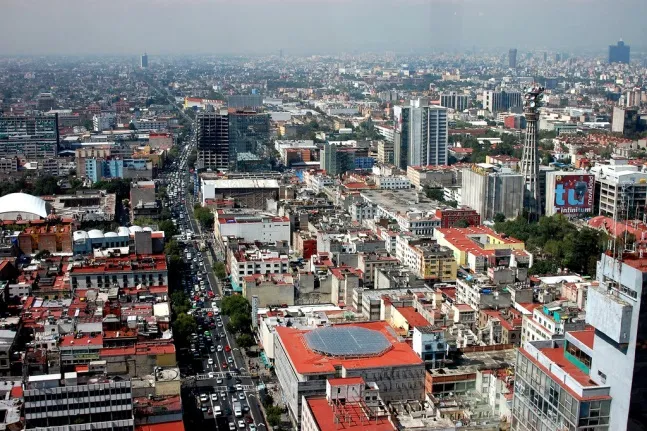
Image Resource Megacity metabolism: What cities are the worst energy hogs? This paper provides the first estimate of energy and material flows in the world’s 27 megacities (cities with over 10 million inhabitants). These megacities are home to 6.7 per cent of the world's population, but consume 9.3 per cent of global electricity and produce 12.6 per cent of global waste. The authors establish statistical relations for energy use, transport, water use, waste and so forth and factors such as average temperature, urban form, level and type of economic activity, and population growth. This allows the researchers to evaluate which cities have high versus low levels of consumption and which ones make efficient use of resources. Read
Resource Waste not, want not: Reducing livestock's greenhouse gas emissions in the UK Livestock, domestic animals raised for meat, dairy and eggs, is responsible for 14.5 percent of anthropogenic greenhouse gas (GHG) emissions. Because of the scale of its contribution, mitigation of emissions from the livestock sector must be addressed in order to avoid an average global temperature rise of more than 2°C compared to pre-industrial times. Read
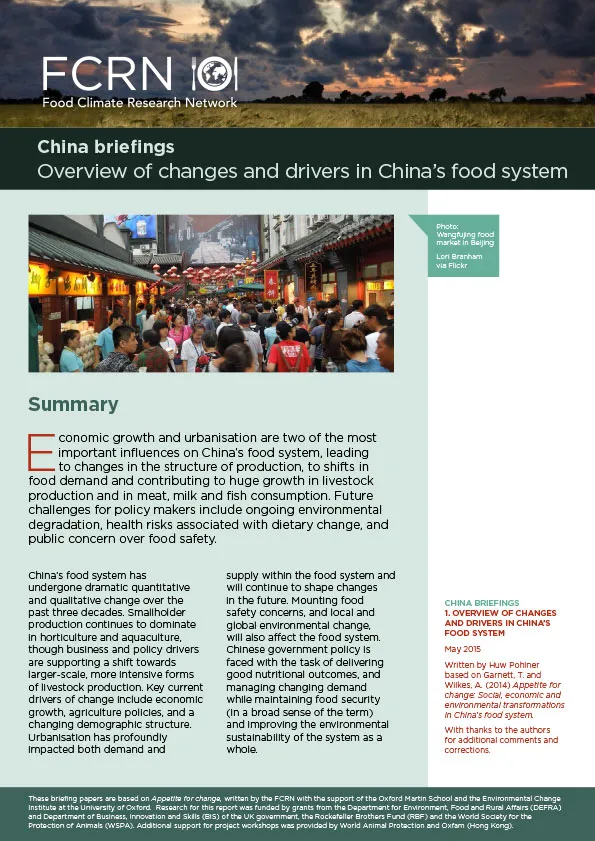
Image Resource FCRN China Briefing papers In 2014, the FCRN released a major report entitled Appetite for change: social, economic and environmental transformations in China’s food system. This provided a detailed and integrative analysis of the dramatic changes in China’s food system over the last 35 years, explored emerging environmental, health, economic and cultural trends and challenges, and identified policy and research implications. Read
Image Resource New initiative explores African opportunities for sustainable food systems Twenty three African and European research partners are involved in this new long term research and innovation partnership on the sustainable intensification of the agro-food system in Africa - PROIntensAfrica. The project is funded by the EU and its focus is on sustainably improving food and nutrition security and the livelihoods of African farmers. Read
Image Resource World Bank blog-post: Greenhouse gas accounting: A step forward for climate-smart agriculture In this blog-post Ademola Braimoh, Senior Natural Resources Management Specialist, at the World Bank, argues that quantifying greenhouse gas emissions from agricultural production is a necessary step for climate-smart agriculture (CSA). He writes that greenhouse gas accounting can provide the numbers and data that are important for solid decision making. Read
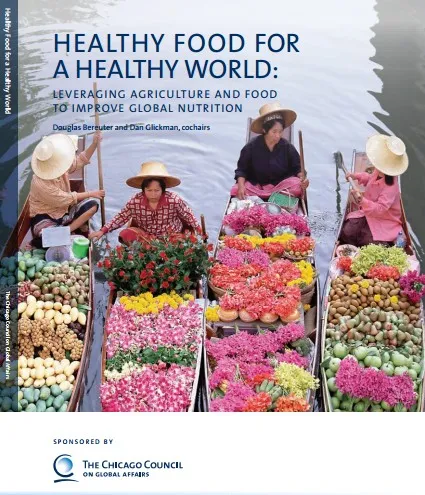
Image Resource Healthy Food for a Healthy World: Leveraging Agriculture & Food to Improve Nutrition This report is published by the Chicago Council for Global Affairs, an independent, nonpartisan organization committed to educating the public—and influencing the public discourse - on global issues of the day. In the report’s introduction they write: “In the effort to produce enough calories to sustain the global population, we have neglected the importance of nutrition. Food systems today simply are not structured to provide the most nutritious food possible to the greatest number of people. We need a new approach to address not just the quantity of food to be produced, but also its quality.” Read