Close
Login Register
Search
  • About
    • What We Do
    • Who We Are
    • FAQs
  • Our Writing
    • Explainers
    • Essays
    • Letterbox
    • Reports & More
  • Podcasts
  • Our Events
  • Projects
    • Power In The Food Systems
    • Local-Global Scale Project
    • MEAT: The Four Futures Podcast
    • Fuel To Fork
    • Nature
    • Reckoning with Regeneration
    • SHIFT
    • Games at TABLE
    • Rethinking the Global Soy Dilemma
  • Resources
  • Opportunities
    • Jobs
    • Funding
    • Courses
    • Collaborations
    • Events
  • Newsletter
  • TABLE (EN)
Search
Back

Sustainable healthy diets

Image
Resource
Two methods for jointly evaluating environmental impact and nutritional content of diets tested in new study on Swedish diets
This paper presents two ways of including environmental and nutritional aspects in the sustainability assessment of diets. Three diets were assessed using these two methods: a diet issued from the National Food Agency as a recommended diet reflecting food preferences in Sweden (SNÖ), a diet corresponding to current average food consumption in Sweden according to the latest food intake survey (Riksmaten) and a Low Carbohydrate-High Fat (LCHF) diet, which is a popular life-style diet in Sweden currently.
Read
Image
Resource
New study calculates and compares the carbon footprint of food groups based on mass, calorie content and nutrient density
In this study, 483 food items (developed by the Casino Group retailer company) were grouped into 34 categories and then 5 major food groups; meat and meat products, milk and dairy products, processed fruits and vegetables, grains and other foods and sweets. The aggregated average carbon footprints of the categories and major food groups were presented per 100 gram of product, per 100 kcal of product and per two different nutrient density scores including six and 15 nutrients respectively.
Read
Image
Resource
House of Commons - Environment, Food and Rural Affairs Committee report: Food security - demand, consumption and waste, Sixth Report of Session 2014–15
This report by the Environment, Food and Rural Affairs Committee focuses on food security. The report makes recommendations for managing consumer demand, such as by encouraging the purchase of sustainably sourced products or the most nutritious food in order to help deliver environmental and health goals. It does not argue that there should be any further degree of compulsion on individuals.
Read
Image
Resource
Can Health and Environmental Concerns Meet in Food Choices?
This study surveys Italian consumers to explore whether there is a relationship between health and environmental sustainability concerns in their food choices. Abstract The objective of the study is to analyze if there is a relationship between health and environmental sustainability concerns in food choices. We used data of 300 Italian consumers collected through a vis-à-vis survey. We performed cross-tabulations and chi-square tests for a selected set of variables measuring both types of concerns, segmenting the sample by age, gender and education.
Read
Image
Resource
Blog-post by Timothy Lang: “Sustainable Diets: Integrity has a sustainability dimension, too”
In this blog-post for the The Institute of Food Safety, Integrity & Protection (TiFSiP) Tim Lang, Professor of Food Policy at the City University London and FCRN advisory board member, discusses sustainable diets. He argues that the pursuit of food integrity and authenticity is also the pursuit of sustainability.
Read
Image
Resource
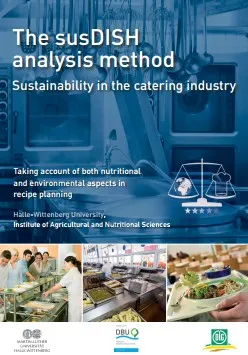
The susDISH analysis method – Sustainability in the catering industry
The booklet The susDISH analysis method – Sustainability in the catering industry, taking account of both nutritional and environmental aspects in recipe planning is published by the Institute of Agricultural and Nutritional Sciences of the Halle-Wittenberg University.
Read
Image
Resource
Eating Better report on awareness and attitudes on meat
The report Let's Talk About Meat: changing dietary behaviour for the 21st century is launched alongside a new YouGov survey, commissioned by the Eating Better alliance and Friends of the Earth, which looked into the awareness and attitudes on meat among the among the public in Britain. The survey found that around one in three people (35%) in Britain say they are willing to consider eating less meat, with one in five (20%) saying they have already cut back on the amount of meat they eat over the last year. Only 5% say they are eating more.
Read
Image
Resource
The impact of healthier dietary scenarios on the global blue water scarcity footprint of food consumption in the UK
This study aims to assess the effect of five dietary scenarios – designed to promote healthier and more sustainable eating – on the blue water scarcity footprint of UK food consumption. The objectives are to estimate the total blue water consumed in producing food commodities consumed in the UK; the contribution, and geographical concentration, to global blue water scarcity; and the potential impact of alternative healthy eating scenarios on global blue water scarcity.
Read
Image
Resource
Live Longer? Save the Planet? Better diet could nail both
A study led by University of Minnesota's David Tilman finds that shifting modern diets towards healthier, Mediterranean diets could improve quality of life and reduce greenhouse gas emissions. The team synthesized data on the environmental costs of food production, diet trends and population growth, and showed the health and environment costs of continuing our current health trends as compared to shifting to a healthier diet.
Read
  • VIEW MORE

Sign up for Fodder, our monthly newsletter unpacking the future of food.

Tick below to opt-in to email communications.

You can change your mind at any time by clicking the unsubscribe link in the footer of any email you receive from us, or by contacting us at info@tabledebates.org.

We use Mailchimp as our marketing platform. By clicking below to subscribe, you acknowledge that your information will be transferred to Mailchimp for processing. Learn more about Mailchimp's privacy practices.
  • Glossary
  • About
  • Our Writing
  • Podcasts
  • Resources

Social

YouTube Facebook Instagram

© Copyright 2025

A collaboration between: