Close
Login Register
Search
  • About
    • What We Do
    • Who We Are
    • FAQs
  • Our Writing
    • Explainers
    • Essays
    • Letterbox
    • Reports & More
  • Podcasts
  • Our Events
  • Projects
    • Power In The Food Systems
    • Local-Global Scale Project
    • MEAT: The Four Futures Podcast
    • Fuel To Fork
    • Nature
    • Reckoning with Regeneration
    • SHIFT
    • Games at TABLE
    • Rethinking the Global Soy Dilemma
  • Resources
  • Opportunities
    • Jobs
    • Funding
    • Courses
    • Collaborations
    • Events
  • Newsletter
  • TABLE (EN)
Search
Back

Supply chains

Image
Resource
Investors call for new business outlook on protein sourcing: more plants, less meat
A group of investors, worth $1.25 trillion, has contributed to a report calling for food companies to change the way in which they include protein in their products to reduce environmental risk. The FAIRR initiative’s report – The Future of Food: The Investment Case for a Protein Shake Up – argues that forward-looking investors and businesses should act now to help shape a new market in sustainable protein, with less of this macronutrient coming from animals, and more from plants (and perhaps from insects and algae).
Read
Image
Resource
Special Issue: Linking Local Consumption to Global Impacts
This special issue of the Journal of Industrial Ecology takes a closer look at how consumption is increasingly met by global supply chains that often involve large geographical distances.
Read
Image
Resource
Catering for sustainability: Exploring the business cases for adopting and promoting sustainable diets in the foodservice sector
This report aims to understand whether, why and how sustainable diets are promoted by individual foodservice companies, and to assess the business cases for adopting and promoting sustainable diets across the sector.
Read
Image
Resource
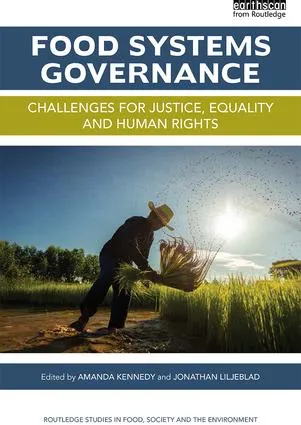
Food Systems Governance - Challenges for justice, equality and human rights
Sustainability and food production represent a major challenge to society, with both consumption and supply sides posing practical and ethical dilemmas. This book shows that food governance issues can occur in many ways and at many points along the food chain. The risks and impacts, particularly with the increasing globalisation of food systems, are often distributed in unequal ways.
Read
Image
Resource
Report: 'Mitigating risks and vulnerabilities in the energy-food-water nexus in developing countries'
This report entitled 'Mitigating risks and vulnerabilities in the energy-food-water nexus in developing countries' analyses global nexus interconnections (such as the dependence of food systems on energy at every stage of the food value chain) and identifies key challenges for food, energy and water security, which include economic and population growth, resource depletion, environmental degradation, climate change and globalisation.
Read
Image
Resource
The role of Supplier Relationship Management in reducing Greenhouse Gas emissions from food supply chains: Supplier engagement in the UK supermarket sector
This paper looks at how supplier relationship management impacts emission levels from food supply chains. It investigates the influence of corporate Supplier Engagement Programmes (SEP) and the limitations of SEP-led improvements. Supplier Engagement Programmes are programmes set up to allow supermarkets to, for example, review carbon reduction measures and request GHG emissions and other data from their suppliers.
Read
Image
Resource
Lloyd’s emerging risk report 2015: Food system shock - the insurance impacts of acute disruption to global food supply
This report, commissioned by Lloyd’s, describes how our food system is becoming increasingly vulnerable to acute shocks and underlines the pressing need to reduce the uncertainty surrounding the impacts of an extreme shock to the food supply.
Read
Resource
Waste not, want not: Reducing livestock's greenhouse gas emissions in the UK
Livestock, domestic animals raised for meat, dairy and eggs, is responsible for 14.5 percent of anthropogenic greenhouse gas (GHG) emissions.  Because of the scale of its contribution, mitigation of emissions from the livestock sector must be addressed in order to avoid an average global temperature rise of more than 2°C compared to pre-industrial times. 
Read
Image
Resource
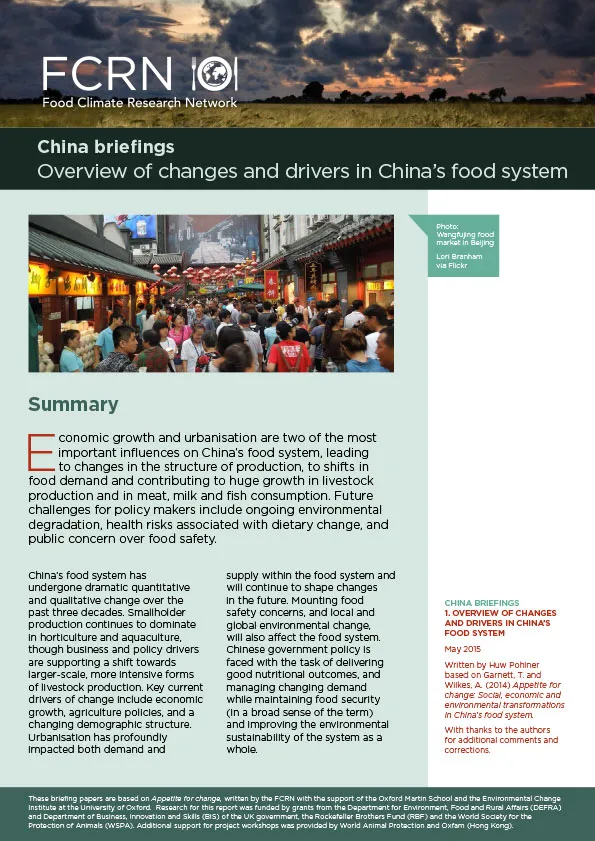
FCRN China Briefing papers
In 2014, the FCRN released a major report entitled Appetite for change: social, economic and environmental transformations in China’s food system. This provided a detailed and integrative analysis of the dramatic changes in China’s food system over the last 35 years, explored emerging environmental, health, economic and cultural trends and challenges, and identified policy and research implications.  
Read
  • VIEW MORE

Sign up for Fodder, our monthly newsletter unpacking the future of food.

Tick below to opt-in to email communications.

You can change your mind at any time by clicking the unsubscribe link in the footer of any email you receive from us, or by contacting us at info@tabledebates.org.

We use Mailchimp as our marketing platform. By clicking below to subscribe, you acknowledge that your information will be transferred to Mailchimp for processing. Learn more about Mailchimp's privacy practices.
  • Glossary
  • About
  • Our Writing
  • Podcasts
  • Resources

Social

YouTube Facebook Instagram

© Copyright 2025

A collaboration between: