Close
Login Register
Search
  • About
    • What We Do
    • Who We Are
    • FAQs
  • Our Writing
    • Explainers
    • Essays
    • Letterbox
    • Reports & More
  • Podcasts
  • Our Events
  • Projects
    • Power In The Food Systems
    • Local-Global Scale Project
    • MEAT: The Four Futures Podcast
    • Fuel To Fork
    • Nature
    • Reckoning with Regeneration
    • SHIFT
    • Games at TABLE
    • Rethinking the Global Soy Dilemma
  • Resources
  • Opportunities
    • Jobs
    • Funding
    • Courses
    • Collaborations
    • Events
  • Newsletter
  • TABLE (EN)
Search
Back

TABLE

Image
Resource
European Commission brief: Rooftop gardens could grow three quarters of city’s vegetables
This brief argues that rooftop gardens in cities could supply cities with more than three quarters of their vegetable requirements. The brief from the European Commission is based on evidence from a case study from Bologna, Italy.
Read
Image
Resource
Ikea has launched a new veggie version of its famous Swedish meatballs
The launch of the new vegetarian alternative to the meatballs – grönsaksbullar - is what Ikea calls “the first step to include a wider variety of healthier and more sustainable food choices”.
Read
Image
Resource
Briefing paper: Ecological progress: Understanding China’s new framework for sustainable development
The Climate Group has produced a new briefing about China’s 13th Five Year Plan. The plan, to be released in March 2016, provides a blueprint that will guide the country’s economic and political progress between 2016 and 2020.  Its targets and policies, will have global implications, as China moves to become the world’s largest economy.
Read
Image
Resource
Frozen Food and Food Security in the UK
A new report from at Cranfield University suggests that increasing the production and consumption of frozen food in the UK can play a significant role in delivering the government’s 2020 and 2050 food security targets. The report, Frozen Food and Food Security in the UK, was produced by sustainability experts at Cranfield University on behalf of the British Frozen Food Federation (BFFF).
Read
Image
Resource
IIED briefing: Sustainable intensification revisited
Sustainable intensification is receiving growing attention as a way to address the challenge of feeding an increasingly populous and resource-constrained world. But are we asking too much of it? Nearly 20 years after the concept was developed, this briefing revisits the term and asks what sustainable intensification is — a useful guiding framework for raising agricultural productivity on existing arable land in a sustainable manner; and what it is not -a paradigm for achieving food security overall.
Read
Image
Resource
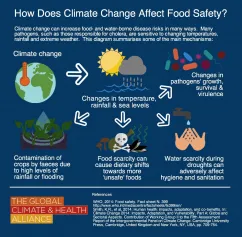
Briefing paper: Climate Change and Food Safety
The 2015 World Health Day took place on April 7th, and it focused on the theme of Food Safety. With this day in mind, the  Global Climate and Health Alliance has published a new briefing paper on climate change and food safety.
Read
Image
Resource
WHO: Using price policies to promote healthier diets
This publication provides information on using price policies to promote healthy diets and explores policy developments from around the WHO European Region. It examines the economic theory underpinning the use of subsidies and taxation and explores the available evidence.
Read
Image
Resource
UN Global Sustainable Development Report (GSDR) Brief: Synergies between healthy and sustainable diets
In a recent brief for the UN Global Sustainable Development Report (GSDR) a group of researchers, including Tara Garnett of the FCRN, proposed that well-designed policies targeting the demand for particular foods could simultaneously improve the health of the global population and achieve environmental sustainability.
Read
Image
Resource
High-fat dairy products linked to reduced type 2 diabetes risk – and high meat consumption to increased risk
This paper finds that consumption of high-fat yoghurt and cheese are linked to reduced risks of developing type 2 diabetes – reducing these risks by as much as a fifth. High meat consumption, on the other hand, is linked to a higher risk, regardless of the fat content of the meat. These results are in line with previous studies of eating habits that indicated a link between high consumption of dairy products and a reduced risk of type 2 diabetes.
Read
  • VIEW MORE

Sign up for Fodder, our monthly newsletter unpacking the future of food.

Tick below to opt-in to email communications.

You can change your mind at any time by clicking the unsubscribe link in the footer of any email you receive from us, or by contacting us at info@tabledebates.org.

We use Mailchimp as our marketing platform. By clicking below to subscribe, you acknowledge that your information will be transferred to Mailchimp for processing. Learn more about Mailchimp's privacy practices.

  • Glossary
  • About
  • Our Writing
  • Podcasts
  • Resources

Social

YouTube Facebook Instagram

© Copyright 2025

A collaboration between: