Image Resources Our extensive research library contains thousands of summaries of journal articles, reports and news stories that can be searched by keyword and category RESOURCES CATEGORY Books Briefing paper Event recording Featured articles Featured report Game Journal articles News and resources Reports Think piece Video Working paper Workshop summary Year 2026 2025 2024 2023 2022 2021 2020 2019 2018 2017 2016 2015 2014 2013 2012 2011 2010 2009 2008 2007 2002 2001 Image Resource New models calculate and compare the true costs of various fuels to health, climate and the environment This research from Duke University presents policymakers with a more accurate framework for estimating the costs of a broad range of health, climate and environmental damages linked to emissions from fossil fuels, industry, biomass burning and agriculture. Read Image Resource Do High Consumers of Sugar-Sweetened Beverages Respond Differently to Price Changes? A Finite Mixture IV-Tobit Approach This study compared the impact that a 20 per cent sales tax and a 20 cents per litre excise tax on beverages such as carbonated non-diet soft drinks, cordials and fruit drinks would have on moderate and high consumers. It found that although high consumers of sugar-sweetened beverages have the least elastic demand, they drink so much that they are up against household budget limits, and therefore adding tax would bring down their consumption. Read Image Resource Special issue of Development: Nutrition Volume 57.2 of Development - the quarterly journal of the Society for International Development - was produced in the lead-up to the Second International Conference on Nutrition (ICN2). It explores the relationship between nutrition, food security and sustainable agriculture. Read Image Resource New paper argues material lifestyles are not making us happier Although not specifically focusing on food sustainability this paper is of relevance for the larger debate on alternative models of sustainable development. The paper concludes that our modern material lifestyles are failing to make us happier, are damaging our health, are no longer sustainable and cost the overall economy tens of billions of pounds every year. Read Image Resource Sustainable nutrition between the poles of health and environment. Potentials of altered diets and avoidable food losses Author summary This article provides a synopsis of the main research findings from the book “Environmental protection with knife and fork – the ecological rucksack of nutrition in Germany”, various peer-reviewed publications and as well as the underlying dissertation of the author. The first part of the article presents an overview of current challenges in the transdisciplinary field of nutrition, environment and public health. After a brief presentation of the methods, in the results section life cycle assessment results are presented on product and consumption levels and possible courses of action are derived – with a special focus on different diets and reduced food losses. Read Image Resource Food research international special volume: Impacts of climate change on food safety This special issue focuses on the implications of climate change for food safety. The introductory paper to the series briefly summarizes the current state of knowledge. It states that: Read Image Resource Environmental impact of dietary change: a systematic review This systematic review evaluates the environmental impact of 49 dietary scenarios and shows that shifts in consumption could reduce diet-related GHG emissions and land use demand by up to 50%. The paper states that the amount and type of meat in the diet mainly affects the improvement potential. The research also identifies and addresses research gaps and key methodological aspects influencing outcomes. Read Image Resource Climate metrics and the carbon footprint of livestock products: where's the beef? Due to the large share of non-CO2 GHGs in emissions from livestock production, the choice of GHG metric used to compare emissions of different GHGs is crucial, both in order to assess the aggregate contribution of the livestock sector to climate change and for highlighting hot-spots in the animal food chain where emission reductions can be most cost-effectively made. Read Image Resource Breeding for productivity and breeding for welfare: what is the relationship? A question that emerged from FCRN's previous discussions with various experts on animal farming was whether breeding for productivity and animal welfare can be aligned. Read VIEW MORE
Image Resource New models calculate and compare the true costs of various fuels to health, climate and the environment This research from Duke University presents policymakers with a more accurate framework for estimating the costs of a broad range of health, climate and environmental damages linked to emissions from fossil fuels, industry, biomass burning and agriculture. Read
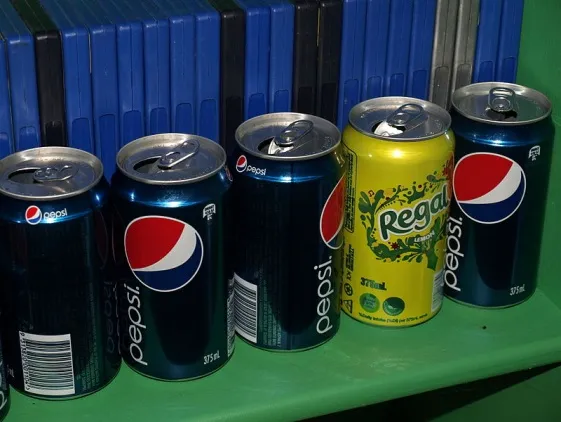
Image Resource Do High Consumers of Sugar-Sweetened Beverages Respond Differently to Price Changes? A Finite Mixture IV-Tobit Approach This study compared the impact that a 20 per cent sales tax and a 20 cents per litre excise tax on beverages such as carbonated non-diet soft drinks, cordials and fruit drinks would have on moderate and high consumers. It found that although high consumers of sugar-sweetened beverages have the least elastic demand, they drink so much that they are up against household budget limits, and therefore adding tax would bring down their consumption. Read
Image Resource Special issue of Development: Nutrition Volume 57.2 of Development - the quarterly journal of the Society for International Development - was produced in the lead-up to the Second International Conference on Nutrition (ICN2). It explores the relationship between nutrition, food security and sustainable agriculture. Read
Image Resource New paper argues material lifestyles are not making us happier Although not specifically focusing on food sustainability this paper is of relevance for the larger debate on alternative models of sustainable development. The paper concludes that our modern material lifestyles are failing to make us happier, are damaging our health, are no longer sustainable and cost the overall economy tens of billions of pounds every year. Read
Image Resource Sustainable nutrition between the poles of health and environment. Potentials of altered diets and avoidable food losses Author summary This article provides a synopsis of the main research findings from the book “Environmental protection with knife and fork – the ecological rucksack of nutrition in Germany”, various peer-reviewed publications and as well as the underlying dissertation of the author. The first part of the article presents an overview of current challenges in the transdisciplinary field of nutrition, environment and public health. After a brief presentation of the methods, in the results section life cycle assessment results are presented on product and consumption levels and possible courses of action are derived – with a special focus on different diets and reduced food losses. Read
Image Resource Food research international special volume: Impacts of climate change on food safety This special issue focuses on the implications of climate change for food safety. The introductory paper to the series briefly summarizes the current state of knowledge. It states that: Read
Image Resource Environmental impact of dietary change: a systematic review This systematic review evaluates the environmental impact of 49 dietary scenarios and shows that shifts in consumption could reduce diet-related GHG emissions and land use demand by up to 50%. The paper states that the amount and type of meat in the diet mainly affects the improvement potential. The research also identifies and addresses research gaps and key methodological aspects influencing outcomes. Read
Image Resource Climate metrics and the carbon footprint of livestock products: where's the beef? Due to the large share of non-CO2 GHGs in emissions from livestock production, the choice of GHG metric used to compare emissions of different GHGs is crucial, both in order to assess the aggregate contribution of the livestock sector to climate change and for highlighting hot-spots in the animal food chain where emission reductions can be most cost-effectively made. Read
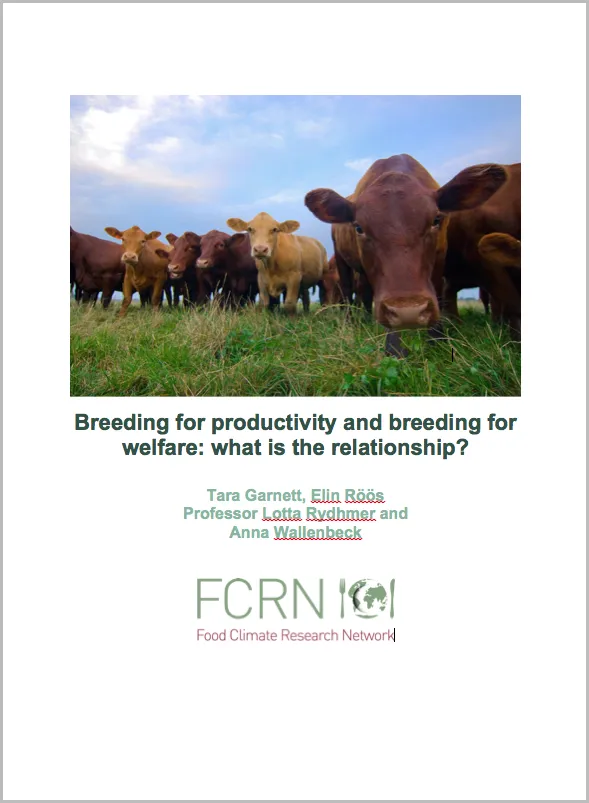
Image Resource Breeding for productivity and breeding for welfare: what is the relationship? A question that emerged from FCRN's previous discussions with various experts on animal farming was whether breeding for productivity and animal welfare can be aligned. Read