
Protein is having its (latest) moment in the sun
Protein – as problem, aspiration, solution, obsession – is everywhere.
In our everyday lives, thanks to the efforts of marketeers, retailers and social media influencers, we’re urged to make sure that we get ‘enough’ protein, whether this is to meet our fitness goals, to lose weight or to combat ageing. So powerful has this nutritional idea become that the word ‘protein’ often features more prominently on the product label than the containing food itself. What do we need? Not yoghurt, or ice cream, or a snack bar, but protein. In fact, protein has become a word so ubiquitous in public discourse that articles about its ubiquity – which tend to start with an opener a bit like this one – are also everywhere.
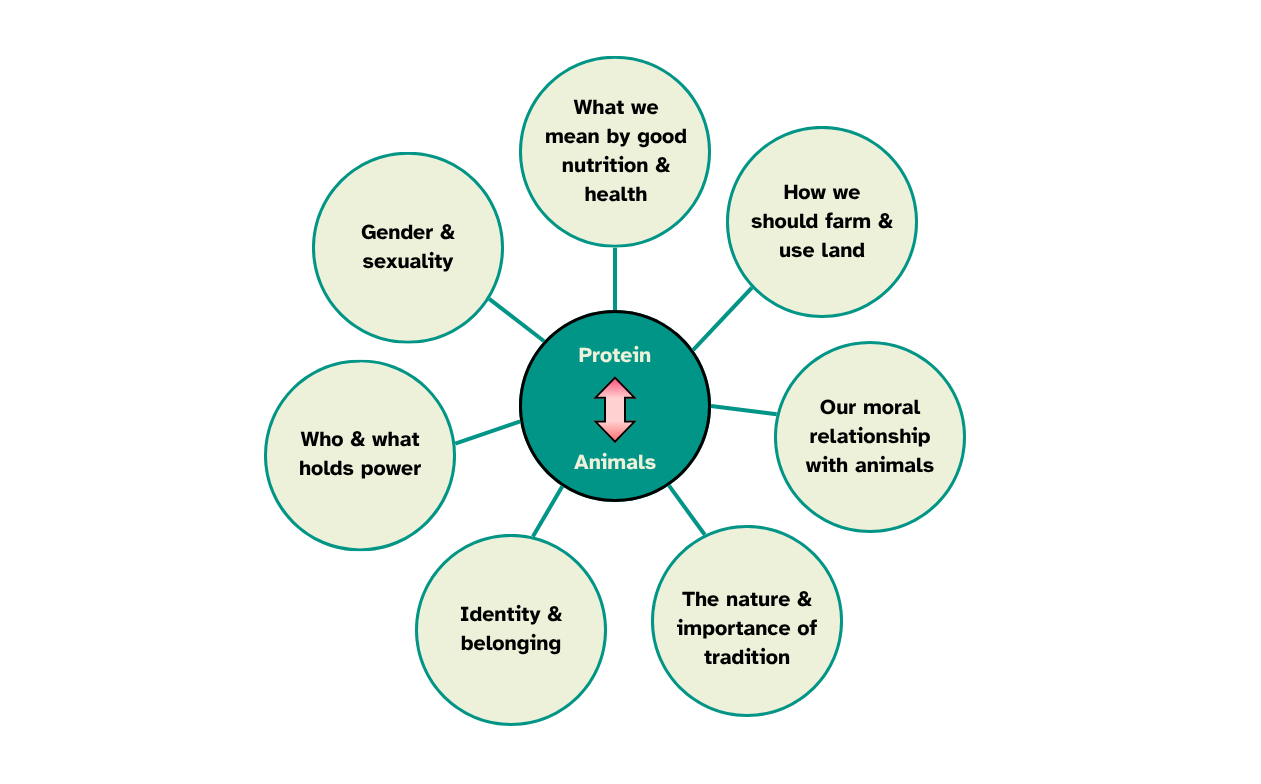
Within the more delimited world of professional thought and action on food systems here too protein dominates the conversation. The focus in this world is on what to do about it, and the language tends to be of protein futures, protein transitions, protein alternatives. Topics rise and fall in prominence, but right now within this community, protein has become a kind of shorthand for a whole range of other social, economic, ethical, environmental concerns that people talk about when they talk about the food system, and as such, the stories these different stakeholders tell about protein – how important it is in our diets, what kinds of protein are good or bad and how we should be producing and distributing it – tend to mirror and reinforce the familiar tribal groupings that delineate contemporary food system debates.
It’s worth noting, of course, that these ‘professional’ discussions don’t exist in isolation from the lay, since food system researchers, policymakers and activists are also people who shop, see adverts, worry about their health or their looks, and think about what to eat for dinner. What they focus on in their professional lives will to some extent be influenced by the wider public discourse of the world they live in. Of course what might also be the case is that, as with much else in people’s lives, there are contradictions between their professional stances on the protein issue and their individual anxieties and behaviours, which they may or may not choose to dwell upon.
In short, protein is having its moment, and that moment is complicated, as this essay aims to describe and explore. Before doing so, however, it’s worth saying that our fascination with this nutrient isn’t new. As our TABLE report, Primed for power: a short cultural history of protein and its accompanying essay Where does protein get its power? explain, since its ‘discovery’ as a nutrient in 1838, protein has risen and fallen in the public and professional consciousness several times, and while all nutrients are special, some nutrients seem to be – or are seen to be – more special than others. This is perhaps reflected in the very name ‘protein’, derived as it is from the Greek for ‘best’, ‘supremacy’ and ‘first place’. While the early scientific idea that protein was the ultimate, and indeed the only nutrient we actually really need, was quite quickly knocked down, a general sense of its all-encompassing goodness and importance continued over the years.
These perceived attributes gained strength from the fact that protein quickly became conflated with meat and animal products more generally. This is perhaps understandable, since meat is indeed a rich source of protein. But as reinforcing factors, meat was already a high-status food because of its associations both with wealth and with vigour and strength – and therefore masculinity – and these associations became increasingly fused with notions of Britishness or European-ness (given high meat intakes in this part of the world) and therefore mastery and therefore superiority: Europeans eat a lot of meat, Europeans are conquering the world, meat is high in protein, protein is the supreme nutrient – ergo these things are all connected.
This combination of associations influenced the setting of very high recommendations for protein intakes from the 1850s through to the turn of the twentieth century. These recommendations were to be found both in the scientific literature and – the two are obviously connected – also the earliest institutional ideas about what British citizens or subsets thereof, such as the military, should be eating (see Figure 1). However, as research into human nutritional requirements continued and evolved and as evidence emerged that protein, while important, wasn’t the nutritional be-all and end-all it was originally supposed to be, the recommendations for intakes began to fall, and they more or less continued falling over the course of the twentieth century, through to where they have settled today.
Notwithstanding this decline, the 1950s through to the 1970s saw another surge of interest in protein, with the spotlight this time falling on the British colonies and ex-colonies in sub-Saharan Africa. Medics and other Westerners working in these regions had observed a condition among children and some adults, characterised by muscle wasting, swollen pot-bellies, dry skin, reddish hair and extreme tiredness; this constellation of symptoms came to be called ‘kwashiorkor’. While the initial diagnosis was that this might be due to multiple kinds of nutritional deficiency, over time medical attention narrowed down to a single-minded focus on protein. These children, it was argued, lacked protein, and this lack could only be remedied by the feeding of large quantities of protein-containing milk, which available foods, including breast milk, could alone not supply, and which therefore had to be delivered in the form of imported products like milk powder and condensed milk.
Over the years, the kwashiorkor = protein-deficiency hypothesis gained a huge amount of traction and it took several decades before it was recognised that the problem was more complex than a matter of protein insufficiency alone. Multiple factors were at play, and even today there isn’t a clear consensus as to its causes. Other possible explanations include one or more of the following: a basic lack of food energy, specific amino acid deficiencies, oxidative stress, aspergillus/aflatoxin exposure, intestinal damage from repeated parasitic infections, as well as various forms of micronutrient deficiency, a consequence of the fact that people’s diets were composed almost entirely of a single starchy staple, such as maize.
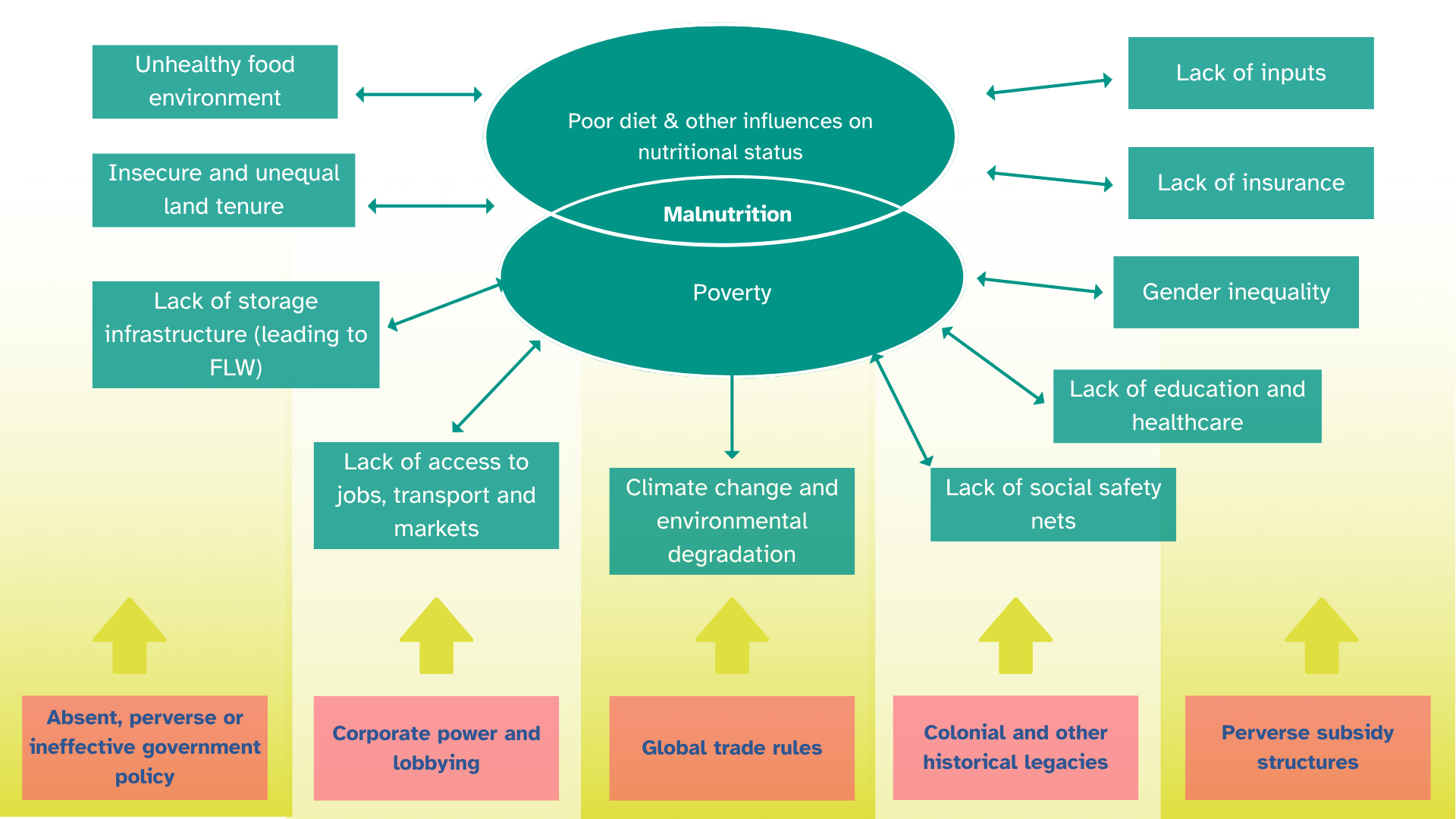
The question that perhaps should have been asked is: why were people subsisting on a single food source and in these conditions? Observers note that the overwhelming focus on nutrients per se at the time overshadowed explanations for this condition that considered the social, economic or political causes of the problem and that would therefore have centred on poverty and its causes. These very crucially included colonialism and the decisions being made, or that had been made, by the colonial administration.
More broadly, and concurrent with this focus on kwashiorkor was a growing anxiety that, with rapidly growing populations especially in the Global South, it might not be possible to produce enough food to feed the world, and in particular to produce enough protein to meet our growing global needs. These anxieties had wider consequences for technological developments in agriculture but they also sparked a huge amount of interest and investment into the development of novel, non-traditional forms of protein, from meals and flours made of fish through to substances based on petroleum derivatives. While most of these innovations never really saw the light of commercial day, a few of them, Quorn and TVP in particular, are still going strong and are widely available for sale.
So to summarise, we’ve been here before. Our fascination with protein isn’t new, and it seems to go in waves. The first wave was in the latter part of the nineteenth century through to the turn of the twentieth. The second was a surge from the 1950s through to the 1970s, the era of the Population Bomb1, Limits to Growth2 and Diet for a Small Planet3; right now we seem to be riding the crest of wave number three. The recommendations set at the turn of the twentieth century, and the general medical consensus that there are more important nutrients to worry about than protein, are starting to be reconsidered and critiqued. As for those 1970s preoccupations with producing enough – of food in general and protein in particular – well, they are of course very live today, even if the discussions take somewhat different forms and reflect a wider set of anxieties.
Figure 1: Trends in protein intake recommendations over time
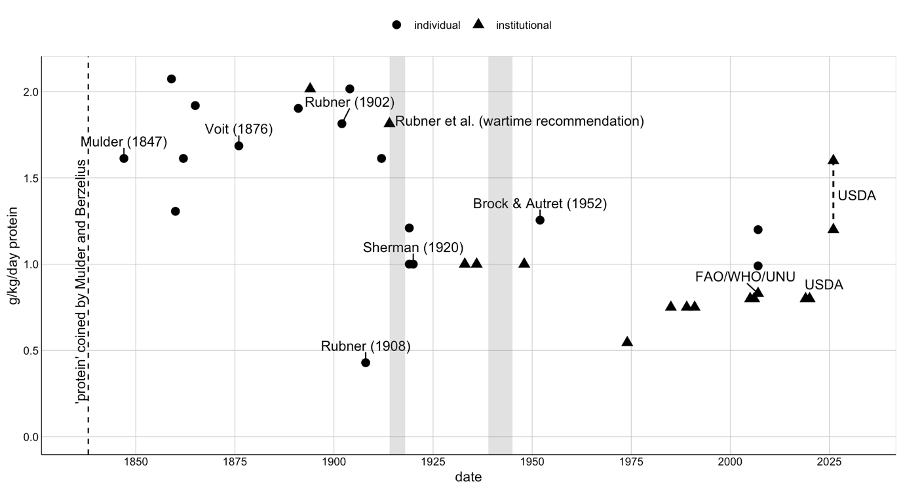
Source: adapted from Blaxter T., and Garnett T. (2022). Primed for power: a short cultural history of protein. TABLE.


Comments (0)