Three Councils, Three Approaches
Government Embeddedness in Cologne
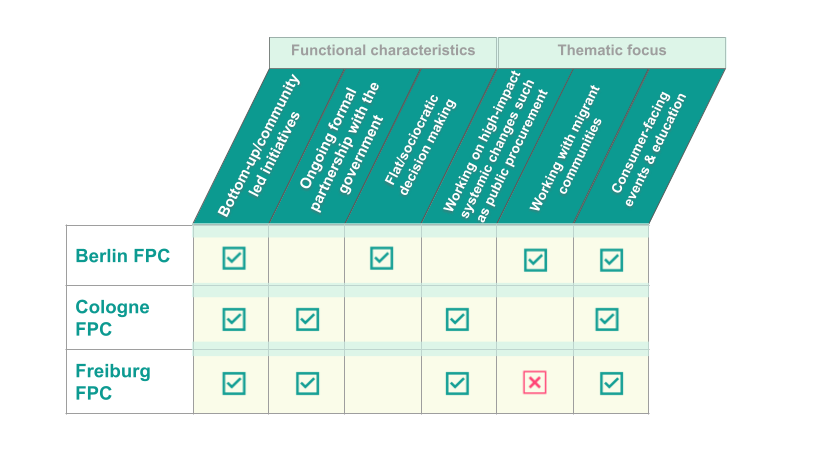
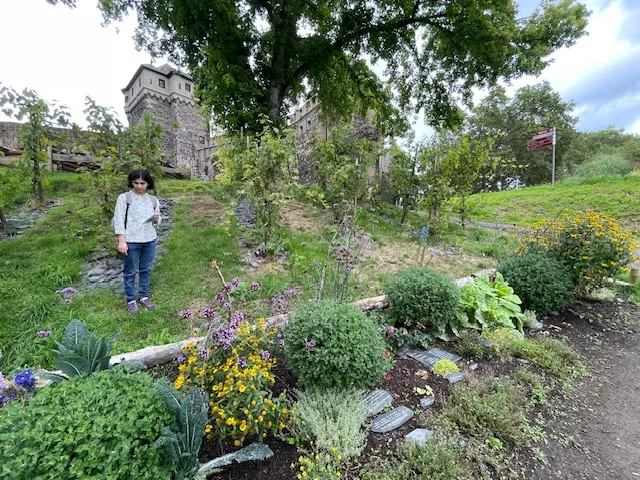
Cologne FPC built its influence from the inside out. Growing out of a local association Taste of Heimat, supporting local value chains and inspired by Toronto’s well-established FPC model, it made use of existing relationships to find early allies within the City of Cologne’s administration. Cologne had previously signed the Milan Urban Food Policy Pact, a non-binding international commitment to sustainable urban food policies, which was a useful political hook. The Council secured formal recognition from the city government early on, mandating that city officials collaborate with the Council in their official capacity, establishing a contractual partnership with the municipality and embedding food policy within official governance structures. It anchored its relevance over time through high-visibility projects: its Edible City initiative, which integrates edible planting into public urban spaces, earned national and international recognition, while its school nutrition programmes proved difficult for any politician to oppose. Cologne's bet was on embeddedness: staying close to power in order to shift it.
Autonomy in Berlin
Berlin’s FPC made the opposite choice. Wary of becoming a service provider for the state, the Berlin FPC deliberately distanced itself from direct government funding, operating as an independent advocacy voice. Upon its formation, FPC attracted experts and professionals who were invested in the topic of food systems transitions and food democracy in Berlin, and brought valuable insights and network to the Council. Unintended hierarchies emerged as citizens without formal expertise felt sidelined in decision-making dominated by experts. To break this hierarchy, there were major shifts in how the FPC engaged volunteers, evolving it from an unintentionally hierarchical, expert-driven model to a decentralised, citizen-led structure. This in turn led to challenges—many experts lost interest as they could no longer utilise the FPC as a space for political advocacy. The Council lost out on the strategic advantages that experts brought, such as political leverage, policy knowledge, and structured leadership, while the less experienced yet enthusiastic volunteers lacked direction in tackling structural and governance-related tasks. Participation declined. It was then that the FPC adopted a sociocratic governance model, distributing decision-making across thematic citizen circles with responsibility for their own projects, and positioned itself as a space for food democracy rather than food delivery. In this sociocratic model² a strategic ‘Core Circle’ (Kreisitzung) aligns efforts across different themes, ensuring coordination but does not interfere in project-related decisions. Fundamental decisions remain open to discussion and require voting from all members.
Berlin's bet was on autonomy: staying independent from the government in order to push further.
Leadership in Freiburg
Freiburg FPC’s approach sat somewhere between that of Cologne and Berlin. Emerging from a regional festival for sustainable food, early motivation was to ensure a more continuous and structured impact beyond the festival’s annual reach. At first it operated entirely through self-funded efforts, holding meetings in a local winery, until the founding members worked to establish the Council as a Verein (registered association).
Initially the council worked on projects within themes that reflected the interests of the founding members and the city’s inclination to fund certain projects. A Strategy Circle was tasked with signing off on projects and funding applications, but met only every two months, which led to delays in decision-making, particularly for smaller projects that required quicker approvals. It became a site of competing priorities. Some members pushed for large-scale, government-linked projects, while others prioritised grassroots, consumer-driven initiatives. The Council restructured its governance over time to introduce a middle management layer that could support volunteers, speed up decision-making, and reduce the burnout that had been quietly hollowing out participation. The Strategy Circle is now composed of Management and Volunteers, who handle large, strategic projects and set overall priorities, eliminating bottlenecks for smaller initiatives. This shift empowers volunteers, allowing them to take quick action, stay motivated, and feel a sense of ownership over their work.
Freiburg's bet was on resilience: staying grounded enough to last.
No single approach is the answer
The contrasting approaches of Cologne and Berlin’s Food Policy Councils (FPCs) in engaging with the government open up a broader discussion on scalability and resilience. Cologne’s model is rooted in active government collaboration, securing formal agreements, financial support, and institutional legitimacy. By embedding itself within the city’s governance structures, the Cologne FPC has gained direct influence over policy decisions and resource allocation, allowing it to scale its initiatives through municipal support. However, this close alignment also poses risks—such as dependency on political will and potential limitations in pushing for more radical reforms that may challenge government priorities.
Berlin, on the other hand, is taking a deliberate step back from government integration, opting instead for an independent advocacy role. This model allows the FPC to maintain political autonomy, act as a watchdog, and pressure the administration without bureaucratic constraints. While this approach ensures ideological integrity and flexibility, it also raises challenges for scalability. Without direct institutional backing, the Berlin FPC must constantly mobilise external funding, navigate shifting political landscapes, and rely on civil society momentum to sustain its initiatives. Funding, however, remains a common challenge for both institutions.
Despite their different approaches, both the Berlin and Freiburg FPCs struggle with volunteer retention and high turnover, which places much of the workload on a handful of paid staff members. Both councils have chosen to be volunteer-oriented, but their models diverge significantly. Berlin pursues a flat, citizen-led structure, while Freiburg incorporates hierarchy and paid positions to facilitate decision-making. These choices reflect distinct priorities: Berlin emphasises egalitarianism and inclusivity, Freiburg prioritises efficiency and effective programme implementation. While Berlin’s sociocratic model fosters inclusivity, the lack of clear governance structures has made sustained engagement and accountability a challenge. The FPC continues to grapple with questions of responsibility, participation, and balancing activism with governance. In Freiburg, the reliance on paid staff for decision-making ensures quicker execution and better administrative support, but risks reducing volunteer ownership, as decision-making becomes concentrated within a smaller group. Additionally, securing long-term funding for paid roles adds financial pressure, making scalability dependent on continued external support.
Why do Food Policy Councils still matter?
None of these examples have found a definitive answer. All approaches have real trade-offs. What these FPCs share is a conviction that working at the local level on food systems matters, even when, especially when, the global picture is discouraging.
I am not sure I can fully resolve the tension I started with. Does it actually make a difference to work at the scale of a city, a neighbourhood, a food council, when the forces shaping what we eat are global, geopolitical, and largely indifferent to local advocacy? I genuinely do not know.
What I observed across all three councils is that none of them had found a single answer to the question of how to scale their work. And that question matters more than it might seem. In India, where I first started working on food systems policy, the sheer size of the problem makes local solutions feel almost insufficient by definition. Millions of people. Vast supply chains. Structural inequalities baked in over generations. It is no surprise that funders and policymakers increasingly ask whether an initiative is scalable before they ask whether it is good. When philanthropies and development institutions allocate resources, they want to know that an approach can travel, replicate, and deliver impact at a scope that matches the problem. The logic is somewhat understandable: if hunger, climate breakdown, and food injustice are systemic, should not the solutions be too?
But I don’t think the logic holds as cleanly as it sounds. Global food system challenges are not caused by a single failure that a single scaled-up solution can fix. They are the product of accumulated local decisions, political economies, and cultural contexts that look different in every city and every region. What scales in Toronto may not travel to Freiburg. What works in Belo Horizonte may not map onto Berlin. The instinct to find one replicable model and spread it everywhere may actually flatten the very diversity that makes food systems resilient. The research I did suggests that FPCs can shift local food cultures, influence municipal policy, and keep food justice on urban agendas that would otherwise ignore it. Whether that adds up to systemic change, whether it can, remains genuinely open. But I would argue it is the wrong question to ask in isolation.
But I keep returning to something I read in a research paper by Moore (2015): that scale does not only mean bigger. It can mean deeper. More rooted. More resilient to the pressures that will inevitably come. The FPCs I studied were scaling deep, building the community relationships, governance structures, and institutional legitimacy that might outlast any single political moment.
That strikes me, as a researcher and as someone still looking for “good” food, as worth paying attention to.
The author conducted this research during a German Chancellor Fellowship with the Alexander von Humboldt Foundation. This essay draws on semi-structured interviews and observational research with the Food Policy Councils of Berlin, Cologne, and Freiburg.
Credits:
Peter Volz: die Agronauten and founding member, Food Policy Council of Freiburg;
Nadine Blanke, Food Policy Council of Freiburg;
Felix Krause, Food Policy Council of Freiburg;
Beatrice Walthall: Founding member, Food Policy Council Berlin;
Saskia Richards; Food Policy Council of Berlin;
Amna Hashemi: Food Policy Council of Berlin;
Zoe Heuschkel and other members of Food Policy Council of Cologne;
Dr. Annette Piorr: ZALF Working Group leader, Land Use decision in the spatial and systems context
Comments (0)