Game
Foodscape
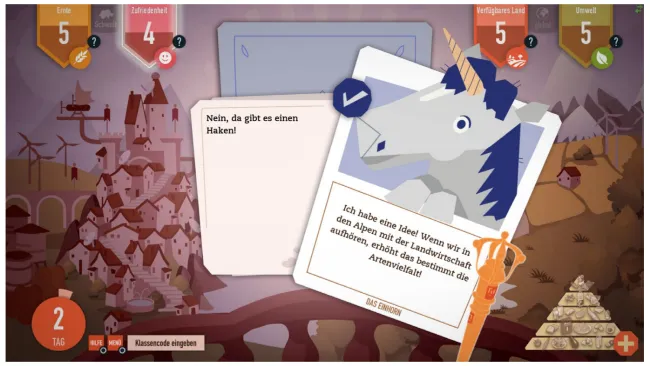
By managing the in-game resources efficiently, players learn how to keep a diet that is both healthy and good for the environment, while also understanding that these goals are sometimes in conflict.
General information
Websites: https://foodscape.ch/
Projects: https://www.zhaw.ch/de/forschung/projekt/71287
Funding: ZHAW, ZHdK,
Stiftung Mercator Schweiz
Author/s and contacts
Isabel Jaisli, jais@zhaw.ch
Nija Sonja Böckler, nija.boeckler@zhdk.ch
Why have you developed this game?
Agricultural production, consumption, trade of food… Food systems are as complex as they are central to our daily lives. Our food supply has a greater impact on the environment, economy and society than almost any other area of life. And yet we are not very familiar with the structures and mechanisms that outline food.
To act responsibly, it is necessary to understand these interrelationships, to be able to assess effects and to know concrete options for action. Foodscape.ch is a digital serious game, which should convey these competences, based on the Swiss food system. For instance, connections between food and land resources are shown in a playful way and made tangible.
Objectives
1.What are the objectives of the game?
By managing the in-game resources efficiently, players learn how to keep a diet that is both healthy and good for the environment, while also understanding that these goals are sometimes in conflict. Foodscape aims to clarify the complexities of agri-food systems. Note, the game is accompanied by a learning sequence for teachers.
2. Who is the target audience?
Foodscape was designed for Swiss students aged 12 to 18. The learning sequence designed for teachers helps embedding the game for classroom use.
3.How the game contributes to addressing the debates around the food system?
Conflicting goals in the (Swiss) agri-food system are highlighted, and players explore actions for a healthy diet respecting the environment.
4. How the game contributes to food system transformation? What is the impact?
The game target future consumers. When the young generation understand the agri-food system better, their future consumption choices might be impacted.
How to play?
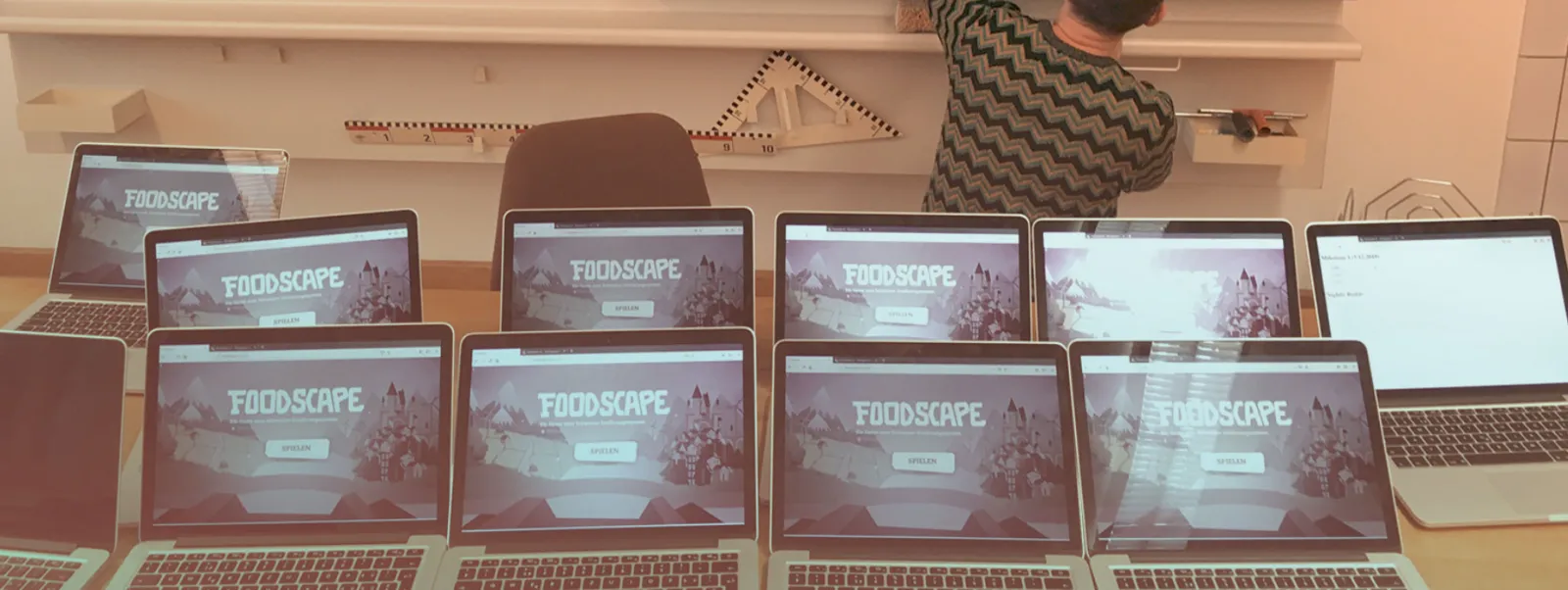
Foodscape is available in German and can be played individually on any computer or tablet directly in the browser – no installation required.
It is also well-suited for classroom use: we recommend having two students share one computer, which naturally encourages discussion and reflection on the decisions made in the game.
One play session takes between 5 and 15 minutes. The game is intentionally challenging, so players are unlikely to reach the goal on their first attempt – teachers should plan for 25 to 30 minutes of total playtime.
An optional feature allows teachers to integrate live class votes on political decisions called “Klassenabstimmung”, modelled on Swiss direct democracy (Volksabstimmungen). During gameplay, the whole class votes together on relevant social and political issues, and the results directly affect each individual player's game. This feature highlights the impact of political decision-making on everyday life and fosters both a sense of community and an awareness of how majority decisions shape individual outcomes.
The accompanying teaching materials include concrete guidance on lesson structure, a wide range of worksheets and info sheets, and a ready-to-use PowerPoint presentation to deepen students' understanding of the Swiss food system. All materials can also be used independently of the game.
Comments (0)