Essay
Radically reimagining land ownership and governance for a sustainable food transition
Several pioneering farmers and growers in the Netherlands have started to change the way they ‘own’ agricultural land, and have embarked on a collaboration with researchers to collectively reimagine ways in which agricultural property is used under the law. This essay explores how these examples from the Netherlands could inspire agricultural property relations in Scotland, a country with both the most concentrated private land ownership in Europe, and a unique legal infrastructure for recognising community ownership.
By Lin Batten (PhD Researcher at the University of Strathclyde) and Naomi Beingessner (Qualitative Researcher in Land Tenure and Governance at the James Hutton Institute).
Large-scale conventional agriculture, characterised by high chemical inputs, the widespread use of hybrid seed varieties, and heavy machinery, is largely acknowledged to be no longer environmentally nor economically sustainable. The necessary transition away from this conventional model consistently calls for farm diversification, a more equitable sharing of resources and land, and improved governmental support mechanisms to ensure that farmers have the financial ability and support to transition towards more environmentally friendly practices. Some scholars, such as Calo, Sippel, and Wach, suggest there is an inherent flaw in private agricultural property that limits transition away from this conventional set-up. Private property is, in the words of these academics, the legal codification of a capitalist asset (the land). In private hands, the land not only requires generation of private gains, but it concentrates decision-making about the use of that agricultural land to private individuals or companies. The capitalist market economy demands subsidised conventional agricultural production at scale in order to maximise private profits, thereby concentrating land, power and capital. It not only diminishes the land’s multi-faceted benefits for biodiversity, local enjoyment, history and identity, but it also hampers a transition to a more environmentally, economically and socially sustainable form of agriculture.
However, the aim of this essay is not to merely dabble in hypothetical notions of how we could move beyond private agricultural ownership. Instead, we will show that alternative property models are not only possible but are already happening, by highlighting practical examples in Scotland and the Netherlands. At present, Scotland has the most concentrated private landownership structure in Europe, with 421 private owners owning 50% of Scotland’s private rural land. A shift in Scotland’s legal framework on property relations, as passed in the recent Land Reform (Scotland) Act 2025, could create a more diverse ownership structure, and possibly allow for that necessary economic, social and environmentally sustainable transition in the food system. This essay draws on examples of the various legal interpretations of rural land tenure and ownership in the Netherlands as presented during a legal geography workshop organised by the University of Glasgow and Radboud University in the Netherlands. The essay aims to analyse whether these have the potential to be replicated in Scotland and how this could be supported by the law.
Legal Reimaginings of Property
Before this essay moves onto practical examples, it should be emphasised that private property is largely a legal construct. This section provides a brief overview on legal theory literature to help better understand how the law in this field is interpreted.
A classic example of the traditional interpretation of private property is the castle-and-moat model: the owners being the kings and queens of their castle. This model of ownership is the most dominant in property thinking and is largely based on exclusion – I can enjoy and profit from my property, and you cannot. Its legitimacy is based solely on whether the owner operates within the boundaries of property law or tradition. Land, once owned, can thus be exploited, profited from, and used. It sits on a bedrock of power that can only be curtailed in exchange of due compensation.
Some legal scholars propose a reimagining of this traditional model of property law. In the castle-and-moat style of property, law is seen as a set of rules to demarcate the limitations of ownership and the economy. For example, no trespassing in other people’s private homes and no building on someone else’s land without their explicit permission. The law protects those who own the castle (I can profit from this land) and prohibits and excludes those surrounding the castle (we cannot access this land). Scholars, such as Singer, Akkermans, and Shoemaker, propose a different philosophy, one which accepts fluidity in the interpretation of law and sees it as a tool to support positive change. In this model, the law is a tool that can be leveraged in land reform and property debate to reimagine property’s purpose in the agricultural sector, from benefitting solely individual wealth towards collective or community and environmental benefits as well. As Scottish land activist Wightman states: “Land is about power. It is about the nature of power, how that power is derived, how it is distributed and how it is exercised”. This notion is challenged by potentially moving from individual rights over property to, for instance, community responsibility or even community ownership.
In the Netherlands, the notion of private property is already sometimes challenged by government policy. For example, land is taken back into Dutch government ownership to build a highway. Another example, though it was quickly disbanded, was a policy plan that opted to take ownership of conventional agricultural farmland, with or without the willingness to sell. If the Dutch government can expropriate land for a highway, it could expropriate it for the public good. To shift away from land use that is inherently private and benefits individuals, rather than the wider community and environment, is to reimagine how else we can organise the ownership of property.
Law does not only have to be limiting and regulatory; it is a reflection of common values. Since private property signifies power, tradition, place, and belonging, these values could be set against speculative land ownership and used in the service of alternatives. Such alternatives might be useful to inform what in recent years has been at the forefront in the European political landscape: an equitable and just food transition.
Property, Food and Community; Alternative Thinking from the Netherlands
Pioneering corporations, cooperatives, community initiatives, and land trusts are piloting examples that embody a different way of organising private ownership in practice. Especially in the agricultural sector and predominantly driven by agroecological principles, grassroots organisations are starting to seek and take back control of, ownership over and access to the means of production or land and thereby challenging private agricultural ownership in practice.
One such example is Kapitaloceen: the Dutch charity shows an alternative to the dominant notion of private property in the Western agricultural land sector.
“Collective non-property in a post-capitalist system” is an ambitious way to rethink how traditional (private) property relations work. In practice, this is what David and Dido, founders of Kapitaloceen, attempt on the agricultural land they steward. They steward 4.5 hectares of what used to be a conventional fruit farm that they have now transitioned to farm under agroecological management, operating as a market garden with a vegetable and fruit box scheme among other income streams.
The Dutch land market has been heavily criticised for inhibiting access to land for new entrants and non-conventional farmers through the gradual increase of land price. This has resulted in a concentration of land ownership (those who can afford land often already have land) and has raised the barrier for access to land for new entrant farmers. This is driven largely by financial investment companies, who operate on agricultural land as a speculative investment market. Farmland is seen as an investment opportunity and valued for its appreciation, with resulting land prices outstripping the amount of profit that can be made through farming alone. Kapitaloceen’s ownership structure is creatively set up to ensure that the central question of ‘who owns the land’ is reframed to be ‘who has decision-making power over this land’. Their structure involves three legal entities, making it as deliberately convoluted as possible to sell the land back onto the land market. No single legal entity of the three is empowered to make such a decision or to make a profit from a land sale.
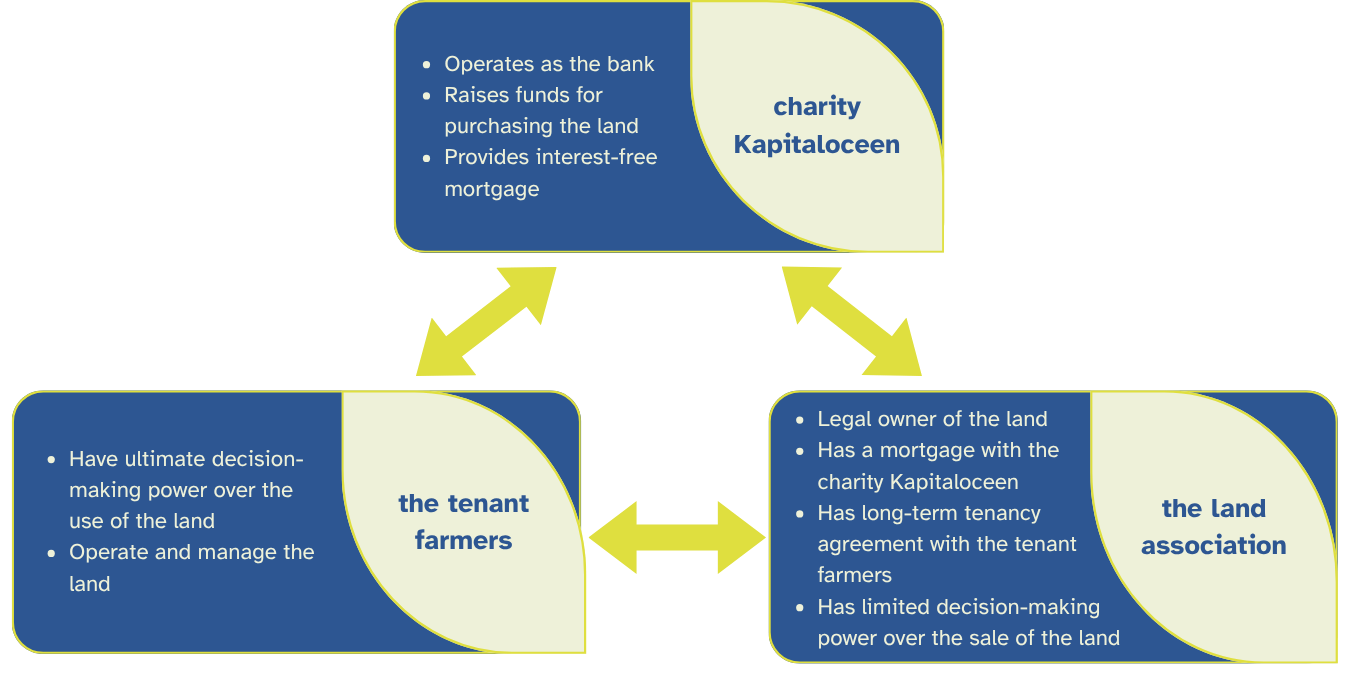
The three legal entities are set up as follows. Firstly, the charity Kapitaloceen raised €401,000 (around £336,300) to purchase their first 4.5 hectares of land through donations and taking on interest-free loans from 37 individuals. Secondly, the charity lends this raised money (like an interest-free mortgage) to the second legal entity: a non-profit named the ‘Land Association’ (De Land Vereniging). The Land Association, in turn, purchases and thus legally owns the land using their interest-free mortgage. Thirdly, the Land Association embarks on a long-term tenancy agreement with the farmers, who then steward the land and have decision-making power over and stable entitlement to that land. This checks-and-balance system allows the land to be governed democratically based on agroecological principles and ensures long-term agri-environmental practices and investment through a secure tenancy.
A cooperative called ‘Land van Ons’ (Land of Ours) also works with a non-traditional investment model. Investing with Land van Ons is accessible for many with a low threshold of 30 EU to purchase (and own) about 1 m2 of agricultural land. They currently have around 24 parcels of land, between 5 and 25 hectares each, managed by an organic or biodynamic farming-tenant on a long-term lease. The land of the farm is thus owned by a great number of people, held by the cooperative. Land van Ons should, in theory, hold the land in perpetuity for the purpose of agri-environmental restoration. However, a major critique is that the investors can sell their land (in m2) after a minimum of two years of investment, thereby making a profit from rising land prices. It is therefore a part the dominant system of the agricultural land market, which limits access to land through inflated land prices.
The initiative Ús Hôf (‘Our Garden) does things differently. Where Land van Ons and Kapitaloceen focus on raising funds to purchase land, Ús Hôf already ‘owns’ land but ensures that it can never be sold. The land is owned by three different institutions, similar to Kapitaloceen, but the main organisation is a cooperative run by its members. None of these three organisations singlehandedly have the power to sell their land back onto the market. This comes with challenges. As the legal structure of layered ownership is so secure and embedded in the statutes of the cooperative, the land cannot be sold on the open market. The question then is: since the land cannot be sold, what is its value? From, for instance, a tax perspective (capital-gains tax or inheritance tax for example), how do you tax something that is beyond value?
As of yet, the similarities between these farms and organisations are that they have to work creatively within the existing system of private property. There is no set of rules that allows for direct communal ownership or communal access rights. Within each of these examples, there is still one organisation, be it a charity or cooperative, that ultimately owns the land, albeit with heavily curtailed decision-making power over that land.
These examples of alternative ownership models have individually and collectively contributed to a change in the food system by consistently and strategically converting land away from conventional practices towards other forms of agriculture - be that organic, biodynamic or under agroecological management. These examples of individual ‘bright spots’ in the agroecological sector beg the question of scale. Could these models, or variations of these models, gather sufficient clout collectively to drive an equitable and environmentally-friendly food transition? Can these models be applied more widely (in the Scottish context, for example) so a network of such small landholdings might emerge in the process?
If these models are scaled to an extent that it becomes a more normal part of society, in accordance with Akkermans’ view, the law must follow. Legal reform would be necessary in this future to allow for, acknowledge, and support these varieties of ownership structures.
Agroecological transition in a Scottish Context
There are very few Scotland-based initiatives that follow similar patterns of layered ownership in the agricultural property sector. Kapitaloceen, Land van Ons and Ús Hôf have created an alternative ownership pattern despite Dutch property law; they have worked around the system that simply does not acknowledge forms of common ownership over landholdings. In contrast, Scotland’s legal framework does have a legal structure in which the community becomes a landowner through open-member organisations. As introduced first in 2003, the Land Reform (Scotland) Act introduced groundbreaking provisions to allow for, acknowledge and support community ownership. Scotland does not merely introduce specific provisions for community groups to hold land, but acknowledges and enables community ownership through financial means (e.g. making government funding available to purchase land), legislative support (e.g. helping community groups to become legal landowners), and through political backing (e.g. community ownership being at the forefront of the political debates on land reform). It is an example of a fundamental legislative support and justification for the establishment of alternative ownership models and the potential benefits thereof for the local community.
At the moment, 533 community groups own 2.7% of Scottish Land and have benefitted from the Community Rights provided by the Scottish Government. The 2.7% portion has, however, remained static in recent years. The barrier here is now land prices - they have skyrocketed such that the subsidy pot cannot afford further community buy-out anymore.
The fundamental point of this essay is to provide inspirational and flagship examples of a radical rethinking of property in order to work with the land for an environmentally and economically sustainable future. Despite the official legal position of community groups in Scotland to own property, there are other barriers that curtail their expansion. The Dutch examples are growing despite their official legal position. Perhaps they can learn from each other. These initiatives are paving the way for other groups to follow and challenge the way we think about land and private property. The entire notion of ownership could be questioned: who owns the land?
In this, Scotland’s land reform legislation might be an example of that legal reimagining of a property framework which supports the community and is used as a tool for positive change. Though much is still found wanting in the Land Reform (Scotland) Act 2025 on community ownership, it is the only structure of ownership in the Global North that comes close to what we have described in this essay. If the law ‘reflects common norms’ – the desire to repopulate rural areas, strengthen communities, and enable a sustainable food system transition - it can and will influence the creation of Land Reform for the benefit of the community as a whole.
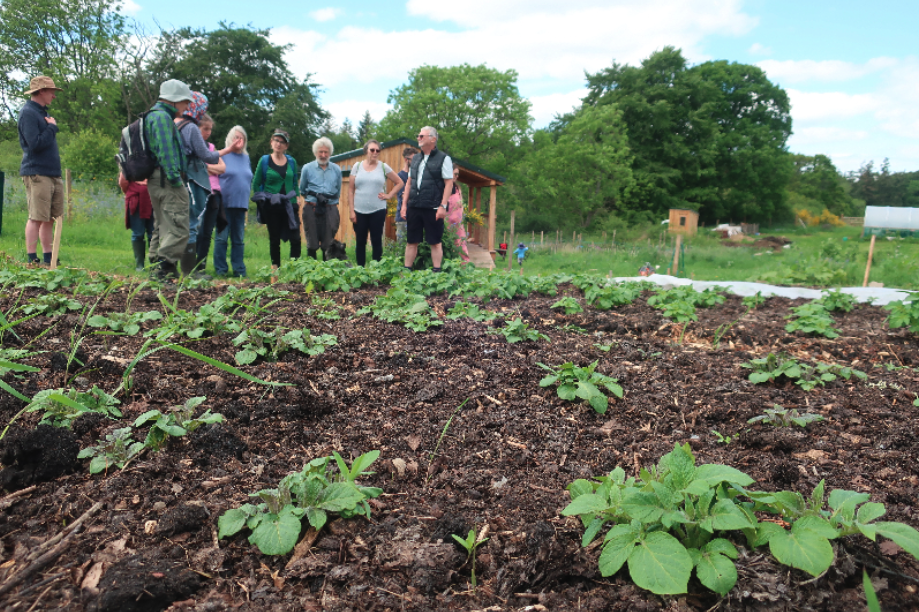
Image: Forres Friends of Woods and Fields, a Moray-based local community garden in Scotland image by Lin Batten
This essay is based on the second workshop in a workshop series on Legal Geography organised by Adam Calo, Assistant Professor at Radboud University, and Frankie McCarthy, Professor at the University of Glasgow, hosted in Nijmegen, Netherlands in October 2023. Funded by the Glasgow Radboud Collaboration Fund, intended to build links between researchers at the University of Glasgow and Radboud University, the workshop brought together practitioners who are embedded in different land access struggles and models and academic researchers to exchange their views, experiences and expertise on land ownership, access to land, property and land law in the context of Dutch food system transformation. It aimed to enhance understanding on the pivotal role of property for sustainability transitions; build a network of scholars and practitioners for exchanging knowledge and expertise; and develop strategies for centring land, property and ownership in conversations, research and policies on food system change in the Netherlands.
Comments (0)