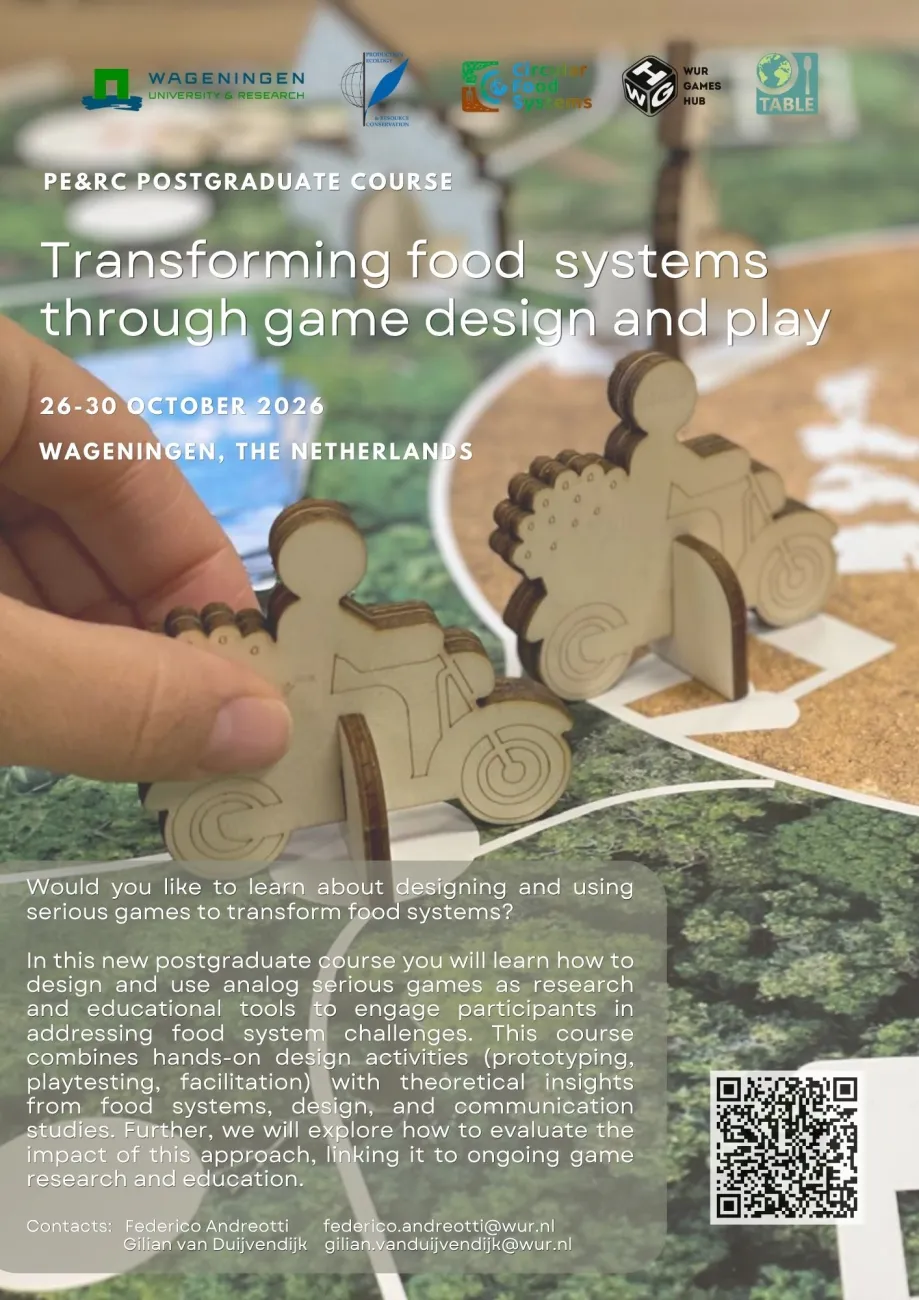
Dates: 26-30 October 2026
The global food system has already crossed four of the nine planetary boundaries, making a fundamental redesign of food systems urgently needed. Supporting this transformation calls for dialogue and participatory tools that can bring together diverse perspectives and values. Analog serious games show strong potential to enable inclusive, reflexive and action-oriented processes for food system transformation.
This course introduces analog serious games (e.g. board and card games, narrative games) as tools to explore and foster food system transformation and challenges the participants to design new and/or adapt existing games and test them in a final event where they can showcase their prototypes.
Participants will design, facilitate and test serious games using real food system case studies, either brought by participants themselves or provided by us.
Participants will learn about existing serious games, design, play and facilitate and assess game sessions using multiple approaches, including Q-methodology, visual research methods, and thematic analysis, applying multiple frameworks such as the Nature Futures Framework, multispecies, post growth and boundary crossing frameworks.
The course brings together researchers and practitioners working on analog serious games for food systems, covering (co-)design, facilitation, assessment and impact in food system contexts.
The teaching team includes members from Wageningen University & Research, the WUR Games Hub, the CiFoS team, Utrecht University, the University of Twente, Oxford University TABLE Debates, Alliance Bioversity International, and the United Nations. The course is supported by both a physical game library, connected to WUR’s Teaching and Learning Centre, and a digital game library, hosted by Oxford University TABLE Debates.
After completing the course, participants will be able to understand and reflect on:
- The role of analog serious games as participatory and reflexive tools for food system transformation and redesign
- How values, power relations, political and ethical considerations shape dialogue and decision-making in food system transformation processes
- The use of frameworks for assessing game session (e.g. Nature Futures Framework, multispecies, post-growth and boundary crossing frameworks)
- The opportunities and limitations of serious games for learning, dialogue and impact in real-world food system transformation contexts
Setup
The course starts on Monday morning with an introduction and a keynote on the state of practice of analog serious games for food system transformation followed by a collective game session. On Monday afternoon and Tuesday, interactive sessions combine short lectures with tutorials: game design, facilitation, data collection, and group work. On Monday evening, a pizza night is organized to get to know the participants, teachers, and Wageningen. On Wednesday, an excursion takes place to the Twente Design Lab, focused on game design. On Thursday, the course continues with game design, prototyping, and play-testing sessions. The course ends on Friday early afternoon with a public showcase and group presentations and testing prototype sessions of the developed game.
Participants work in small interdisciplinary teams (4–5 people) to design new or adapt existing analog serious games for real food system case studies, and to iteratively test their games throughout the week till the final event on Friday. Each group will design, facilitate and test serious games using real food system case studies provided by us.
Prior knowledge: Basic knowledge of farming or food system, system thinking and/or sustainability transition.
Lecturers
- Federico Andreotti - Wageningen University
- Tamsin Blaxter - Oxford University, TABLE debates
- Robert-Jan den Haan - Twente University
- Sarah Jones - Alliance Bioversity-CIAT
- Darko Petrovic - United Nations World Food Programme
- Jet Vervoort - Wageningen University
- Stefan Werning - Utrecht University
Contact
Federico Andreotti (Earth Systems and Global Change group, Wageningen University)
Gilian van Duijvendijk (PE&RC)
In terms of skills and competences, participants will be able to:
- Design, and/or adapt and prototype analog serious games for food system transformation
- Facilitate serious game sessions in participatory and transdisciplinary food system contexts, while engaging with multiple perspectives and values
- Apply multiple methods to assess serious game sessions and outcomes (including Q-methodology, visual methods and thematic analysis)
- Use conceptual frameworks to support serious game design and assessment for food system transformation
- Organize and facilitate a game (prototype) session during a showcase event
Lecturers
- Federico Andreotti - Wageningen University
- Tamsin Blaxter - Oxford University, TABLE debates
- Robert-Jan den Haan - Twente University
- Sarah Jones - Alliance Bioversity-CIAT
- Darko Petrovic - United Nations World Food Programme
- Jet Vervoort - Wageningen University
Stefan Werning - Utrecht University