Essay
How to get out of deep sh*t: the need for honest and nature-inclusive policy measures for livestock farming in the Netherlands
Nitrogen has been at the centre of ongoing tensions in Dutch agricultural policy. Mirjam Schoonhoven-Speijer explores the history of the tensions and some proposed solutions.
Mirjam is a post-doctorate researcher at Wageningen University. She’s interested in the informal part of food systems, because this is where, especially in the Global South, most of the exchanges in food systems happen. Yet it is also undervalued in research, policy and practice. Her PhD research, also at Wageningen University, involved a comparison of formal and informal market governance arrangements in the Ugandan oilseeds sector. The deceptively simple question of ‘how exchanges in food markets actually work and evolve in daily practice’ makes her tick. She explores this question with an interdisciplinary background in anthropology, development studies, sociology, agricultural economics, and innovation studies.
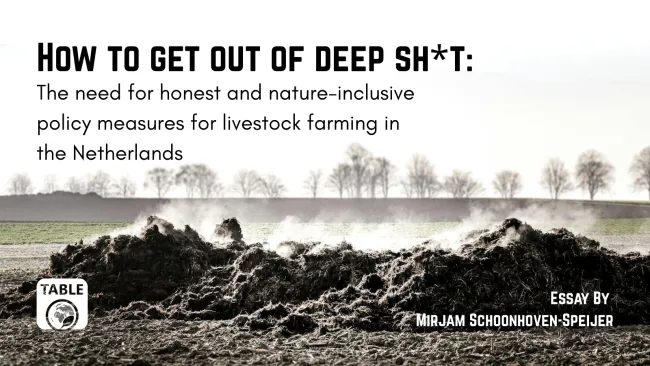
At the end of last year, the prestigious EAT-Lancet report 20251 was published, showing how transforming diets and production is essential to keep within planetary boundaries and to protect both human and environmental health. Food systems are considered the largest contributor to five of six environmental boundaries already crossed — climate, biodiversity, land use, freshwater, and nitrogen and phosphorus cycles. This latter one, crossing nitrogen and phosphorus cycles, is particularly familiar to Dutch livestock farmers. On October 1st 2019, protesting farmers caused the worst traffic jam in the history of the Netherlands, taking 2000 tractors to the highway. They were protesting due to a report published by a government advisory committee a week before, announcing the ‘drastic measures’ that were necessary to reduce nitrogen emissions: the committee advised buying out and shutting down livestock farms2.
In the Netherlands, agriculture is responsible for 60% of nitrogen emissions, and by far the largest share of this excess nitrogen comes from livestock farms3 - in short, from manure. It’s now 6 years since these first announcements and protests, and the situation is still similar, if not worse. Politicians have since not been able to agree on what measures to take in a tumultuous political landscape, with three different governments since 2019 and the fourth currently in the making. Since 2024, the new minister of agriculture - member of right-wing party ‘BoerBurgerBeweging’ (farmers and citizens party) supposedly supporting farmers – has kept introducing plans which are practically unfeasible as they don’t adhere to national and EU laws and regulations. If Dutch politicians continue to stall any progress out of this ‘nitrogen crisis’, then, to quote a popular Dutch skit on the issue, ‘there might be nothing left but brambles’4 (incidentally a bush that grows very well on nitrogen).
The EAT-Lancet report calls for transforming food systems as essential to securing a safe, just and sustainable future for all5. But what does that look like in my own polarized context of Dutch agriculture policies, where the need for change feels very urgent, yet it seems difficult to make real progress? In this essay, I will take the Dutch ‘nitrogen crisis’ as an example of an urgent need for food system transformation, and the political obstacles that stand in the way. After exploring what the problem is exactly, and why it is so hard to move forward, and I will look to some of the examples of viable ways out of the Dutch ‘nitrogen crisis’.
Nitrogen plays a dual role in the agri-food system, as TABLE’s Nitrogen Explainer summarizes: “it is an essential nutrient for all life forms, yet also an environmental pollutant causing a range of environmental and human health impacts. Reductions in nitrogen emissions from food systems are necessary, for instance through human dietary change to less animal-sourced food”. Livestock density in the Netherlands is the highest in Europe. The Netherlands also currently have the highest nitrogen emissions in Europe: with 46kg/ha, it is four times as high as the European average of 11.2kg/ha. The largest share, two-thirds, of these emissions comes from livestock farms. This causes problems such as the leaching of nitrogen (and phosphate) into ground and surface water – Dutch water quality is currently one of the lowest in Europe, as the release of nitrogen emissions into the air, and subsequent nitrogen deposition on Natura 20006 sites is causing an alarming loss of biodiversity. The ‘Veluwe’, the largest nature protected area in the Netherlands, is surrounded by farms and is facing dramatic losses of nature: oak forests are dying, unique flower species and heather butterflies are growing extinct, to mention just a few of the effects7.
All this didn’t happen overnight. Livestock farming in the Netherlands became such a large sector with too high deposition levels due to years of policies focusing on expansion of the Dutch farming sector and on maximal productivity. High production levels of milk and other dairy products are reached by the use of high nitrogen inputs in the form of fertilizers for high yielding grass varieties to feed to cows, and complemented with concentrated feed for the cows’ optimal milk production. This all leads to high nitrogen outputs in the form of excess cow manure8. Inputs are provided by an agro-industry profiting from the current production system, and as such unwilling to change9. Moreover, for years, Dutch farmers were allowed to spread more animal manure on their land than the EU Nitrates Directive allowed10 to other countries, an exception made under the so-called ‘Nitrates Directive derogation’ originally in response to the Netherlands’ argument that its grasslands could absorb higher nutrient loads. This in total creates a system of economic and political structures not easy to change, and hindering the ‘right to a healthy environment’, one of three rights that food systems must support, according to EAT-Lancet 202511. Measures reducing nitrogen emissions are urgently needed, to improve soil and water quality and to increase biodiversity.
The wider political landscape is slowly changing, as the European Commission decided in 2022 that the Netherlands would lose their derogation rights, implying that livestock manure usage will have to be significantly lowered by 2026. Is it possible to make a shift to lower levels of nitrogen emissions, and contribute to more sustainable ways of livestock farming?
The rise of populism in Dutch (and European) politics is moving in a different direction. Up until the summer of 2024, policies were in development to address the Dutch nitrogen crisis, and agreement was reached in parliament on the ‘national program rural areas’. The 12 Dutch provinces selected were in the lead for developing coherent policy, including to improve nature and reduce nitrogen emissions, with an available budget of 20 billion euros12. In addition, a national buy-out scheme, in which the government would buy out livestock farmers willing to stop farming, was to be developed to get a grip on the manure surplus. However, the summer of 2024 marked the installation of a new, right-wing government coalition and a new minister of agriculture who was a member of a populist, right-wing party, which quickly announced they would disregard all these plans, further stalling much necessary action. Claiming to have the interests of farmers at heart, they have been working on new measures to tackle manure excess for the past one and a half years without success, aiming for much less reduction of the cattle population. They are also proposing to re-open EU negotiations about the derogation measures - something the previous Minister of Agriculture has labelled ‘impossible’. While this proposal might appear to be speaking to farmers who are faced with very real and serious problems, it avoids presenting constructive and feasible alternatives.
What might these constructive alternatives be? The EAT-Lancet report argues for a global one-third reduction in livestock meat production, making cropland available for fruits, vegetables and legumes, as well as combining these dietary shifts with mitigation efforts such as carbon pricing. What can be sustainable options for Dutch farmers, strongly reducing the use of nitrogen products, but still enabling them to make a living? I describe here two possible alternatives for livestock rearing, as well as changes in how livestock is managed.
A first alternative is exchanging livestock for the production of grasses or legumes. Both are sustainable options: grasses like elephant grass or fibre hemp can both be used in the construction and insulation of houses – as the construction sector is in dire need of raw materials. These crops in themselves might not have very high market value. However, if farmers were to be paid for the volumes of carbon sequestration they effect, they can make an important contribution to nitrogen reduction, healthier soils, more biodiversity and climate change mitigation13. Legumes aid in transition towards a more plant-based diet. As an example, a lively event on February 7th 2024 called ‘Under the spell of the bean’, organized by Wageningen University’s Klimaat Café, discussed the re-introduction of a bean traditionally grown in the Netherlands: lupine14. Lupine is a bean with high protein levels, so it is potentially relevant for a food system transition from meat towards more plant-based diets. It is also a bean with relatively high rates of nitrogen fixation, and therefore useful for reducing excess levels of nitrogen, as well as fixing nitrogen in soil, so that much less nitrogen inputs are necessary. The bean is being re-introduced by the organisation Lekker Lupine15 (which translates to ‘tasty lupines’) who are working to not only support farmers, but also to address bottlenecks in the wider food system, such as getting these legume products on the shelf in supermarkets. This was an inspiring example, showing the importance of not only introducing crops contributing to plant-based diets on farms, but of involving parties along the value chain.
Second, farmers might not need to stop livestock farming altogether, but could invest in so-called ecological forms of intensification – in short, measures improving biodiversity as part of methods of livestock farming that need far less nitrogen inputs. Measures such as raising different cow breeds and improving soil life - so that the soil is more nitrogen sufficient – both reduce the need for adding nitrogen via inputs (which then risk run-off etc). In other words, it is an adaptation of the livestock ecosystem, so it works towards a healthier ecosystem, instead of the next grass harvest16. However, the milk production per cow or per hectare will reduce (this financial loss is somewhat compensated for by the reduction of fodder and fertiliser costs, but not in the short-term). This needs investments by the government to develop the market for sustainably produced milk17.
In both types of changes, farmers need to be able to see a revenue model worth investing in - making sure that farmers can earn more with fewer nitrogen outputs. They might need a nudge by a government financing these more sustainable ways of farming, for instance by providing bonuses for investing in better ecosystems. It is valuable for all when farmers’ investment in more sustainable agriculture turns out to be investments in improved water quality, greater nitrogen fixation and soil carbon sequestration, sustaining and improving biodiversity, and improving the landscape. In such a way, farm incomes might even out, as ecological forms of intensification need financial expenditure in terms of fertilizer, fodder, medicines, and heavy machinery.
Concluding, what is the role of policy measures and governance in the sustainable transitions that the EAT-Lancet report argues for so urgently? Currently, Dutch right-wing politics seem to be downright denying the problem. Or in the words of Diederik Samson, a former Dutch politician and one of the architects of the EU ‘Green Deal’, ‘the illusion that problems can be solved by denying them, has now become official government policy’18. There is a need for honestly detailing the causes and extent of these problems, as well as honest policy measures and examples of positive alternatives – like re-introducing a local legume, whereby the whole value chain is taken into account. All these measures should go hand in hand when transitioning to a more sustainable food system. And farmers have the right to such measures. They have generally complied with laws and regulations in recent decades, have made investments according to the then current thinking about intensive livestock farming, only now to be told that their sector must shrink substantially. We will only get ‘out of the sh*t’ when livestock farmers are offered worthwhile alternatives. And we now have the opportunity to make sure these alternatives are gearing more towards a sustainable future.
Comments (0)