Close
Login Register
Search
  • About
    • What We Do
    • Who We Are
    • FAQs
  • Our Writing
    • Explainers
    • Essays
    • Letterbox
    • Reports & More
  • Podcasts
  • Our Events
  • Projects
    • Power In The Food Systems
    • Local-Global Scale Project
    • MEAT: The Four Futures Podcast
    • Fuel To Fork
    • Nature
    • Reckoning with Regeneration
    • SHIFT
    • Rethinking the Global Soy Dilemma
  • Resources
  • Opportunities
    • Jobs
    • Funding
    • Courses
    • Collaborations
    • Events
  • Newsletter
  • TABLE (EN)
Search
Back

Food safety

Image
Resource
FAO's Work on Climate Change -UNFCCC 2015
This publication summarises the work of the FAO with the agricultural community to tackle climate change and its effects. The report begins by summarising four key underpinning principles of their work with food production systems:
Read
Image
Resource
Reducing the land use of EU pork production: where there's swill, there's a way
This paper discusses the use of food waste as a feed source for pigs reared for pork in the EU, the current policy landscape and implications for agricultural land use, profits and pork production of using waste as feed.  The authors find that re-legalising the use of food waste as pig feed in the EU could spare 1.8 million hectares of global agricultural land, improve profitability for many farmers, and produce pork of high quality.
Read
Image
Resource
Improving agriculture and nutrition with open data
This report argues that open data can be a powerful tool to solve problems around the world in agriculture and nutrition: from drought, pests and diseases, to food security and food safety.
Read
Image
Resource
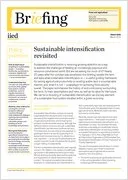
IIED briefing: Sustainable intensification revisited
Sustainable intensification is receiving growing attention as a way to address the challenge of feeding an increasingly populous and resource-constrained world. But are we asking too much of it? Nearly 20 years after the concept was developed, this briefing revisits the term and asks what sustainable intensification is — a useful guiding framework for raising agricultural productivity on existing arable land in a sustainable manner; and what it is not -a paradigm for achieving food security overall.
Read
Image
Resource
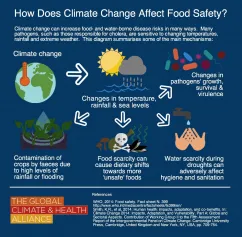
Briefing paper: Climate Change and Food Safety
The 2015 World Health Day took place on April 7th, and it focused on the theme of Food Safety. With this day in mind, the  Global Climate and Health Alliance has published a new briefing paper on climate change and food safety.
Read
Resource
Addressing China’s grand challenge of achieving food security while ensuring environmental sustainability
This short article discusses policies for achieving food security and environmental objectives in China. Rural development has been placed at the top of the policy agenda in China but recently the Chinese leadership has also included an ambition to achieve environmental sustainability. This is presented as part of the plans for an “ecological civilization”, presented at the 18th Plenary Congress of the Communist Party of China.
Read
Image
Resource
Briefing: How TTIP undermines food safety and animal welfare
In a new briefing – “How TTIP undermines food safety and animal welfare”, Friends of the Earth Europe, Compassion in World Farming, IATP, Grain and the Center for Food Safety, says that TTIP (the Transatlantic Trade and Investment Partnership) is likely to restrict efforts to build healthier, fairer and more sustainable food systems on both sides of the Atlantic.
Read
Image
Resource
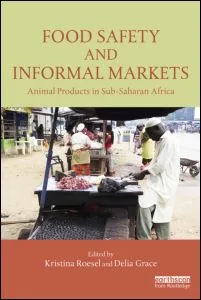
Food Safety and Informal Markets - Animal Products in Sub-Saharan Africa
Animal products are vital components of the diets and livelihoods of people across sub-Saharan Africa. They are frequently traded in local, unregulated markets and this can pose significant health risks.
Read
Image
Resource
BBC article: How safe is mouldy food to eat?
British families throw away about seven million tonnes of food and drink every year, enough to fill Wembley stadium to the brim. While most of this food has gone past its sell-by date, in this article Michael Mosley talks to a food safety expert to find how much of it could still safely be eaten.  There is some useful information on when it is ok to scrap mould off food and eat it, and where it is not. Read the full article here.
Read
  • VIEW MORE

Sign up for Fodder, our newsletter covering sustainable food news.

Sign up
  • Glossary
  • About
  • Our Writing
  • Podcasts
  • Resources

Social

YouTube Facebook Instagram

© Copyright 2025

A collaboration between: