Close
Login Register
Search
  • About
    • What We Do
    • Who We Are
    • FAQs
  • Our Writing
    • Explainers
    • Essays
    • Letterbox
    • More
  • Podcasts
  • Our Events
  • Projects
    • Power In The Food Systems
    • Local-Global Scale Project
    • MEAT: The Four Futures Podcast
    • Fuel To Fork
    • Nature
    • Reckoning with Regeneration
    • SHIFT
    • Rethinking the Global Soy Dilemma
  • Resources
  • Opportunities
    • Jobs
    • Funding
    • Courses
    • Collaborations
    • Events
  • Newsletter
  • TABLE (EN)
Search
Back

Food and agriculture policy

Image
Resource
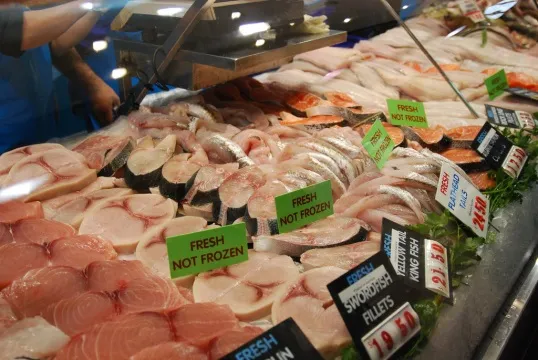
Seafood businesses launch sustainable labelling and sourcing codes
The Sustainable Seafood Coalition (SSC) has launched a new 'labelling code', intended to ensure that consumers are sure about what environmental claims on fish and seafood mean. A new 'sourcing code' accompanies the labelling and ensures that the coalition members source their fish and seafood products responsibly.
Read
Image
Resource
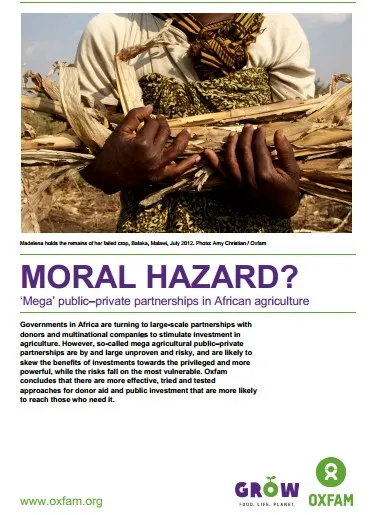
Oxfam briefing paper on public–private partnerships in African agriculture
This report from Oxfam discusses large-scale partnerships between governments in Africa and donors and multinational companies. “Moral Hazard? ‘Mega’ public–private partnerships in African agriculture” is as the name suggests critical of these partnerships (PPP) and questions whether these partnerships lead to poverty eradication and improved rural livelihoods. The report argues that this way of mobilizing funds for the agricultural sector is often unproven and risky.
Read
Image
Resource
New IFPRI website on food and climate
The International Food Policy Research Institute (IFPRI) has launched a new website dedicated to climate change and food policy research and impacts. The website covers news, event updates, project profiles, and shares related materials from across its climate change research portfolio. Since the CGIAR Research Program on Climate Change, Agriculture and Food Security (CCAFS) is a prominent partner in the field of climate change, much of CCAFS and IFPRI’s mutual work together will be featured on the site. Visit the web site here.
Read
Image
Resource
Sustainable food futures, the role of ICT & citizen-consumers
A new paper published in Futures urges discussions about unsustainable food consumption to include more consideration of consumer habits and practices. Responding to reports by the World Economic Forum and the European Commission, it hypothesises that technological innovations and ‘produce more with less’ approaches fail to take into account the varied and nuanced consumer attitudes that surround food, and therefore do not fully consider whether the public would ever actually adopt proposed solutions.
Read
Image
Resource
Greenhouse Gas Emission Estimates of U.S. Dietary Choices and Food Loss
This paper looks at the environmental costs of food production and consumption. It offers an updated account of the GHG emissions associated with production of U.S. food losses at the retail/institution and consumer level and also considers the effects of a shift in diets away from current US consumption patterns towards those recommended by USDA dietary guidelines.
Read
Image
Resource
Blog: Raising food prices to end hunger
In this blog post for Global Food Security, former FAO agricultural economist Andrew MacMillan says the doctrine that food prices should be kept as low as possible to end hunger is wrong.
Read
Image
Resource
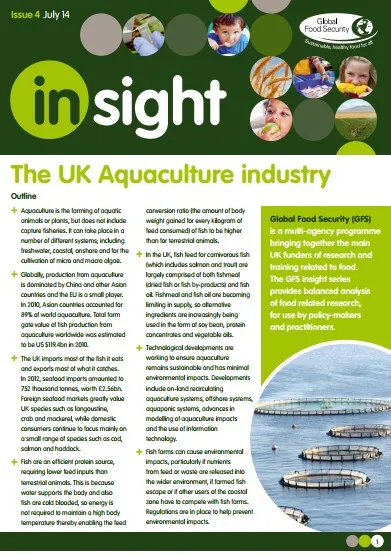
Report highlights UK aquaculture
A recent issue of The Global Food Security (GFS) programme’s Insight series, which intends to provide a “balanced analysis of food related research for use by policy-makers and practitioners”, explores aquatic farming in the UK. 
Read
Image
Resource
The role of no-till agriculture in climate change mitigation may be over-stated
This review, published in Nature Climate Change, concludes that the role of no-till agriculture in mitigating climate change may be over-stated . No-till and reduced tillage are methods of establishing crops with low soil disturbance as opposed to conventional tillage involving ploughing or other practices.
Read
Image
Resource
A systematic review of the effectiveness of food taxes and subsidies to improve diets: Understanding the recent evidence
Food taxes & subsidies are effective at improving diets, according to a systematic review carried out by Australian researchers and published in the journal Nutrition Reviews. The systematic review analyses evidence from research published between January 2009 and March 2012 looking at the effectiveness of food taxes and subsidies on consumption. Included in the review were only papers assessing a specific food tax and those which directly and prospectively observed consumer responses to a fiscal policy intervention.
Read
  • VIEW MORE

Sign up for Fodder, our newsletter covering sustainable food news.

Sign up
  • Glossary
  • About
  • Our Writing
  • Podcasts
  • Resources

Social

YouTube Facebook Instagram

© Copyright 2025

A collaboration between: