“They had chains which they fastened about the leg of the nearest hog, and the other end of the chain they hooked into one of the rings upon the wheel. So, as the wheel turned, a hog was suddenly jerked off his feet and borne aloft. At the same instant the ear was assailed by a most terrifying shriek; the visitors started in alarm, the women turned pale and shrank back. The shriek was followed by another, louder and yet more agonizing - for once started upon that journey, the hog never came back; at the top of the wheel he was shunted off upon a trolley and went sailing down the room. And meantime another was swung up, and then another, and another, until there was a double line of them, each dangling by a foot and kicking in frenzy - and squealing.”
So Upton Sinclair describes the slaughterhouse in his novel The Jungle. The American public was so horrified by what they read that the government was pressured to pass the Meat Inspection Act and the Pure Food and Drug Act, regulating the sanitary conditions of the food sold in the United States. This is only one of the many examples of something shocking leading to a public pressure campaign to effect change.
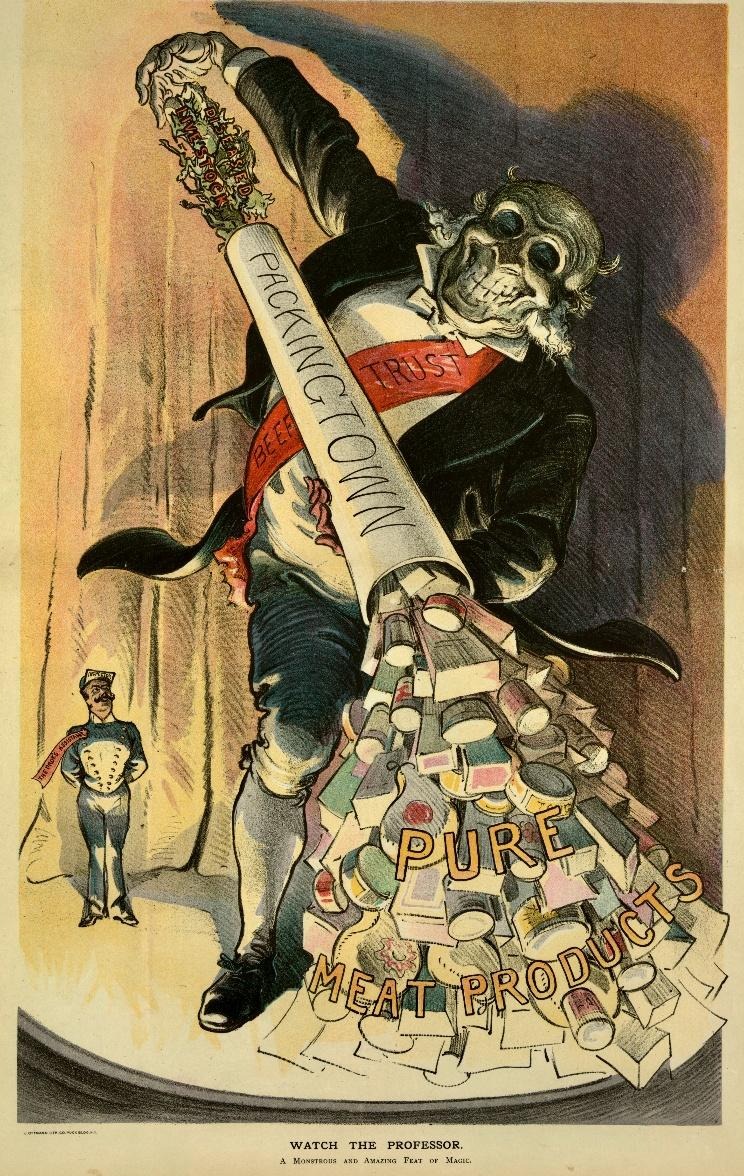
A humorous cartoon mockingly depicting the beef industry production, and regulators' complicity. Puck Magazine, 1906. Credit: Library of Congress.
Reading that passage likely elicited strong emotions in you as well. It probably made you uneasy, and likely made you at least a little bit disgusted. It is in fact remarkably easy to make people feel disgusted, it happens all the time, across many different contexts. And because it is so easily elicited, it is also easy to use, and to exploit. After all, disgust appeals to one of our most basic instincts: we do not want to touch, come into contact with, or consume what we find revolting.
Disgust has long functioned as a powerful mechanism for social and moral change, but this can come with ethical risks. While disgust can expose hidden harms and motivate reform, it can also entrench stigma, justify exclusion, and obscure more careful reasoning. Disgust can drive change; the challenge is to know how, when, and at what cost.
Few domains make use of disgust as consistently as the world of food. Our food system is full of these narratives: when we think about what to eat, and what to buy, we rarely notice how much of our behaviour is shaped by emotion. However, we are constantly surrounded by pressures, norms, advertisements, and campaigns designed to leverage these emotions to shape our food consumption. Disgust is one of their main targets.
But what is it that humans find disgusting? Disgust is part of a behavioural system that we all have and that is designed to keep us away from pathogens and other potential hazards. It plays an important role in keeping us healthy, choosing who we share our space with, and deciding what food we eat.
Charles Darwin described disgust as “something revolting, primarily in relation to the sense of taste, as actually perceived or vividly imagined; and secondarily to anything which causes a similar feeling, through the sense of smell, touch, and even of eyesight.” Since then, many researchers have tried to uncover the secrets of this peculiar emotion. What they found is that, other than making us automatically recoil from certain things, such as food, disgust plays a controversial role in our moral psychology.
The language of disgust
Researchers like Paul Rozin, who pioneered disgust research in the 1980s, called this phenomenon “preadaptation”. This means that the emotion of disgust, which originally evolved for a specific function, has over time been recruited for a different function, in this case shaping our judgements of what is moral and immoral. These two types of disgust, the one triggered by physical things such as blood and rotten food, and the one that rises up when we see something morally controversial, are based on a shared “disgust” network in the brain. While the former results in facial and motor responses (i.e. a specific facial expression and movement away from the object), as well as sometimes a feeling of nausea, the latter is more a “cognitive” distancing act, largely due to additional brain regions that are activated when we experience moral disgust. Essentially, when we encounter something disgusting on the floor, we have an automatic visceral reaction that makes us avoid it, while when we see someone commit an immoral act, that same affective response is attached to ideas about right and wrong, good and bad, making us react as if the violation was a sort of moral contamination. Often those immoral acts can be exemplified or tied down to a more physical-type reaction. Many of the disgusting moral violations have to do with sexual taboos, food impurity, and violence. It is undeniable that people do experience disgust at a variety of things, and that they often use this as an indication of moral condemnation.
As a result, our moral language is saturated with disgust. Someone cheats on their partner? Disgusting behaviour. A conman cheats an elderly woman out of her savings? A disgusting person. A romantic relationship with a considerable age gap? Gross! This latest one is an example of one of the main issues with moral disgust, that is, that it is widely dependent on context and culture. Average age gaps vary considerably in different parts of the world. At the same time, different relationship rules elicit more disgusting feelings in Western populations than they would have in the past, e.g. marriage between cousins, which is now effectively a taboo in the West. Your feelings of disgust are very specific – to where you live, to where you grew up, and to the time you live in.
From physical to moral disgust
In our everyday discourse, calling something disgusting often implies that it is also wrong. The link between disgust and moral condemnation often feels immediate and automatic. But can we really make that connection? Can disgust reliably guide our moral judgements?
Philosopher Martha Nussbaum famously argued that it cannot. Nussbaum argues, quite convincingly, that disgust has repeatedly been used to enforce stigma, prejudice, and discrimination against marginalized groups. Disgust, she argues, follows social anxieties more reliably than moral truths. Prototypical examples of the usage of disgusting imagery are the narratives evoked to degrade the Jewish population in Nazi Germany, whose propaganda often likened Jews to disgusting animals. Dehumanizing language such as this is present in other genocides (notably the one in Rwanda), but also in charged political campaigns: for example, using disgust to discriminate against homosexuality or the often referred to image of “swarms” of immigrants invading western countries.

Antisemitic poster in German-occupied Poland, 1941. Caption reads: “Jews are lice. They cause typhus”. Credit: US Holocaust Memorial Museum
We need to make a distinction then between what is, i.e. that people do experience disgust at many things in society and that they use it as a moral guide, and what should be, that is, what should in fact guide our moral reasoning? Disgust is often used as a proxy for moral condemnation, but it should not be, because it can too easily elicited by non-moral cues that can nevertheless trigger moralistic overreach.
This tension between disgust as a catalyst for reform and disgust as a tool of oppression runs throughout the food system. It becomes especially salient when we examine contemporary debates about meat, animal ethics, and emerging food technologies.
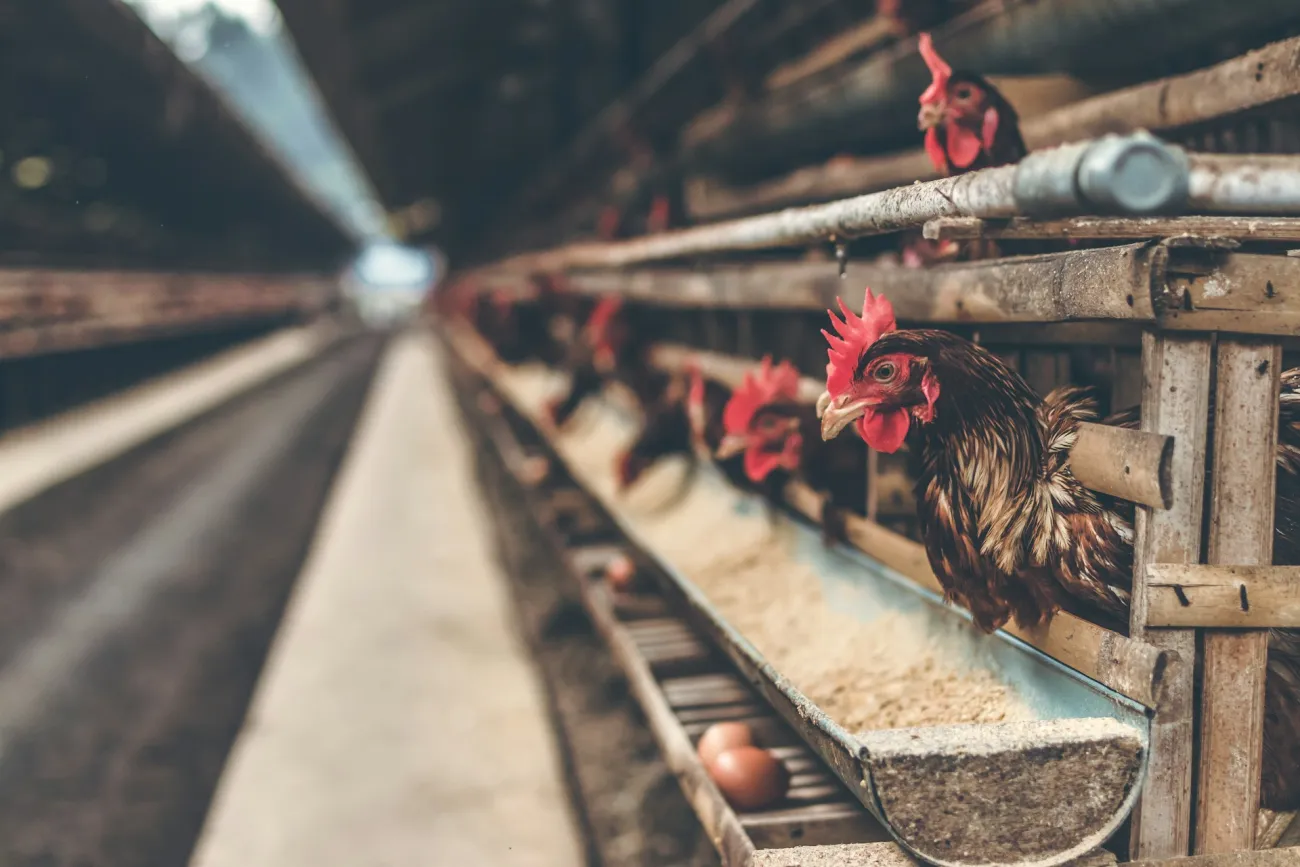
Anxieties around meat eating are as current today as they have always been, although their form has shifted in response to contemporary concerns. Animal ethics and welfare, environmental sustainability, and health are prominent examples. Advocates, researchers, and campaigners are trying to shape the public discourse to spearhead a radical change of the current food system. Using disgust has emerged as a prominent tactic to do so. Campaigns often shock audiences with graphic images of animal suffering or unsanitary conditions in factory farms. NGO Viva, for example, produced an ad where a couple ordering some takeaway pulled pork receives at their door a live pig and a butcher’s knife. Undercover footage from inside farms is powerful precisely because it elicits immediate visceral reactions to dirt, confinement, and harm.
Much like Sinclair’s portrayal of American slaughterhouses inadvertently transformed food regulation, contemporary animal rights or environmental advocates are attempting to do the same by exposing the hidden realities of industrial meat production. Campaigns focus on animals “sitting in each others’ waste”, the potential of illness and disease risks to humans and the adverse consequences for health, and the possibility of contamination of the food system and the environment. Campaigns may also provoke disgust by reframing foods in unappealing terms, for example referring to eggs as “chicken menstruation”. These narratives are very powerful because they can leverage our disgust responses to support a shared conclusion: that factory farms are bad, and the system must be changed.
At this point however, an ethical question becomes unavoidable: if disgust is not a reliable guide to morality, what are we to make of its use in these campaigns? Does appealing to disgust risk reproducing the same harms that philosophers like Nussbaum warn against? Can disgust directed at practices bleed into disgust directed at people?
Different episodes of discrimination, stigma, and ostracism can be linked back to food traditions and food practices. Disgust and food are strongly linked because of the evolutionary origin of the emotion. But food is also a cultural artifact, it is shaped by people, environments, and traditions. Because of this, different parts of the world developed vastly different diets and traditional meals, and these often come into contact, mix, and clash. Meat in particular occupies a central place in many of these traditions.
Food that is good to think
Eating meat is a common practice in largely every part of the world, but different cultures eat and categorize food differently: for example, pigs are not food for Jews and Muslims, and cows are not food for Hindus, even if for starkly different reasons. Anthropologist Edmund Leach theorised that we categorise animals based on cultural and symbolic distinctions, largely based on relations of closeness: pets, farm animals, game animals, and remote wild animals. These categories shape not only what is eaten, but how animals are morally perceived.
The French anthropologist Levi-Strauss famously said that a food has to be not only good to eat, but also good to think. How we think about animals can shape emotional responses to the idea of eating them. These beliefs are strongly dependent on context, and reflect current moral values. When disgust becomes attached to ethical concerns, these categories matter greatly.
These differences in food traditions, and in our perceptions of the animals that are the source of meat, can raise conflicts. They can be exploited to mark groups as different, inferior, or impure. Not all disgust narratives do this, and when they do, it is generally not accidental. They serve political and social projects aimed at exclusion, hierarchy, and control.
A clear illustration of this dynamic can be found in the long history of caste-based discrimination against Dalits in India. As one of the lowest castes in the traditional hierarchy, Dalits face discrimination across many domains of life, including work, marriage, and access to resources. Food plays a central role in this system. In Indian society, food practices are deeply intertwined with caste status: the caste one belongs to shapes what foods are available or acceptable, while the foods one eats are taken as visible markers of caste identity.
Centuries of economic and social marginalization have shaped Dalit diets in ways that are then morally reinterpreted through the lens of disgust. For example, despite the cow’s sacred status in Hindu religious traditions, beef is an important ingredient in Dalit cuisine. Abstinence from certain meats and vegetarianism more broadly function as symbols of purity, moral worth, and high social standing, and are associated with castes at the top of the hierarchy. Food sharing across caste lines is rare, and the foods consumed by Dalits are often framed as shameful or polluting. As a result, Dalit culinary traditions remain marginalized and largely invisible.
There is a clear feedback loop here that is fed and sustained by disgust. The consumption of foods marked as impure reinforces social stratification, which in turn legitimizes further exclusion. Disgust reflects existing hierarchies, and it actively helps to maintain them. Because of their caste position, Dalits are often confined to occupations deemed unclean, such as handling waste, cleaning, or disposing of carcasses, which is work that is itself framed as disgusting. This segregation in occupations reinforces the idea that Dalits themselves are polluting, and that whatever they touch, including food, becomes contaminated. Members of higher castes may therefore refuse to share food with Dalits, citing feelings of disgust as if they were natural or morally justified.
Here, disgust does not challenge injustice but it reinforces it. It naturalizes hierarchy, making the exclusion appear justified instead of socially constructed. So not all uses of disgust are ethically equivalent. The crucial difference lies in who or what it is targeted to, its scope, and its goal.
Animal advocacy typically advances a universal claim: that animals should not be harmed or exploited for food. While disgust is used to expose harmful practices, the target is a system, not a group of people defined by identity, tradition, or status. Campaigns often contrast the disgusting conditions of farmed animals with alternatives described as “clean” and “pure”, highlighting the absence of the animal and the dirty conditions that would be present in farmed meat.
Clean meat and moral cleanliness
This language is also prominent in cultivated meat advocacy, where terms like “clean meat” highlight the absence of animal suffering and unsanitary conditions. These novel technologies are emerging as a way of overcoming the need to rear and kill animals for food, thereby avoiding the associated environmental damage and suffering. This meat is produced through a laboratory process, whereby a small sample of cells is taken from a living animal, and is then put into bioreactors, where it is bathed in nutrients, like proteins, vitamins, and sugar, that allow it to multiply. The outcome of this procedure is the same natural muscle and fat tissues that you would find inside the original animal. These tissues are then modelled into familiar meats, like hamburgers, chicken nuggets, and more.
This technology has the ability to radically change the way we produce meat. Advocates praise it for its lower environmental impact with respect to conventional meat, as well as for addressing the ethical and moral implications of animal farming. Yet it also elicits different emotions, be it fascination, scepticism, and often, disgust. Opponents have seized on this and different narratives are being created to address the possibility of cultivated meat entering the market. Researchers have identified the many narratives and counter-narratives surrounding this new technology and other meat alternatives, where a battle is beginning to take shape what “good” and “clean” food is and what it will look like amidst technological upheaval.
Italian agricultural group Coldiretti, for example, launched a campaign against cultivated meat which highlighted particular aspects aimed at eliciting fear and disgust among consumers. Communication strategies highlight the production in laboratory settings, stoking fears about health consequences and stressing its lack of naturalness.
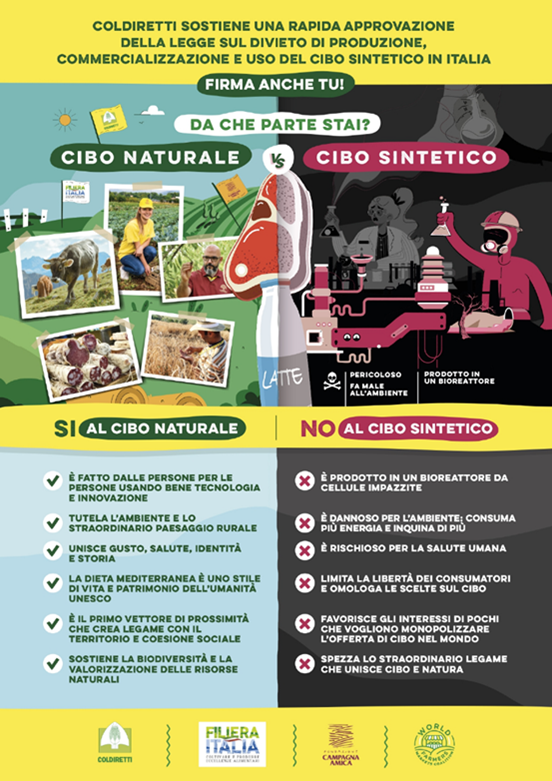
Anti cultured meat flyer from Italian agriculture group Coldiretti.
Similarly, the organization Center for the Environment and Welfare, a group that often campaigns on behalf of the agricultural and meat sector, launched a campaign to discredit cultivated meat by framing it as an untested artificial product made with chemicals and growth factors.
These campaigns are not limited to cultivated meat. Biotechnology innovations such as genetic modification, gene editing, and other cell cultured technologies have inspired several campaigns. Campaigners tell tales of unnatural manipulation of natural foods, while images of laboratories support narratives of contamination and artificiality, and these contribute to disgust responses to many of these novel technologies. Representative of this is the term “Frankenfoods” used to argue against novel foods, evoking the image of the unrestricted scientist tinkering without thinking of the consequences, bound by no natural or moral law, and of the product of his creation, an unnatural patchwork of pieces that create a monster.
Groups such as the National Academies of Science are trying to counter the “Frankenfood” narrative with the help of campaigns that emphasise GMO safety, environmental benefits, and food security. These aim to clarify the science and safety of these processes and normalise the use of these technologies. However, countering immediate disgust responses often proves difficult.
These narratives illustrate how disgust can function conservatively, to resist change rather than enabling it. What emerges is then not a simple moral story about the use of disgust being good or bad, but a more complex picture of how it can capture attention and shape judgements in a wide variety of contexts.
The allure of the disgusting
While our current food system is undergoing rapid changes, narratives of disgust and cleanliness continue to operate around our food system and our meat-eating traditions in sometimes surprising ways. In some cases, some level of disgust is not a bad thing at all. Eating, as a practice, is itself somewhat gross, and meat is rarely framed as a purely healthy or nutritious food. Instead, it is often treated as an indulgence, something that can be proudly gross. We frequently hear that a hamburger is better when it is greasy, messy, and excessive.
As philosopher Carolyn Korsmeyer has argued, disgust can be alluring in itself and can even generate an attractive quality in food. Fast food is appealing not because it is wholesome or nourishing, but precisely because it is heavy, greasy, and transgressive, a reward after a bad day rather than a model of dietary virtue.
Here, disgust is not mobilized to repel or condemn, but to entice. This inversion shows that disgust is not inherently moral or anti-consumption; it can be flipped on its head and deployed strategically. Vegan marketing has increasingly adopted this logic as well. Products such as vegan “dirty” burgers deliberately invoke the same connotations of excess and indulgence, while restaurants like the Norwegian “Dirty Vegan” aim to attract customers by drawing on the pleasurable associations of food that is messy, ‘sinful’, and satisfying.
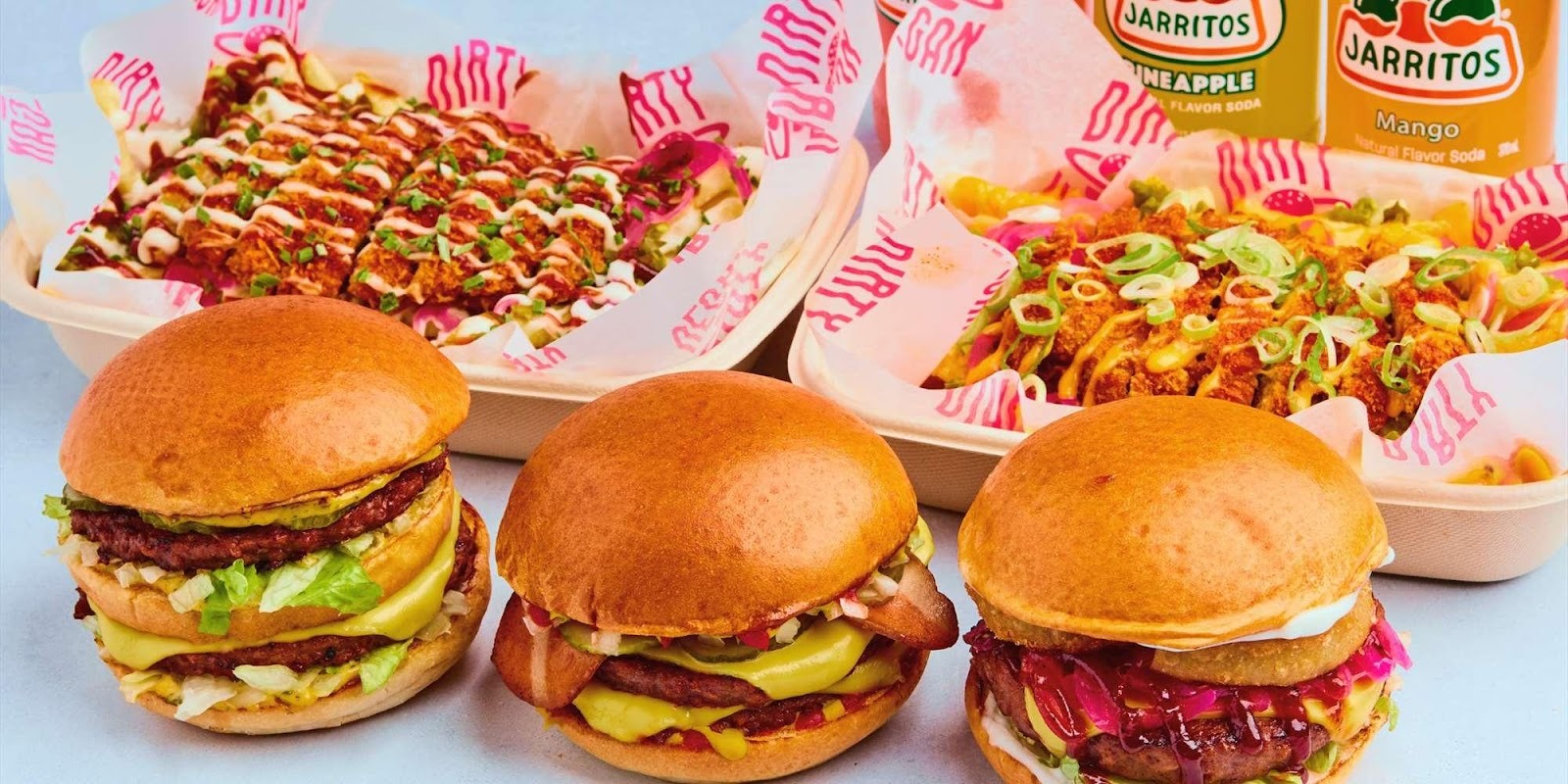
A promotional image for the “Dirty Vegan” restaurant in Bergen.
This final contrast reinforces the idea that disgust is not a moral signal in itself. Instead, it is a flexible emotional mechanism that can be directed towards very different ends depending on who mobilizes it and for what purpose.
Disgust reactions are automatic, but our attention is driven to certain objects or practices by actors with particular aims, that are sometimes moral, sometimes protective, and sometimes simply conservative. It is important to recognise that disgust alone is not a moral compass. As philosophers such as Martha Nussbaum argue, feeling disgusted by something does not by itself tell us whether it is right or wrong, or whether it should be regulated.
Recognizing disgust as a mechanism for change rather than a moral verdict allows us to evaluate its use more carefully. It can expose hidden harms and motivate reform, but can also stigmatize, oversimplify, and harm. The ethical task is not to eliminate disgust from food politics, but to remain critically aware of how it is mobilized, and ultimately, who it serves.



Comments (0)