Acknowledgements
Many thanks indeed to Ruth Mattock for extremely helpful comments and suggestions on several versions of this essay, and thank you to Jackie Turner for design and formatting.
TABLE director Tara Garnett traces the ways in which stories influence how we imagine the world as it exists and how it could change in the future.
If a story at its simplest is an account of how this led to that, then the story of how I ended up working on food is that it’s because of the stories I read when I was little.
As a child of the 1970s my literary diet included books by authors whose very names I enjoy listing - CS Lewis, Roald Dahl, Arthur Ransome, JR Tolkien, Maurice Sendak, Laura Ingalls Wilder, E Nesbit, Beatrix Potter, Noel Streatfield, Lewis Carroll and many more. There were fairy tales too, as well as a jumble of myths and legends from around the world. I read a lot; I was read to a lot.
As is the way with children’s literature, food loomed very large; there were life changing chocolate bars, body changing mushrooms, a rare and precious orange, a toffee tree growing in the soil of a new world, bread and milk and blackberries. The flip side in these stories was just as important - I felt the outrage of hunger, the monstrousness of deprivation. The having of ample good food embodied that union of nurture and dizzying freedom that all children want, the triumph of good versus evil, the justest of just desserts. What I absorbed from these stories was that food mattered, morally.
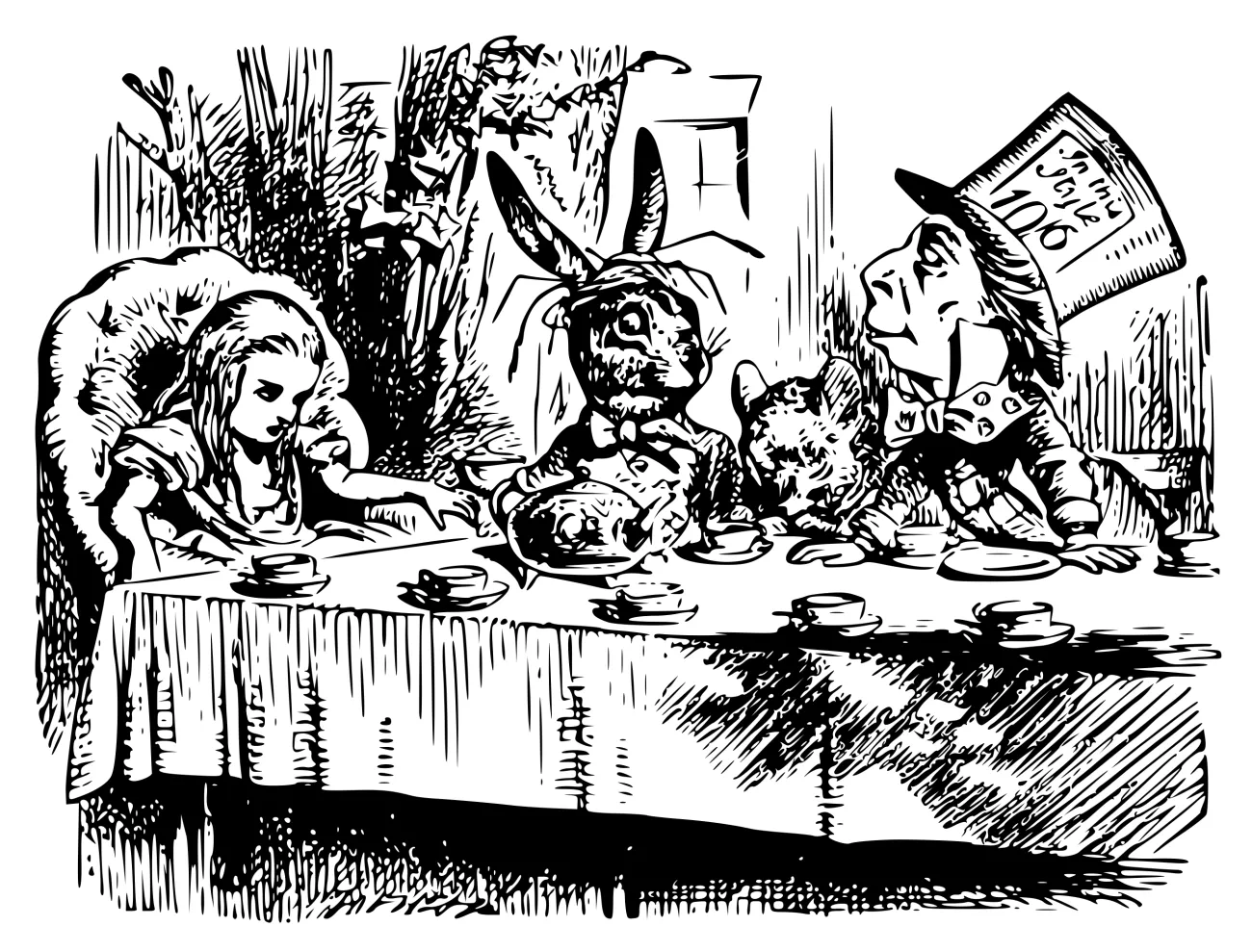
Alice at the Mad Hatter's tea party. Illustration by John Tenniel (1865)
Because I went to a series of Church of England schools, these beliefs were naturally reinforced by daily readings of the Bible. Since the Bible is the work of agrarian peoples, food is the medium of its morality, and the language of the King James version therefore fed me multiple goodnesses of bread and wine, milk and honey, loaves, fishes and lambs, and put a fertile Garden in the middle of all things – an idea of home, a state of completeness. My Godless, but somewhat literary little soul gobbled up this heady combination of ethics and aesthetics.
Later on in my childhood I came across an old family scrapbook consisting of wartime newspaper cuttings, some of them recipes put out by the Ministry of Health as part of its ‘War on the Home Front’. These miserable culinary concoctions were the exigencies of scarcity, and people loathed them at the time, but I, a child lucky enough to grow up in abundance, was enchanted. Equipped with the virtues of ingenuity and resourcefulness, the hero protagonist (admittedly undefined and hazy) would triumph over injustice and adversity, miraculously making something from nearly nothing. Frugality, I learned, was the mother of plenty.
I could continue … but in short, I took from the stories of my childhood the idea that food is infinitely absorbing, imaginatively expansive, morally loaded, and somehow, vaguely but powerfully, able to ‘heal’. To say that what I do now is a direct consequence of what I read then is obviously not the whole truth, life being far more wayward than that, but the story contains some truth. This did indeed lead to that. Because here I am now, forty-odd years on, one of many people now working at the intersection of food, health, ethics and environment, and I still think about food in this way.
You could think of today’s food system as a story, in which case most people would more or less agree on who the characters in it are: rich people, poor people, policy makers, financial institutions, farmers and the like, although everyone will also have their blind spots, the characters they never notice or whose names they forget. They’ll also mostly agree on what kinds of problems these characters face as they walk through the plot - I’m thinking here about climate change, the loss of nature, diet-related sicknesses, poverty, animal suffering; although again, there will be some skimming and overlooking.
But beyond that, they don’t always agree about what the story really means, or even who the goodies and the baddies are. Importantly, while everybody wants the story to end happily, they don’t necessarily have the same idea of what ‘happy’ looks like.
To start with the first disagreement: the meaning of the story at its core, or, in more technical terms, the problem diagnosis. Some will say our food story is ‘really’ all about human greed; we’re like the fisherman’s wife in the fairy tale, never happy with what we have. We need to become better people, live better by sharing more, consuming less, valuing differently. Others will say it’s a matter of the structures and institutions that shape us and our actions. Change these, change the balance of power, create more equality, and socio-ecological harmony will prevail. And then there’s a third group, who have little truck with - as they see it - all this moralising and politicising: our problems, for these people, are technical. As are our solutions. So let’s ramp up our efforts to do what we’re already good at doing: being quick-witted monkey innovators.
These readers of the food system story (who also, of course, constitute its creators and its characters) will also have different happy endings in mind: for some, a happy future world is one that’s a greener, healthier version of today – one with all the convenience and none of the cost. For others their ‘good’ might be a world with an entirely different socio-political structure, an entirely different way of relating to the natural world, an entirely different sense of what we think we need and want.
Sandwiched between causes and ends are the means: here we encounter disagreements about how they think change should happen, and who or what is responsible. Whose fault is it, who has agency, who’s the powerless victim? Put these three sets of differences together and you get a multitude of textual interpretations, so to speak, each of which has a very different account of what ‘the’ story is, what it’s actually saying. Each story defines its heroes and villains differently, and each has its totems and taboos. What we also see is that these ‘big’ stories about the past, present and future of food appear, piecemeal, in ongoing disputes about how best to farm, or the goods and bads of different foods or diets, or the balance between individual freedom and the collective good, or whether to put an economic value on nature.
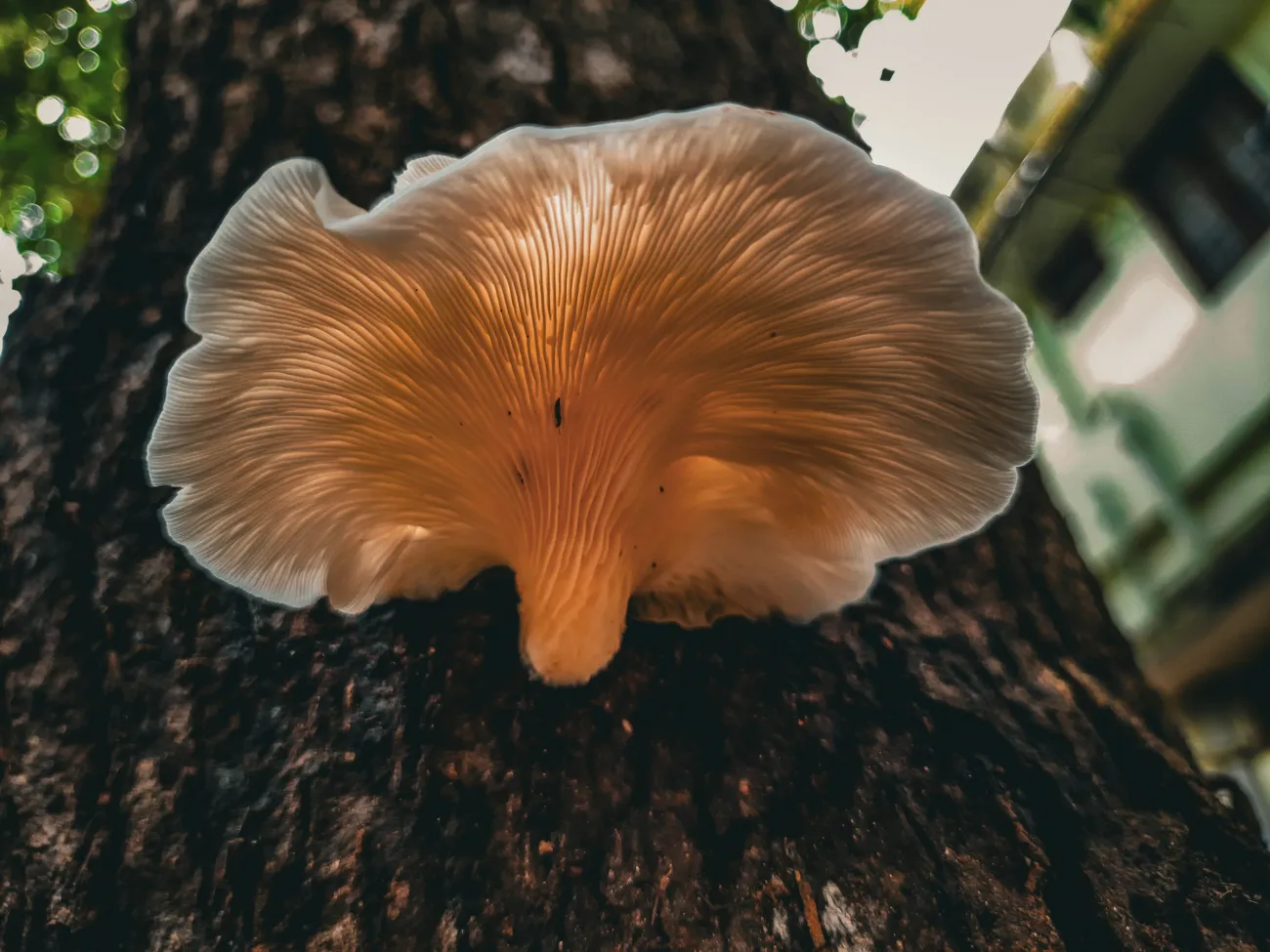
Mushroom growing out of a tree. Photo by Ankit Pai via Unsplash.
Over the course of my working life, we - researchers, activists, industry professionals and policy makers - have learned a great deal about how food is connected to so much that matters in the world today. This is thanks to a large and ever-increasing evidence base – the literature of ‘facts’ so to speak – that shows these connections across a range of societal and environmental concerns. Study after study articulates the problems; study after study also suggests a multitude of things we could do to tackle them in ways that yield many benefits, even if these suggestions don’t always point in the same direction.
And yet action lags seriously behind awareness. This is frustrating - we know so much and the problems are so urgent, so why does nothing change? People cite many reasons, but one thing they mostly agree upon is that it’s not for a lack of these same ‘facts.’ We’re drowning in them. What’s missing, it seems, are two additional necessities: general agreement as to what the facts imply when it comes to action - because people make sense of the facts differently - and second, a way to make facts salient – to get them to matter to people in a position to change things. In short, we need meanings that matter.
Which is why there’s been a lot of talk recently about the need to focus more on stories, storytelling, narratives. I see this emphasis not just among philanthropists and campaign groups but also within a frustrated scientific community. The great hope is that storytelling can communicate what facts imply and create salience, can make one’s own campaign or message stand out from that of others, and can counter what are perceived to be the psychologically sophisticated stories being told by powerful actors who are currently obstructing change.
If logic and reason don’t cut it, goes the thinking, then maybe inspiring and persuasive stories will.
It’s not that any of this is new per se – we’ve always used stories as a tool for getting things to change both within and widely beyond the food community - but in the explicit naming of storytelling as an approach, it has become something, around which energy, attention and excitement constellate. This imbues it with a kind of ontological force. When Columbus "discovered" America, suddenly America "existed."
As someone who carried on reading through her adolescence and beyond, who ended up studying English literature at university, and who recognises the deep impact of stories on my own life, I find myself experiencing mixed feelings about this enthusiasm. I naturally share my colleagues’ intense concern at the lack of progress we’re making and I feel strongly we need to do something to get change to happen. And of course I want to persuade and inspire - who doesn’t?
Yet at the same time, there’s a part of me that’s wary, a little irritated and definitely unclear. Stories are slippery unreliable things. They seduce, they deceive, they contradict. Their relationship with truth is ambiguous and ambivalent. I love stories for these very qualities but that’s not to say that I trust them. And so when people declare that we need better stories, my hackles start to rise a little. I feel the need to ask questions about what and why. What is it that people think a story is and is for? Does it need to be for anything? How do they think stories relate to the ‘truth?’ In other words, what do people really mean when they say we need better stories?
I also want to figure out what I think about these questions, which is why I decided to write this.
A neon sign in a shop window in Berlin reads "What is your story?" Photo by Etienne Girardet via Unsplash.
I said a little earlier that a story, at its very simplest, is an account of how this led to that. To express that causality another way, a story’s a way of making meaning from data. There is a description of a state, a change in that state as a result of some agent, and an outcome from that change; some kind of why emerges, even if it’s implicit, or contested, or thrown over to the reader to construct.
All this holds very obviously true when we encounter storytelling forms such as novels, films, parables and plays. That said, to qualify, these are also most likely to be the forms that mess about with the simple building blocks of storytelling – they’ll be complicating or confusing the temporality or the causality, casting doubt on the agency of the agent, being obscure or ambivalent as to outcome, blurring the creative divide between writer and reader.
Beyond fiction, we recognise journalism as a form of storytelling (“start with the individual” goes the advice – as indeed I did, above). Stretching things a bit further we might include certain games as part of the story family, as well as magic tricks - the magician sends the viewer scurrying down one causal pathway, while taking a different one.
But science is also about storytelling. I‘m not just referring to science communication where the communication is subservient to the science, but the whole scientific endeavour itself. Without the storytelling element, all there is, is data. So you write up your lab experiment (what you did, why and how) and you draw some conclusions (and this is what happened, and why) - that’s your story. This led to that.
Take, for example, a food system model, which might function by connecting data on different kinds of foods, such as their nutritional and environmental attributes, to data about farming practices, and about certain health, climate or biodiversity outcomes, by way of some kind of posited causal logic. The state of play is: if we carry on eating like this while farming like so, then such and such happens to food availability, to land use, to the incidence of hunger or heart disease, and to greenhouse gas emissions. That’s the story’s opening chapter. The scientist may then continue by introducing a new ‘character’ or event – say a tax or a drought – which changes these other elements, as a result of which a different set of outcomes ensues, which propels the tale a little further onwards.
Even more storified are scenarios, part of a family of tools used by a range of institutions – the military, the Intergovernmental Panel on Climate Change, the oil industry - to imaginatively and sometimes numerically explore a range of possible futures that extrapolate out from aspects of today’s reality. As the well-known saying goes: all models are wrong but some may be useful; here a story can help us ask questions about what we want, what we fear and what we might need to prepare for.
Stretch scenarios a bit further, and we enter the realm of science fiction, the genre that perhaps most obviously both bridges and blurs the divide between ‘fact’ and ‘fiction.’ While it is hard to make generalisations because it is so various, perhaps the one thing stories of this kind hold in common is that they explicitly engage with technical and scientific questions and developments, both imaginatively and morally. A work of science fiction might take the form of myth projected forwards or sideways (Star Wars; Avatar), blur into parable (Star Trek), extrapolate outwards technological or cultural trends that are already present in society (William Gibson); explore contemporary issues in settings that defamiliarise them, so making them more visible (Ursula le Guin; Octavia Butler, Star Trek); try and conceptualise reality from a non human perspective (Olaf Stapleton). They can also (inadvertently) predict or arguably even create futures (Asimov; or E M Forster’s horrifyingly prescient The Machine Stops). Of course, all the examples I’ve mentioned do several of these things at once.
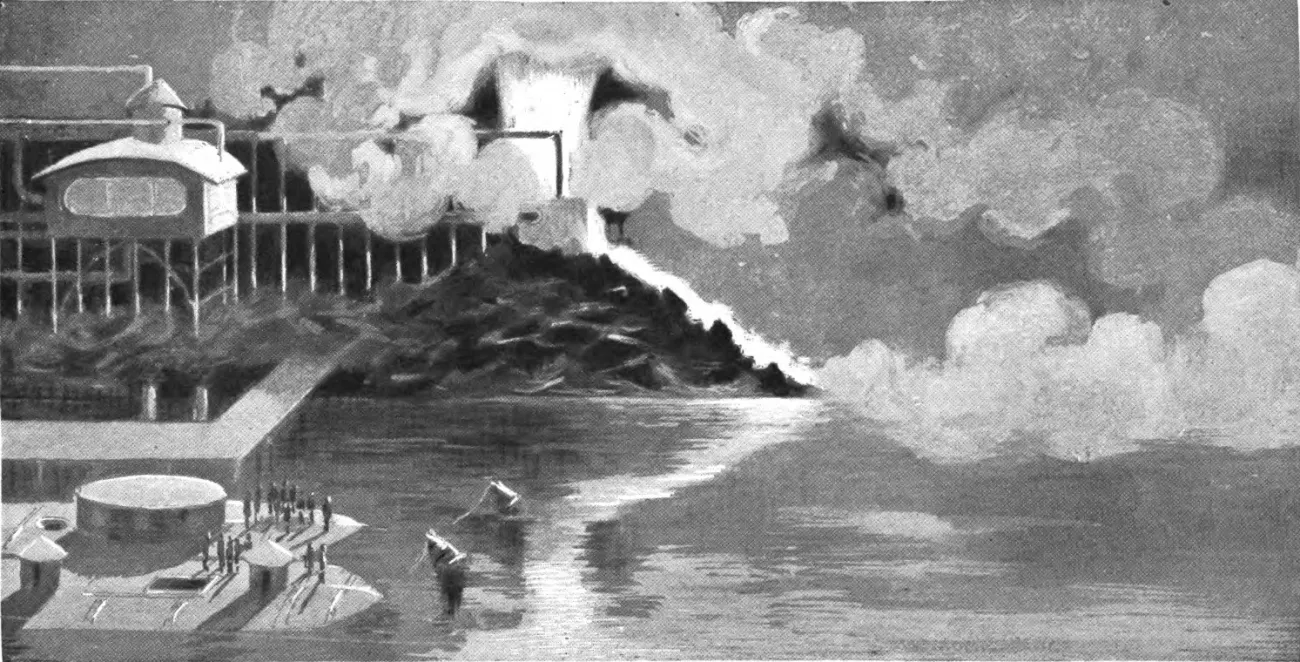
An illustration by William A. Mackay from Clement Fezandié's science fiction novel "Through the Earth" (1898).
Sometimes just as with science fiction, ‘regular’ scientific endeavours don’t just explore future possibilities; they actively create present realities. They do this not only by informing decisions – by providing “evidence for policymaking” as the jargon goes - but more fundamentally by shaping our ideas about what counts as salient. Where your attention goes, there your energy flows.
For me, the life cycle assessment (LCA), which is essentially a very simple model, provides a powerful illustration. I have to say that, when I first encountered the LCA back in the early 2000s, the idea that an item on a shelf had a whole back-story - something we take for granted now - felt revelatory. This, the back-story, is basically, what the LCA is about; it charts how the life of a product, say a tomato, turns out - from the (pre) seeds of its birth to its death by way of someone’s dinner. Using the LCA lens, we see that how this protagonist-tomato is brought up - how it’s fed and cared for and how and where it lives its life (in a glasshouse or a field, in the UK or Spain), has differing consequences, environmental and otherwise, for the world around it. The life cycle approach can be used to explore alternative life paths for the tomato, and can also be used to compare between different varieties (cherries versus round versus beef) or between different nationalities of tomatoes. Once all this has been explored, a judgement is formed: the moral of the story, so to speak.
A really powerful story has a sense of inevitability; we believe that its characters are the only ones that matter, that the things that happen in the story are the only things of import, that the options our hero-tomato has to choose between are the only ones available. The thing is though, we can be so caught up in listening to this story that we may forget to think about the paths not taken, or to look out for what might be important but which we don’t see, or that’s even invisible. Because is the narrator really to be trusted? What are they ignoring or omitting?
The life cycle assessment can tell us that British tomatoes grown in winter are ‘better’ or ‘worse’ than those in Spain because of X or Y or Z, but in so doing the idea that we could eat something other than tomatoes in winter might stay unexplored; nor might we ask if there are other criteria (moral or otherwise) for judging the merits of a particular production pathway. Crucially, an additional story the LCA tells is about metrics and measurability. Its moral isn’t just about the betterness or worseness of British over Spanish tomatoes, but about the importance of measuring things if we want to get to the truth. Measure well enough (in the LCA’s case along the whole life cycle) and an answer will follow.
But while metrics and measurements are essential, the troubling flipside of this way of thinking, to my mind, is that one might end up only noticing - and therefore valuing - that which is measurable.
I want to emphasise that it’s not that the LCA is ‘wrong.’ My point is that its methodology shapes how we approach the question of what counts, which in turn informs what we see, which influences the decisions we make, which in its turn, shapes the world we live in.
The LCA approach is certainly persuasive, but it’s also partial. I think it’s important not to forget this. One could actually look at things otherways, and perhaps therefore act differently, but only if – and this is a big if - we remember that we can. Which is why we need to tell – and listen to – multiple stories.
What’s more, the story told by the LCA - and perhaps I oversimplify here for my own storytelling effect, because LCA methodology is developing in ways that at least try, if not always successfully, to take account of the questions I raise - could be seen as contributing to a much larger story we tell and are told.
I’m talking here about stories in their most expansive sense - stories about who we are, what we do and why, how we interact with one another and what we want and value. These stories are the water we swim in, to borrow from the wonderful speech by David Foster Wallace.¹ For anyone who hasn’t read it – but please do – it opens like this: “… There are these two young fish swimming along and they happen to meet an older fish swimming the other way, who nods at them and says “Morning, boys. How’s the water?” And the two young fish swim on for a bit, and then eventually one of them looks over at the other and goes “What the hell is water?””
To spell things out, the water here is the universe of our taken-for-granteds; call it the status quo. That it is a story, as Wallace points out, is largely invisible to us – it’s just the way things are: reality. Sometimes we might bump up against its walls when something major happens in our lives, or when we meet someone who looks at the world so vertiginously differently that they shake the certainties of our own ups and downs and lefts and rights. Copernicus, Galileo and Darwin are famous examples of story-changers, but we can all think of writers or other thinkers who one way or another have shifted the way we personally look at the world.
Most of the time though, we live our lives, forgetting that we are in a story, that things could actually be different. That’s why these meta-stories are so powerful, and in their power, so limiting.
Many groups working on food systems are trying to combat this amnesia, because they believe that today’s story is destructive and that much of its destructiveness lies in its ‘of courseness,’ in how it locks our thinking into its version of reality.
These groups also want us recognise that other realities are possible. This is why they want to tell persuasive and compelling ‘better’ stories, stories whose telling might not only show people what a fairer, more sustainable world looks like, but might also inspire us to think that it’s possible. In that way, they hope to build the momentum that might lead to its creation.
Their reality however, is of course also its own meta-story, which may itself be more or less visible to them.
So this, perhaps, is one reason for my wariness. However balmy the water, it’s still water and it’s important never to forget that that is what it is. It’s dangerous to be too sure that your story is real. The story is a story, and a story is only ever going to be partial and incomplete.
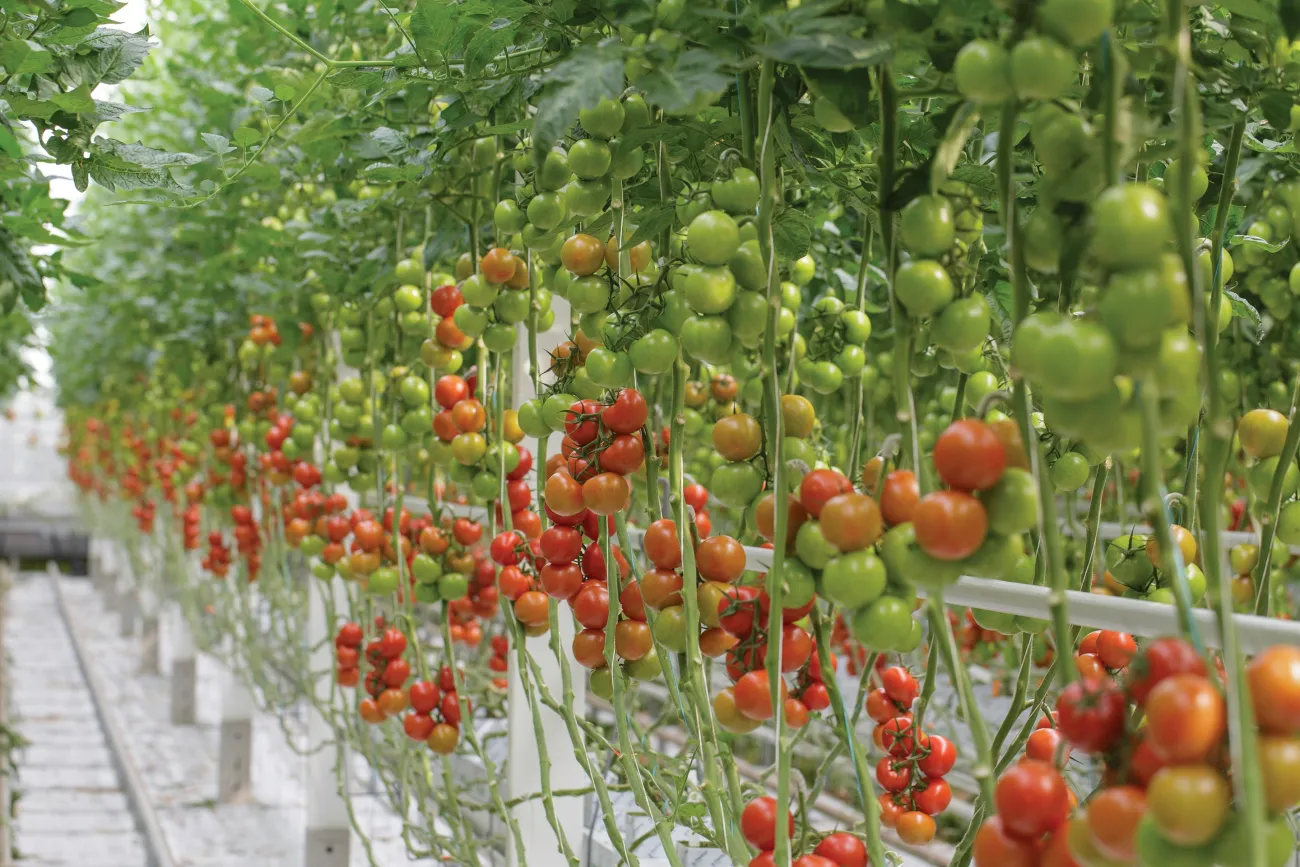
A row of tomatoes in a greenhouse. Photo by Aleksandr Malofeev via Unsplash.
There’s another reason for my ambivalence, which is more personal and very deeply held. I get annoyed when art (here storytelling) is deployed for some instrumental goal, in this case the goals of the scientific or political community. It’s as if art’s role in life were merely to act as the big boys’ handmaiden - attractive, but definitely lowly. I don’t like the hierarchies implied. Stories don’t need to justify themselves. They are their own justification. They matter just for themselves. They are not in service of some other goal
And when they are, I get suspicious. Of course, this happens all the time - there have been plenty of very deliberate attempts to instrumentalise narratives, to tell big new everything-changing stories that make claims to The Truth. Arguably this is the mission both of world religions and of political ideologies, although they might have different views on the causality of shift – on whether the world changes when we become different, or whether, in changing the world around us, our souls will somehow follow. Of course changes in mindsets happen anyway without clear unified intention, as a result of other things that get thrown at us, like technological innovations, or the domino effects of more targeted approaches to specific areas of our lives - the suffragette or civil rights movements, for example. This is as true in the sustainability movement as elsewhere.
This kind of wholesale shift in our paradigms is very hard to achieve or control, and there can be a lot of catastrophic fall out. Most change makers working in the food system tend to take a more humble approach, trying to chip away at the meta-narrative via more delimited and targeted kinds of storytelling. This might mean making more effort with the science communication in order to make the abstractions of scientific findings intelligible and relatable – through articles, photos, podcasts or a documentary.
While this form of piecemeal science communication continues, there is increasing interest within civil society and philanthropy to think in a larger, more strategic sense about storytelling, to tell big stories about who we are and who or what could be. The stories these groups might choose to tell will be based on their sense of what a ‘happy ending’ looks like - a world in which we’ve shifted our diets, or there’s an altered balance of rural-urban living, or a rewilded earth. Their story will feature ‘good’ and ‘bad’ actors, and a pathway (a problem diagnosis) of obstacles to overcome to reach the satisfying finish.
The effective telling of these stories relies on adapting them to the audience: ascertaining which combination of medium + message + trusted messenger resonates with a given audience and then telling these tailored stories, in a way that aligns with the group’s ‘Big Story’.
For example, policy makers need stories that speak to their priorities – likely around the economy – and that inspire confidence that acting upon the story’s suggestions would land well (or could be spun – another story involved here - to land well) with the voting public. Money, growth and jobs are likely to be this story’s star characters, and the necessary tone of sober credibility will be reinforced by the use of data-rich academic studies. As for the messenger – these will be storytellers that policy makers trust – safe and sensible hands.
For economically struggling citizens, worried about the pace of social change and swayed by messaging from the Far Right, data and proof of academic rigour may be much less interesting than the promise of economic dynamism, flourishing local businesses, well paid jobs and strengthened national security. No boats are to be rocked; a public shift towards plant-rich diets might be framed, in this story, not as radical or alternative, but as normal, easy and indeed ‘patriotic.’ For farmers, the art here might be to show how cultural ties to the land, thriving wildlife, sustainable farming practices and income generation are all connected. And so on. Working with and communicating via the right messenger – people or institutions that the target audience trusts – is all important here.
Since stories are always partial, this communication work of tailoring and adapting inevitably involves foregrounding aspects of the truth that appeal to the listener, and glossing over the more awkward or inconsistent bits. If the audience is ‘sophisticated’ you can do this in a sophisticated way², which may involve drawing attention to the awkwardnesses to show that you’re aware of them, while simultaneously dismissing their significance. There will, however, always will be framings and editings.
Reading the paragraphs above, it seems to me that the work I’ve just described sounds a bit like ‘propaganda’. ‘Propaganda’ is, of course, a very loaded word, with connotations of truth-distortion and mind-control – it also tends to be used to refer to content put out by groups and ideologies one doesn’t like. Perhaps a softer, less uncomfortable synonym might be ‘rhetoric,’ a word which, while often used to dismiss (‘that’s just rhetoric’) at least hints at something more respectable - the ancient art of persuasion. After all, if an idea’s worthwhile, it needs to be transmitted, and it would be foolish not to do this as effectively as possible.
Whichever the word, using them in this context makes me sound cynical, which is a quality I dislike, and it also feels like a particularly inappropriate response to the often idealistic work and aspirations of people working to change the food system in ways that I tend to support. Isn’t this approach just practical, realistic? Is it even an ‘approach’, or just what we do given that a 360⁰ overview of the truth is an impossibility? Besides, even if one could somehow get to see truth in its entirety (and not go mad), how would you ever communicate it?
There’s the need for clarity and simplicity, versus the damaging effects of its distortions; the urgency of action (our problems are existential!) versus the need to pause and think, to be sure we go the right way.
Pragmatist-me says: “We’re in a crisis! Go for it - do what you can! Tell great stories, and tell them better!”
Academic-idealist Tara quibbles. I fret about ‘the truth’ even though I know we can only ever understand the world through the medium of stories, and that the idea of an external truth ‘out there’ is itself just another tale. I know too that the best is the enemy of the good; there’s so much corrosive propaganda in circulation, chock-full of lies and (worse) distortive partial-truths, that the more one says nothing to avoid oversimplifying, the more those other stories proliferate and dominate.
“Exactly,” says pragmatist-activist me. We need counter-stories, stories as weapons to fight the forces of darkness. This is David against Goliath, Rebels against Stormtroopers, writ new for our times, now pitting the social justice-come-environmental movement against the corrupt corporo-political cabal. The odds are stacked against, but the underdog will prevail.
I love stories like this. They’re hopeful and morally clear. They stir up, they inspire.
But wait! idealist-academic me persists: are these simple stories really going to help? All too often, simplicity slides into simplisticness - and simplisticness reinforces the binary thinking that’s not just ill-suited to understanding and addressing the complex challenges that arise in our terribly unsimple world, but – vitally - it also feeds the conflict that stops progress from actually being made.
Simple good-versus-bad narratives undermine one centrally asserted principle of many of those working within the food system movement – to be inclusive and to value plurality. Committing to this principle requires us to do several things – to engage in good faith with people we disagree with; to neither villainise nor romanticise the contradictory complexity of peoples and groups; and to beware bundled thinking, that tribal assumption that if someone believes A then she must necessarily also believe B, C and E; or that if A is good then X must necessarily be bad.
When I was ten or eleven we read Lord of the Flies in my English class at school. I am not exaggerating when I say that reading this book fundamentally changed way I saw the world, because for the first time I became consciously aware that a story – in this case a ‘simple’ fable - could have meanings above and beneath the twists and turns of the plot. I started to understand that a story – and for me by extension, reality – could operate at various levels, could mean different things at the same time, could even refer to other stories. Nothing was settled, and the more you prodded and poked, the more unsettled it all became. Meanings proliferated. They were there in there; but they also for me to make.
This fumbling childhood insight seems to be me to be relevant to how we think about our food-related problems today and the stories we tell about them. What’s there, and what meanings do our interpretations make? What, actually, is the story? To ask the question in the biggest and most basic way possible: are things getting better, or are they getting worse?
One answer might be: it depends on the time frame you choose. Looking at certain topics over a longish time frame is arguably quite a cheering experience. As many of the data visualisations on the Our World in Data website show, more people today, including women and girls, are more educated now than ever before, more people have access to healthcare, and we’re living longer too. Some of that increased longevity is due to successes related to the food system - our diets are better, and food is now relatively cheaper; most of us (and with important exceptions in some countries) no longer have to spend most of our incomes on food, and on basic staples at that. This in turn means that we’re more able to pay for healthcare and education and other things that make our lives better. For sure, more and more of us are now dying from the excesses of food abundance, but you could say that that’s because today we’re lucky enough to have avoided dying young from the diseases of poverty.
Or take the environment. Thanks to human ingenuity we now grow vastly more food on any given area of land than we did fifty, a hundred, five hundred years ago, and this means we have been able to meet our growing demand for food with less and less need to convert land in order to grow it. Indeed some agricultural land has even been taken out of production, and returned to nature.
That’s one perspective, over one temporal scale.
If you look at things over another time frame – if you begin your story either at an earlier or else a much later date - you’ll tell a very different tale. For example, one could point out that while we might have reached ‘peak land,’ this is in the context of us having converted about ninety five percent of the earth’s surface for our purposes over the last 10,000 years, about half of this for food production, and at the expense of other life on earth.
Jumping forward to more recent years, the land efficiency of our modern high-yielding agriculture has also had massive side effects, most notably the contamination of soils, rivers and oceans with nitrogen, phosphorus and a witch’s brew of chemicals. And while we might be returning some land to nature, not only do these global averages mask ongoing and damaging land conversions in biodiversity hotspots, but any returns are also insignificant compared with the reality that the average abundance of native species in most terrestrial habitats has fallen by at least twenty percent since about the 1900s, and around a million species are now threatened with extinction.³
Nor are we quite the picture of health that the first narrative would imply. We’ve made some progress in combating world hunger, but it hasn’t been evenly distributed, and in the last few years the downward trend has stalled, with an uptick even, in Sub Saharan Africa. Even in rich countries like the UK, children go to school hungry and people rely on food banks. Moving beyond food security and into other areas of (ill)health, there’s a lot else to be concerned about. The confined industrial livestock systems that characterise the contemporary food system are not only inhumane, but contribute to rising antimicrobial resistance, and are also tee-ing us up for the possibility of a zoonotically induced epidemic of catastrophic proportions.
As for what to do, the conclusions one draws about what actions are good or bad also shift depending on the spatial scale at which you look at things and on who is doing the looking. Take on the one hand panoptical, data-driven accounts of reality, based on the aggregation of systematised, numerical and numerised information, of the kind produced by large land use models. The story their omniscient narrators tell about how best to farm and use land is as follows: use as little of it as possible and farm as efficiently as possible in order to spare as much human-free land as we can for nature. This means focusing on productivity and taking livestock out of the system.
But a small organic, regenerative or agroecologically inclined farmer, looking at things from the position of their patch of land will tell a very different tale. Their good is a way of farming and using land that ‘works with’ nature. Rather than focusing on using as little land as possible, their priority is to use it well, as they see it, by avoiding the use of chemical inputs and recycling nutrients through crop rotations and the integration of farm animals into the system. Maybe more land is used to grow a given amount of food, but this food, for this farmer, is going to be ‘better’ - and besides, since they don’t see there to be a clear divide between the human and the natural domains, humanity's presence in the landscape isn’t necessarily negative. Harmony between people and nature is possible. They will likely be frustrated by the modeller’s conclusions because they seem to negate what the farmer sees and touches to be true.
Who’s right? Both of them, I think, in different ways: both the farmer’s experience and the modeller’s sums. The problem is that the top-down and the bottom-up truths just don’t join up neatly.
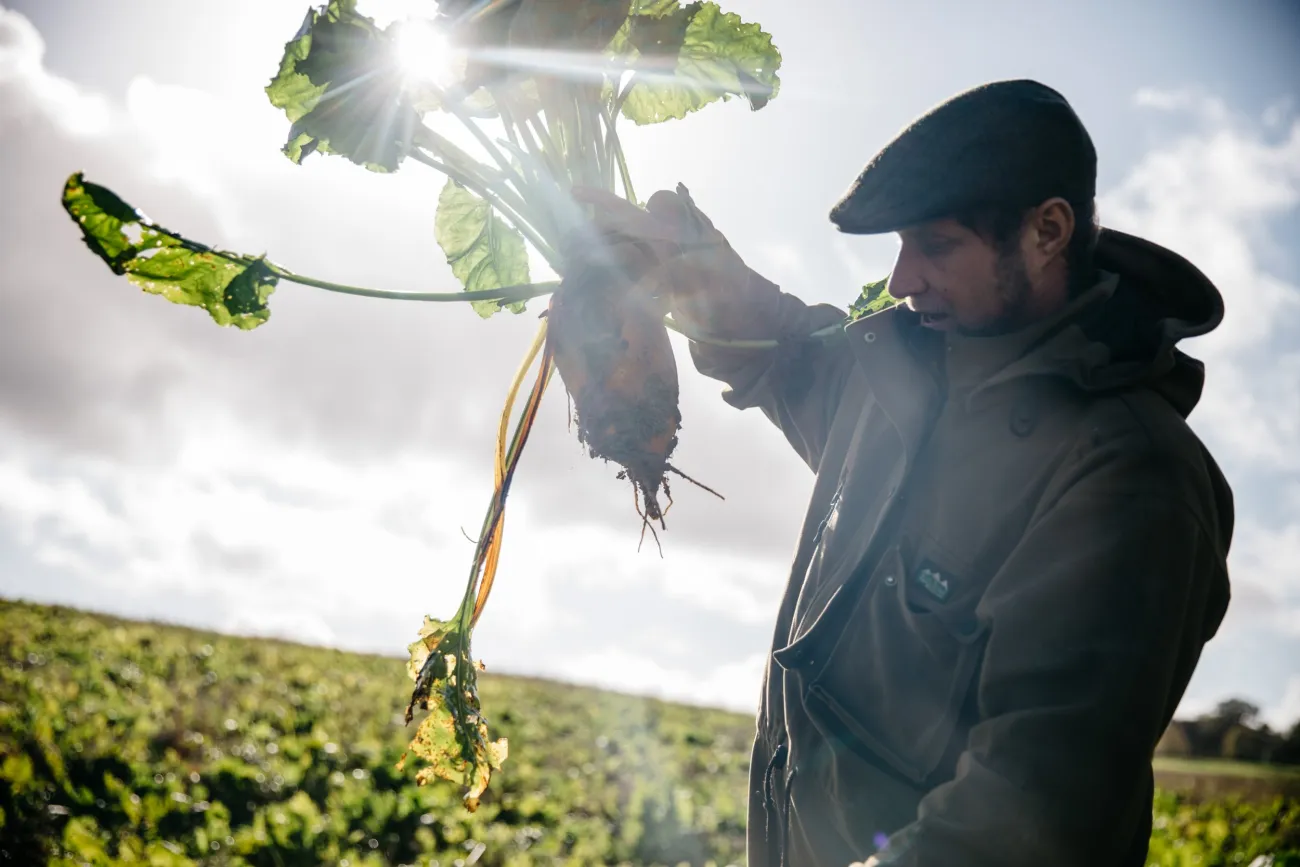
A farmer holds up a large root vegetable. Photo by Alexander Turner.
This is frustrating! I would love there to be a unifying truth somewhere out there, to be found if only we were skilful enough to piece things together correctly. Part of me can’t help holding out for a grand unified theory of everything.
But reality’s likely more junkyard than jigsaw, piled with random objects. All one can do is try and construct some kind of functionality out of it all.
I risk sounding like I’m dissolving into a jelly of helpless relativism here - but my argument is not that all stories are equally (un)true, or that one’s ‘my truth’ is no more or less valid than any other kind of knowledge. That way lies at best a terrible fluffiness, but also more dangerously the alternative factiverse of conspiracies, climate denialism and paralysing cynicism.
The much tamer point I’ve been trying to make in this essay is that any act of ordering information is a kind of storytelling; and all stories are partial and angled, sending the reader in particular direction towards a particular set of conclusions.
It’s not that nothing is true, but that nothing is ‘the truth.’ So reader beware. And in fact one important defence against relativism is scepticism; this is of course a foundational principle of science. Scepticism demands of us not just a critical scrutiny of other people’s work but also of our own. It requires a radical willingness to entertain the idea that one might be wrong, and an inbuilt caution against over-confidently claiming anything to be ‘true.’
It's not just scientific traditions that draw their strength from scepticism. You can find scepticism within the social sciences, arts and humanities too, although the word more commonly used here is ‘criticism’. Reading critically means reading with resistance, against the grain, questioning the message and interrogating the messenger, rubbing the cat’s smooth fur up the wrong way, and looking for the fleas. Who’s telling the story? Why might they be telling it? What are they not saying, in telling this story this way? Is there just one story going on, or multiple stories? How does the story sit with other stories, told by other people, in other places and times and in other ways?
While scepticism is science’s great strength, individual scientists can sometimes forget this core principle, or at least apply it too narrowly. I’m thinking here of a certain attitude which expresses confidence in their scientific ‘answer’ and a disregard for alternative views, without being willing to think more broadly about whether the question that prompted the answer is the only question worth asking, or about who does or doesn’t get to ask the questions, or whether the metrics used - the currency of truth, so to speak – are the only metrics worth considering. A good scientist surely needs to be curious about how his or her own way of looking at or understanding the world might be seen from other standpoints – the standpoint of people working in other disciplinary traditions, or of people doing different work, with different experiences of the world.
‘Critical reading’ can also stem from and engender its own arrogance. If there is no openness in your reading, if your external ideas about what to look for and what’s being said are simply imposed upon a text, then what you end up with is just a confirmation bias.
Whatever one’s background discipline or experience, critical curiosity feels to me to be both essential and the opposite of ‘relativism’ – it’s an attempt to scrutinise, complicate and enlarge one’s understanding rather than simply shrug away the idea of truth.
I’ve said several times in this essay that the current enthusiasm for ‘better stories’ makes me feel wary. I understand the rationale, and perhaps even the need, but my fear is that the urgency of the problems we face prompts the telling of stories that, in offering clear answers, make overconfident and unreflective claims about reality. I am afraid, too, of narrators who believe too entirely that their story is true. All stories are partial. All stories are stories. This is the case even when you think you’re on the ‘right’ side, or rather particularly when you think so, because after all, who doesn’t? Hence my second fear – that in believing too strongly in your rightness, you close your mind to the possibility of other ways of understanding the world, villainising the ‘non believers’ in the process. An uncritical focus on storytelling risks sliding us into a world of ‘messaging’, spin, propaganda, fundamentalism. And, third, it instrumentalises what is of value in and of itself.
On the other hand, it would also be silly to reject the need for ‘better stories’ on the grounds that we should focus on the ‘facts’ instead because – and this is the point I’ve been repeatedly trying to make - the distinction is a false one. All ordering of data is a kind of sense making, and all sense making is a kind of storytelling.
And so yes, if all there is is stories, we really do need better ones.
For me though, better stories are the opposite of propaganda. Better stories aren’t those that compel with their certitude, but instead invite with their complications and their questionings. They have richer texture and more difficult moralities – they’re less Star Wars, and more Iliad. The stories we need now in our difficult times are those that speak to these difficulties, that offer themselves up as experiments, work-in-progress alliances between data, the imagination and uncertainty, and between the story and the audience. They’re open-ended, and they may be more like a conversation, or a game. Better stories, for me, grow valiantly out of the ideological faultlines that divide us, like dandelions from paving stones. They don’t make simple claims to the truth; rather they motivate us to want to seek it out, even while knowing that ‘it’ might not exist. And there are lots of them; they are multiple.
Stories are fabrications that may contain truths; simplifications that can expand our idea of what’s possible; apparently closed accounts that offer themselves up to endless reinterpretations. Stories are vessels into which we pour our souls; and so we give them value. In all these tensions lie their generative capability.
I said earlier that simplicity risked sliding into simplisticness. But perhaps, in pitching distortive simplisticness against confusing complexity I fell into the classic trap of binary thinking. On reflection, I see that while simple stories can be simplistic, they needn’t be. They can also be expansive, if we think of them not so much as cartoons, as charcoal sketches - bold, but suggesting depths and spaces and ambiguities within and beyond the edges of the page. What’s there depends on the artist’s skill – but also on what the viewer sees.
What I’m saying then, to switch artistic mediums, is that better stories really rely upon better reading - because what ‘capability’ ends up being generated is up to us, the reader. Good readers make good stories. The work of reading can make them larger and richer, by finding in or bestowing upon them varied interpretations. None of this stops us from drawing a conclusion, making a decision, nailing a colour to the mast; but it does mean always remembering the possibility that there might be alternatives. Which we might find, if we sit down, and give the story another read.
Better stories then, told by better readers.
Comments (0)