Close
Login Register
Search
  • About
    • What We Do
    • Who We Are
    • FAQs
  • Our Writing
    • Explainers
    • Essays
    • Letterbox
    • Reports & More
  • Podcasts
  • Our Events
  • Projects
    • Power In The Food Systems
    • Local-Global Scale Project
    • MEAT: The Four Futures Podcast
    • Fuel To Fork
    • Nature
    • Reckoning with Regeneration
    • SHIFT
    • Games at TABLE
    • Rethinking the Global Soy Dilemma
  • Resources
  • Opportunities
    • Jobs
    • Funding
    • Courses
    • Collaborations
    • Events
  • Newsletter
  • TABLE (EN)
Search
Back

TABLE

Resource
System expansion and the definition of system boundaries in Product Carbon Footprints of Leather
For companies seeking to undertake Product Carbon Footprints (PCF) of leather and leather goods, one of the most controversial methodological issues relates to the definition of the system boundaries of the PCF study and, in particular, how to deal with the significant upstream burdens associated with livestock breeding and agricultural production of the cow.
Read
Resource
Fieldprint calculator
Read
Resource
IFPRI report: Food policy in 2012: Walk the Talk
The International Food Policy Research Institute (IFPRI) has published its 2012 Food policy report. Its main arguments are as follows: In 2012, world food security remained vulnerable. Progress in the fight against hunger and malnutrition has been piecemeal, at best, and levels remain unacceptably high, with 870 million people hungry and 2 billion suffering from micronutrient deficiencies.
Read
Image
Resource
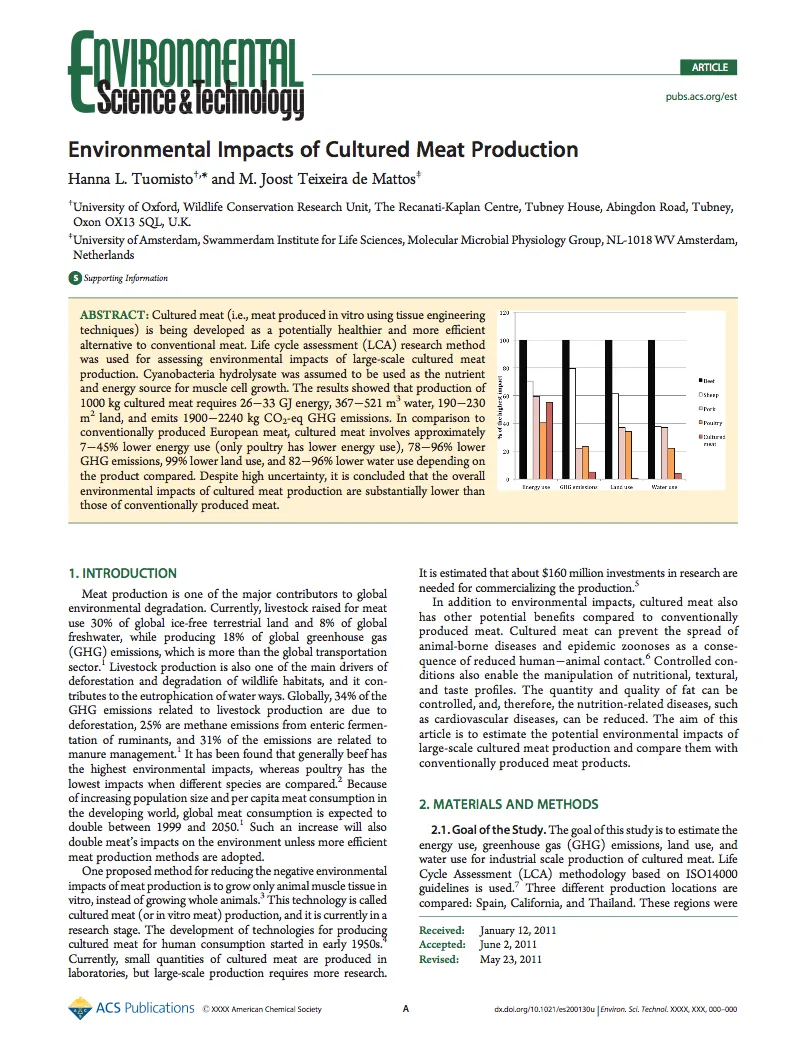
Environmental Impacts of Cultured Meat Production
FCRN network member Hannah Tuomisto has co-authored a life cycle analysis of (hypothetical) in-vitro meat production here: Tuomisto H L, Teixeira de Mattos M J (2011) Environmental Impacts of Cultured Meat Production. Environ. Sci. Technol. dx.doi.org/10.1021/es200130u 
Read
Image
Resource
Bill Gates on meat and artificial meat
Bill Gates seems to have entered into the meat question.  In his view it is simply not possible to feed 9 billion people on a high meat diet and the way forward is therefore the development of artificial meat and eggs. 
Read
Image
Resource
Paper on the EU’s water footprint and the role of diet
This paper finds that the water footprint of agricultural products (a definition that presumably includes non-food products) accounts for 91% of the EU’s production-related water footprint and 89% of its consumption related footpint. It argues that much more water can be saved by modifying diets and reducing food waste than through the traditional water-saving routes highlighted in mainstream awareness raising campaigns. The paper echoes others that find animal products to be particularly water intensive.
Read
Image
Resource
Paper: attitudes to reducing meat consumption
This paper addresses the relationship between meat eating and climate change focusing on motivational explanations of environmentally-relevant consumer behavior. Based on a sample of 1083 Dutch consumers, it examines their responses to the idea that they can make a big difference to nature and climate protection by choosing one or more meals without meat every week.
Read
Image
Resource
Paper: People’s willingness to act on climate change
Consumers influence climate change through their consumption patterns and their support or dismissal of climate mitigation policy measures. Both climate-friendly actions and policy support comprise a broad range of options, which vary in manifold ways and, therefore, might be influenced by different factors.
Read
Resource
Norwegian pension fund pulls out of 23 palm oil companies
The Norwegian pension fund GPFG, the largest in the world and worth US$710 billion, has pulled out of 23 palm oil companies in Indonesia and Malaysia which it judged to unsustainable. GPFG’s investments in the palm oil industry are now reduced by more than 40 per cent.
Read
  • VIEW MORE

Sign up for Fodder, our monthly newsletter unpacking the future of food.

Tick below to opt-in to email communications.

You can change your mind at any time by clicking the unsubscribe link in the footer of any email you receive from us, or by contacting us at info@tabledebates.org.

We use Mailchimp as our marketing platform. By clicking below to subscribe, you acknowledge that your information will be transferred to Mailchimp for processing. Learn more about Mailchimp's privacy practices.
  • Glossary
  • About
  • Our Writing
  • Podcasts
  • Resources

Social

YouTube Facebook Instagram

© Copyright 2025

A collaboration between: