Image
Game
Planetary Plate Puzzle
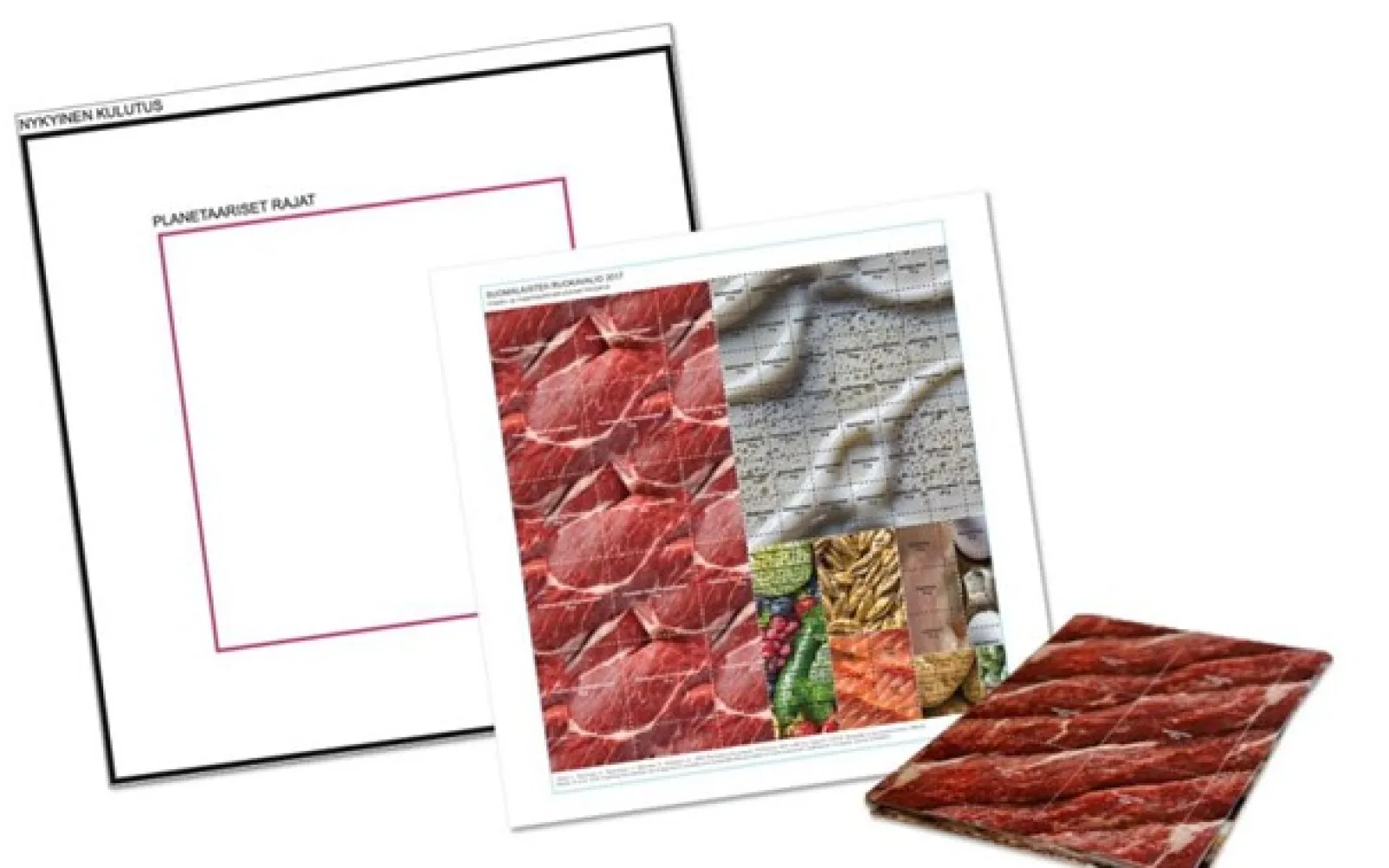
Planetary Plate Puzzle is a co-design game that encourages participants from diverse backgrounds to engage in dialogue and find common ground on sustainable future diets. The game has been tested in research settings and later played at multiple events across Europe. It offers an alternative to often heated and polarized debates on such issues as meat versus vegetarian diets, or traditional versus modern eating practices. Although developed in Finland, this serious game can be used anywhere in the world. Focus of the game is on the human diet, consumption, how food is eaten and used, and prepared. Additionally, the game opens up discussions of the whole food system as players discuss and design their plate.
Image
© Niko Räty
General information
- Planetary Plate Puzzle
- Methods article publication
- Mazac, R., Kaljonen, M., Kurki, K., Räty, N., Tuovila, S., & Herzon, I. (2025). Planetary plate puzzle: a serious game for deliberating sufficient future diets. CoDesign, 1–25. https://doi.org/10.1080/15710882.2025.2501067
- Materials Host Website: https://www.helsinki.fi/en/researchgroups/agroecology/planetary-plate-puzzle
- The game has been developed as part of the Sustainable Niche for Farmed Animals in Food Systems research project funded by the Academy of Finland and carried out by researchers at the University of Helsinki and the Finnish Environment Institute.
- Methods article publication
- Mazac, R, Kaljonen, M., Kurki, K., Räty, N., Tuovila, S., & Herzon, I.
- Rachel Mazac: rachel.mazac@su.se
- Iryna Herzon: iryna.herzon@helsiunki.fi
- Minna Kaljonen: minna.kaljonen@skye.fi
- Planetary Plate Puzzle is a co-design game that encourages participants from diverse backgrounds to engage in dialogue and find common ground on sustainable future diets. The game has been tested in research settings and later played at multiple events across Europe. It offers an alternative to often heated and polarized debates on such issues as meat versus vegetarian diets, or traditional versus modern eating practices. Although developed in Finland, this serious game can be used anywhere in the world.
- Focus of the game is on the human diet, consumption, how food is eaten and used, and prepared. Additionally, the game opens up discussions of the whole food system (the rest of the food system components in Box 1) as players discuss and design their plate.
Objectives
- In the game, participants work together to design a diet for an average citizen in 2050. The diet should fit within planetary boundaries, while also achieving cultural acceptance.
- Sustainable diets must respect planetary boundaries, while also balance nutrition, ethics, cultural acceptability, and livelihoods
- In the game, players collaborate to design a sustainable diet for an average Finn in 2050
- The Puzzle generates discussion and helps players to find common ground amid diverse diets, values, and opinions
- Designing future diets through the game supports dialogue, knowledge exchange, and co-learning
- Target Audience/Who can play?
- The Planetary Plate Puzzle is suitable for players aged 15 and up and it is played in small groups of 3-6 people. As many groups can play as game boards and pieces can be made available for players.
- The Puzzle can be used in teaching (lower and upper secondary schools, universities, adult education), planning sustainability measures, and to support decision-making
- The Puzzle has been tested in a scientific setup, and it has shown to be particularly useful for groups with diverse backgrounds and preferences.
- Human relationships with food are complex, evoking various values, attitudes, memories, and emotions. Defensive reactions are common when food-related beliefs and habits are challenged. Conversations around food choice often dissolve into polarized debates, leaving little room for different views. Researchers at the University of Helsinki and the Finnish Environment Institute developed the Planetary Plate Puzzle, a serious game that allows participants from diverse backgrounds, viewpoints, and dietary preferences to engage in discussions around co-designing culturally acceptable sustainable future diets. The goal is to jointly create a diet for an average citizen in 2050. Anyone can use, distribute and translate the game to other languages and cultural contexts as well. The game can be utilized in teaching and to support decision-making, for example, in schools, higher education, and food services.
- The Planetary Plate Puzzle and its supplementary material are licensed under the CC BY-NC-ND 4.0 license. The work may, however, be translated into other languages, upon condition that the translation will not include other changes, and with mention that it is an unofficial translation of the original work.
- The game has been tested in research settings and successfully opens up conversations about sustainable diets and their connection to food system transformation. Evidence was collected when the game was tested and played during the Sustainable Niche for Farmed Animals in Food systems project. "Initially, people felt a bit tense because their past experiences with food discussions had been quite heated. However, the game guides you to focus on a common goal, and in the end, no one felt challenged because of their own dietary choices or views", noted Kaisa Kurki, one of the researchers. The dialogue created by the Planetary Plate Puzzle offers a refreshing contrast to typical heated debates on such issues as meat versus vegetarian diets, traditional versus modern eating practices. Resulting qualitative findings are fully drafted and currently under review in a forthcoming publication by Kurki and other researchers on the project (as of April 2026).
Image
© Niko Räty
How to play?
- Gameplay
- The game is played in groups of 3-6 people
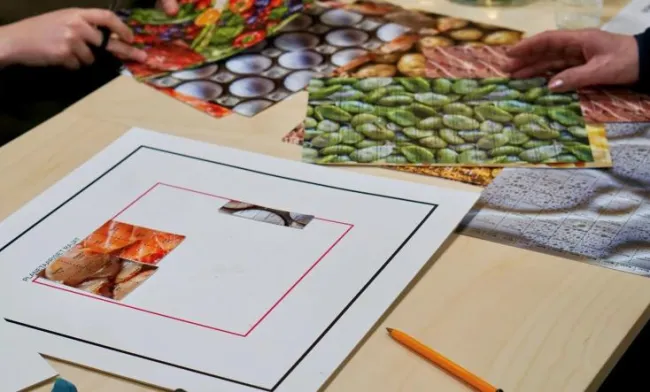
- It has 5 phases and lasts one hour at minimum: 1. Introduction (objectives and introduction round, 10 min) 2. Visualisation (environmental impact of a current diet –board, 5 min) 3. Co-design (designing a future diet collectively in groups 30-60 min) 4. Presentation (10 min) 5. Reflection (10 min)
- Detailed explanation for each phase can be found in the Facilitation Instructions video
- Materials
- The Puzzle includes game board, food group cards, the visualizations of the environmental impact of a current average diet in Finland and the diet based on Nordic Nutrition Recommendations (2023)
- Additionally, scissors, pencils, and post it notes are needed for each group
- Facilitation
- The facilitator prompts the players to think beyond themselves as individuals and consider multiple perspectives
- Cultural viewpoints, aspects of past and future, and personal opinions are often raised into the discussion naturally by the players
- By asking questions, the facilitator may bring other aspects, such as agricultural production, implementation of the new diet, and societal changes into the discussion
- Resources
- Game Materials
- All game materials (linked https://doi.org/10.5281/zenodo.17854803)
- Old version, suitable for copying with printer (game board split into four A4 sheets) can be found here. (https://doi.org/10.6084/m9.figshare.29085143)
- Supplementary Material
- Introduction to the Game : https://www.helsinki.fi/assets/drupal/2025-12/Introduction%20to%20the%20Game.pdf
- Quick Guide : https://www.helsinki.fi/assets/drupal/2025-12/Quick%20Guide.pdf
- Facilitation Instructions (Unitube) : https://www.helsinki.fi/fi/unitube/video/fb8f9e22-8a0c-4a09-ba54-e5386e5bac6d
- Accessible version of the supplementary material : https://www.helsinki.fi/assets/drupal/2025-12/Planetary%20Plate%20Puzzle%20Accessible%20Document.pdf
- Game Materials
Comments (0)