Image Resources Our extensive research library contains thousands of summaries of journal articles, reports and news stories that can be searched by keyword and category RESOURCES CATEGORYBooksBriefing paperEvent recordingFeatured articlesFeatured reportGameJournal articlesNews and resourcesReportsThink pieceVideoWorking paperWorkshop summary YEAR201220132014201520162017201820192020202120222023202420252026 Image Reports UK Food Security Report 2021 This report from the UK government’s Department for Environment, Food & Rural Affairs presents detailed statistics on food security in the UK, covering global food availability, UK food sources, food supply chain resilience, household food security, and food safety & consumer confidence. Read Image Reports The opportunities of agri-carbon markets This report from London-based think tank the Green Alliance reviews the evidence on how carbon can be sequestered on working farms and the challenges that must be addressed if such sequestration is to be incorporated into markets for carbon credits. Read Image Reports Farming for Climate Action: What are we waiting for? This report from the UK’s Nature Friendly Farming Network sets out information on how farming land is currently used in the UK, on greenhouse gas emissions from different farming types, and on how farms can use nature-based solutions to reduce emissions while improving farming resilience in the face of climate change. Read Image Reports Reducing the UK’s food footprint This report from the UK-based Centre for Research into Energy Demand Solutions quantifies greenhouse gas emissions arising from the UK’s food sector. It finds that when emissions are accounted for using a consumption basis (which accounts for emissions associated with imported and exported food), emissions are 52% higher than when a territorial basis is used (only including emissions generated within the country). Read Image Reports Net zero could lead to 15 million new jobs in Latin America and the Caribbean This report from the International Labour Organization and the Inter-American Development Bank examines the implications of net zero emissions policies for employment patterns in Latin America and the Caribbean. TABLE readers may be particularly interested in the report’s comments on jobs in agriculture and plant-based food production, as well as the impacts of dietary change. Read Image Journal articles Consumer experiences of food environments during COVID-19 This study surveyed people from 119 countries about their experiences of food environments and food acquisition practices during the early stages of the COVID-19 pandemic (April 2020). Many respondents experienced physical distancing requirements at food shops (90% of respondents), restricted access to stores (77%), stockpiling foods (67%), increased awareness of food waste (63%) and buying more food due to fear or anxiety (47%). Read Image Journal articles Rich-world dietary shift has double climate benefits This paper looks at the climate impacts of dietary shift towards plant-based foods in high-income nations. It finds that adoption of the EAT-Lancet diet in 54 countries could both reduce annual agricultural production emissions from those countries by 61%, and spare land that could sequester carbon equivalent to 14 years of current global agricultural emissions, through restoration to the natural vegetation associated with today’s climate in each location. Read Image Journal articles Transformative potential of major food report recommendations This paper assesses the extent to which the recommendations of 41 food reports could transform the food system. It argues that few reports are targeting “leverage points” that could result in the most change, and that reports often neglect the implications of power differences between actors. Read Image News and resources What do falling plant-based meat prices mean for beef? This blog post by Saloni Shah and Dan Blaustein-Rejto of US-based think-tank The Breakthrough Institute argues that decreases in the price of plant-based meat alternatives by 10% will likely only have a small impact on cattle production (a 0.15% decrease in the US) and emissions from global cattle production (equivalent to a decrease of 1.4% in US beef production). They conclude that while continuing to improve plant-based meat alternatives is important in order for them to gain a larger market share, it is also important to work on methods and technologies to reduce the environmental impacts of livestock production. Read VIEW MORE
Image Reports UK Food Security Report 2021 This report from the UK government’s Department for Environment, Food & Rural Affairs presents detailed statistics on food security in the UK, covering global food availability, UK food sources, food supply chain resilience, household food security, and food safety & consumer confidence. Read
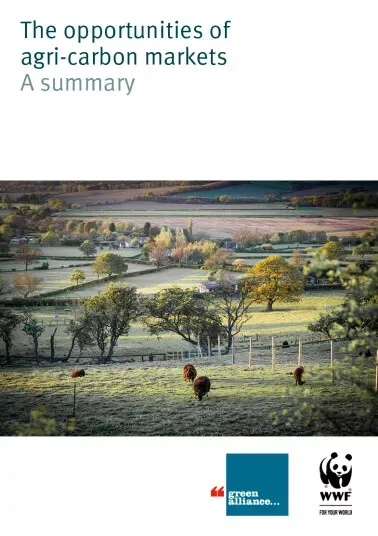
Image Reports The opportunities of agri-carbon markets This report from London-based think tank the Green Alliance reviews the evidence on how carbon can be sequestered on working farms and the challenges that must be addressed if such sequestration is to be incorporated into markets for carbon credits. Read
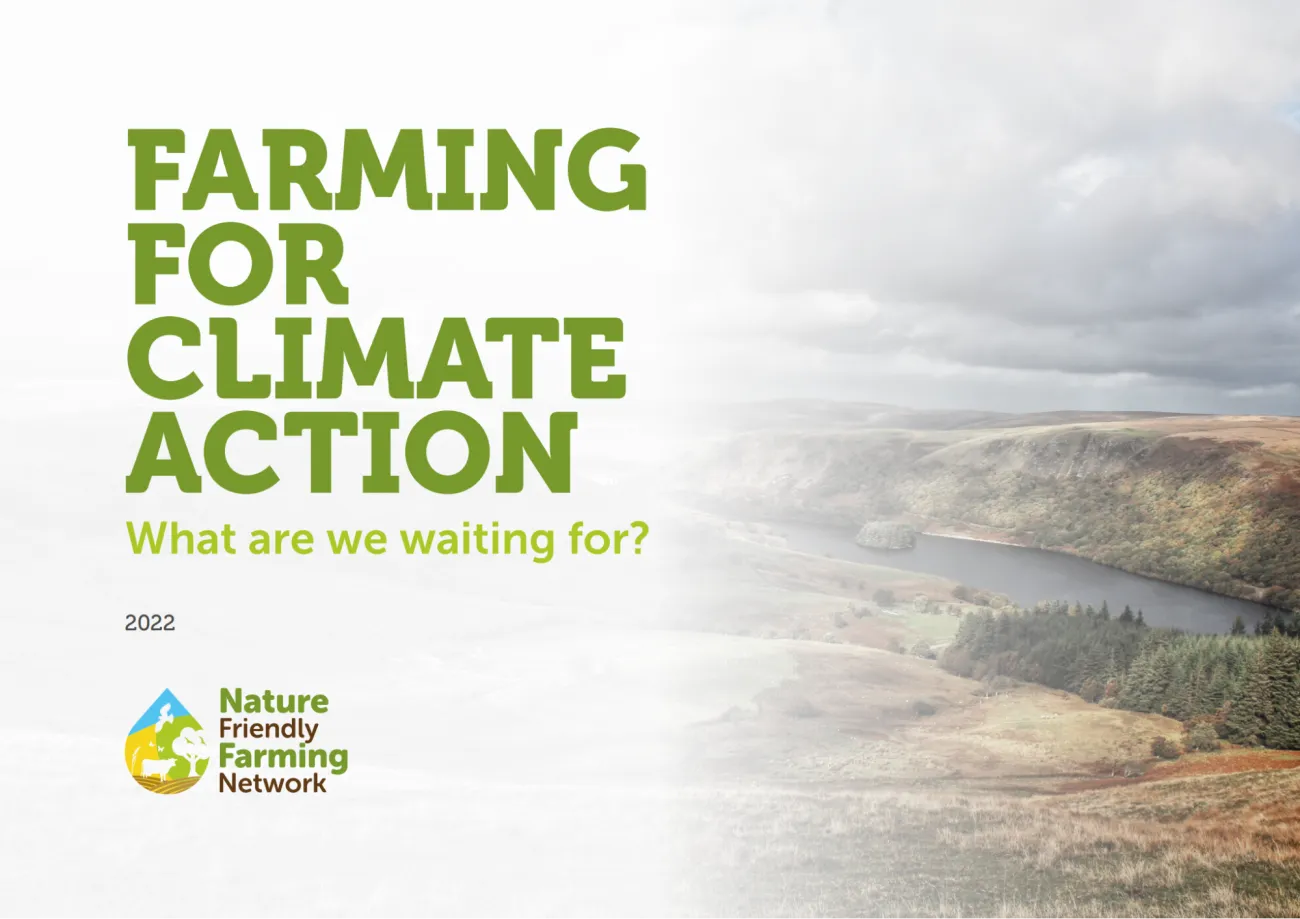
Image Reports Farming for Climate Action: What are we waiting for? This report from the UK’s Nature Friendly Farming Network sets out information on how farming land is currently used in the UK, on greenhouse gas emissions from different farming types, and on how farms can use nature-based solutions to reduce emissions while improving farming resilience in the face of climate change. Read
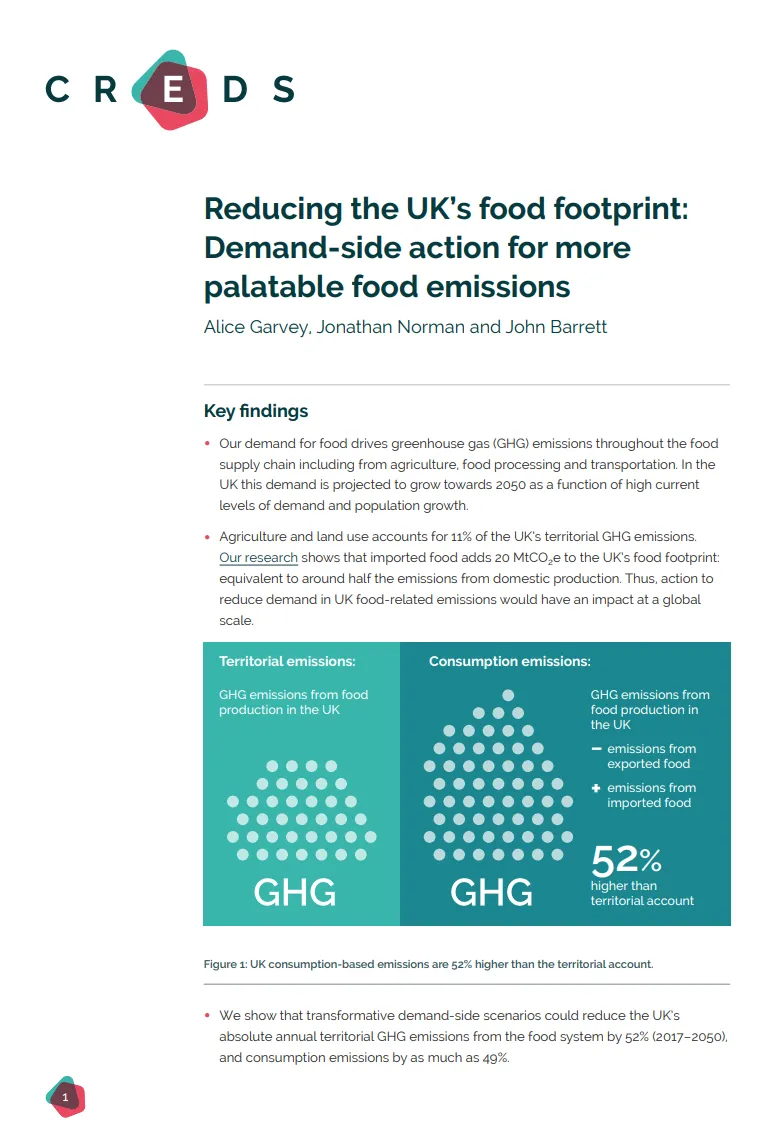
Image Reports Reducing the UK’s food footprint This report from the UK-based Centre for Research into Energy Demand Solutions quantifies greenhouse gas emissions arising from the UK’s food sector. It finds that when emissions are accounted for using a consumption basis (which accounts for emissions associated with imported and exported food), emissions are 52% higher than when a territorial basis is used (only including emissions generated within the country). Read
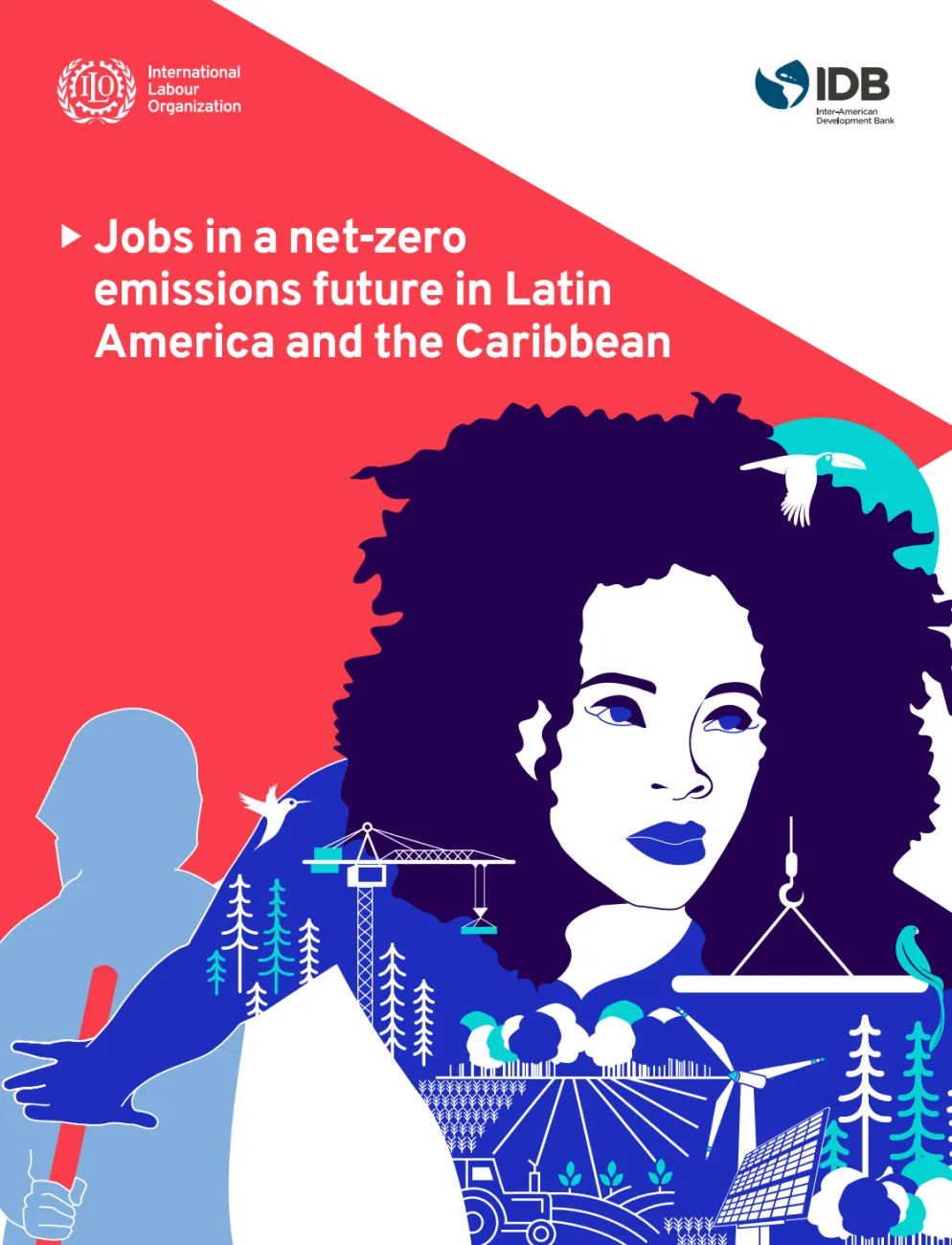
Image Reports Net zero could lead to 15 million new jobs in Latin America and the Caribbean This report from the International Labour Organization and the Inter-American Development Bank examines the implications of net zero emissions policies for employment patterns in Latin America and the Caribbean. TABLE readers may be particularly interested in the report’s comments on jobs in agriculture and plant-based food production, as well as the impacts of dietary change. Read
Image Journal articles Consumer experiences of food environments during COVID-19 This study surveyed people from 119 countries about their experiences of food environments and food acquisition practices during the early stages of the COVID-19 pandemic (April 2020). Many respondents experienced physical distancing requirements at food shops (90% of respondents), restricted access to stores (77%), stockpiling foods (67%), increased awareness of food waste (63%) and buying more food due to fear or anxiety (47%). Read
Image Journal articles Rich-world dietary shift has double climate benefits This paper looks at the climate impacts of dietary shift towards plant-based foods in high-income nations. It finds that adoption of the EAT-Lancet diet in 54 countries could both reduce annual agricultural production emissions from those countries by 61%, and spare land that could sequester carbon equivalent to 14 years of current global agricultural emissions, through restoration to the natural vegetation associated with today’s climate in each location. Read
Image Journal articles Transformative potential of major food report recommendations This paper assesses the extent to which the recommendations of 41 food reports could transform the food system. It argues that few reports are targeting “leverage points” that could result in the most change, and that reports often neglect the implications of power differences between actors. Read
Image News and resources What do falling plant-based meat prices mean for beef? This blog post by Saloni Shah and Dan Blaustein-Rejto of US-based think-tank The Breakthrough Institute argues that decreases in the price of plant-based meat alternatives by 10% will likely only have a small impact on cattle production (a 0.15% decrease in the US) and emissions from global cattle production (equivalent to a decrease of 1.4% in US beef production). They conclude that while continuing to improve plant-based meat alternatives is important in order for them to gain a larger market share, it is also important to work on methods and technologies to reduce the environmental impacts of livestock production. Read